Rakowitz and Bacon

While Long-Suffering Wife (LSW) and I were in London awaiting Middle Son’s (MS’s) final operations and discharge from hospital, we did, as predicted, fit in a couple more exhibitions:

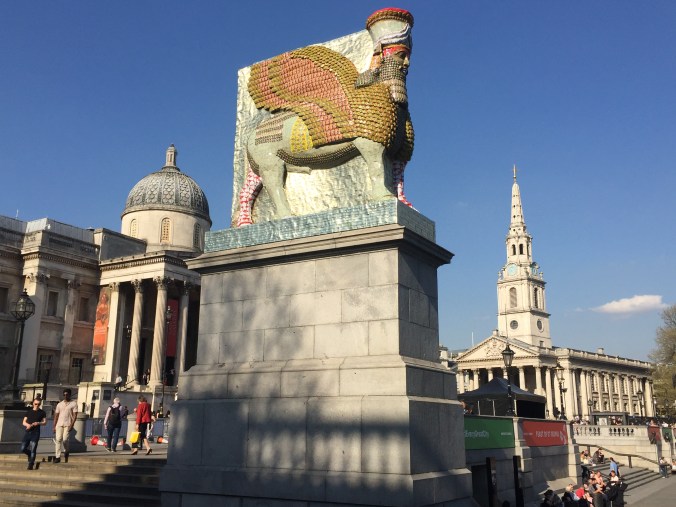
  • At the Whitechapel Gallery, an exhibition of work from the last twenty years by Michael Rakowitz, an Iraqi-American artist perhaps most famous for his work currently on the 4th plinth in Trafalgar Square
  • At the Gagosian Gallery, which neither of us had visited before, an exhibition of about a dozen paintings by Francis Bacon who is one of my favourite artists.

The visits took our minds off MS’s predicament, filled in the non-visiting hours at the hospital and were well worth seeing anyway.

Michael Rakowitz's The Invisible Enemy Should Not Exist In Trafalgar Square

Michael Rakowitz’s The Invisible Enemy Should Not Exist In Trafalgar Square

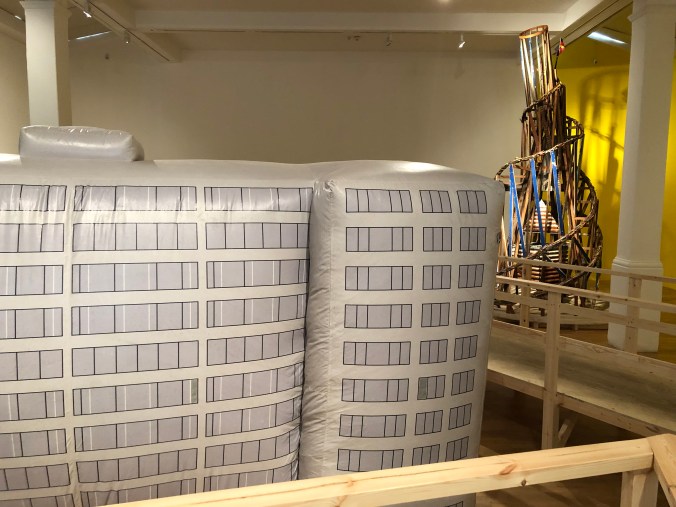
The Rakowitz exhibition at the Whitechapel Gallery was an interesting mix of visual effects across eight ‘installations’.  All of them related to history and most, a little depressingly, draw inspiration from examples of thwarted hope.  For example, the first exhibit, called ‘Dull Roar’ is a very large inflatable building depicting a multi-racial social housing experiment in St Louis, Missouri.  Its cyclical inflation and deflation over a period of a few minutes is a metaphor for the initial hope when the building was opened and its failure as it fell into disrepair, became a focus for social unrest and was ultimately demolished.

'Dull Roar' And 'White Man Got No Dreaming' By Rakowitz

‘Dull Roar’ (Foreground) And ‘White Man Got No Dreaming’ By Rakowitz

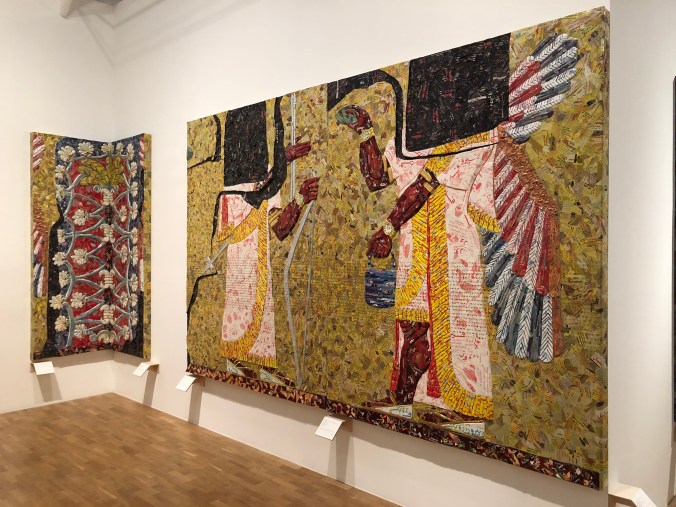
Other rooms and exhibits highlight book destruction, the destruction and reconstruction of antiquities in the war-torn Middle-East and the rise and fall of The Beatles.  The latter includes off-cuts from a 1970 documentary film of the group and many artefacts relating to The Beatles.  These are annotated with postulations about how the break-up occurred and parallels with late 20th century North African history.  The film recounted the The Beatles’ last attempt to repair their relationship with a triumphant concert in North Africa.  The concert never happened.
Archaeological Reconstructions Made Of Middle Eastern Food Packaging (Like The 4th Plinth Monument)

Some Of Rakowitz’s Archaeological Reconstructions Made Of Middle Eastern Food Packaging

The exhibition had a lot of variety and depth and made good use of the Whitechapel Gallery space.

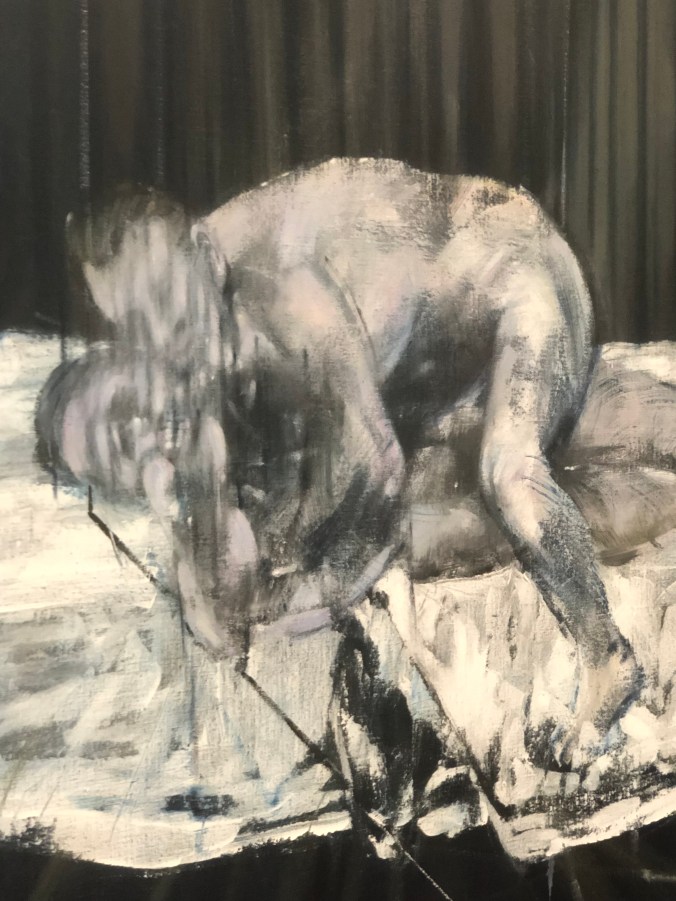
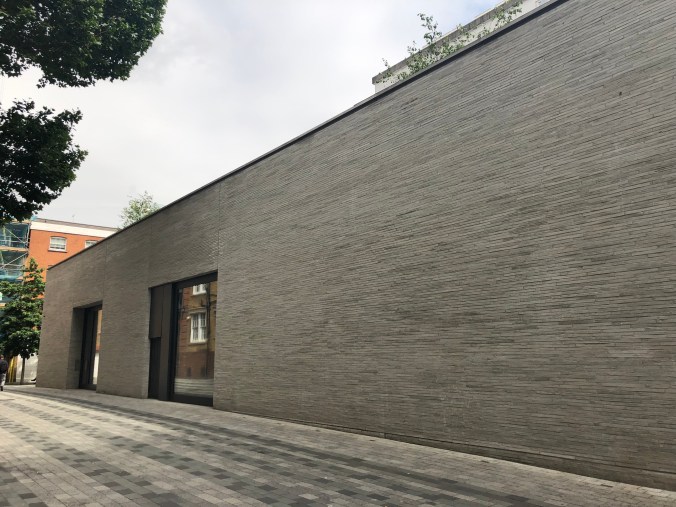
The Gagosian Gallery in Grosvenor Hill (I now find that there are three Gagosian Galleries in London alone and many more worldwide) is also a great art space with large, light rooms.  It’s an interesting rectangular and ultra-modern building tucked behind Berkeley Square.  Inside were a relatively small number of Francis Bacon’s double figure paintings.  All were instantly recognisable as Bacon’s work and about half of them were as dramatic and terrific as I had hoped.
One of the Gagosian Exhibition Paintings By Francis Bacon

One of the Gagosian Exhibition Paintings By Francis Bacon

Most of the works were, as expected, clearly inspired by his anxious, passionate and probably violent relationships.  What was more of a surprise was the interest he had in monkeys and baboons that had been engendered by his trips to Africa.  A couple of the paintings reflected this.

Unlike the Whitechapel Gallery which was a bit pricey to visit, the Gagosian is free.  What’s not to like!

The Gagosian Gallery, Grosvenor Hill

The Gagosian Gallery, Grosvenor Hill

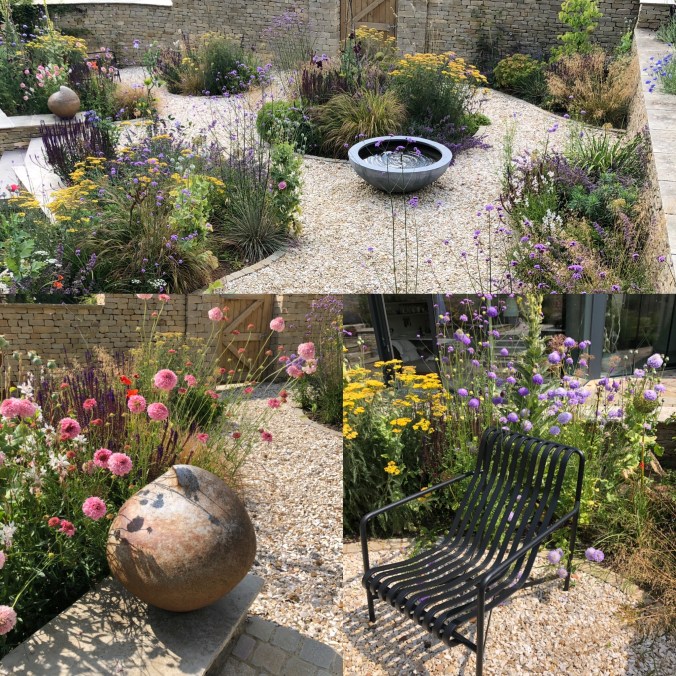
Now we are back in Gloucestershire with MS.  Fortunately the weather has remained wonderful.  The garden is in peak colour – although it could do with a refreshing downpour – and the vegetables are growing faster than the deer can eat them.

The New Garden In Bloom

The New Garden In Bloom

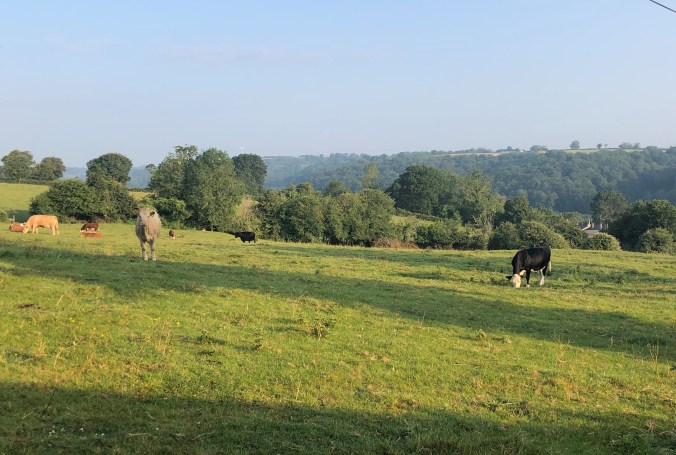
I have reverted to my pattern of last summer of walking in to the local town’s shops before breakfast when it is cool.  That means that LSW can get to work without us leaving MS alone for long and gives me the chance to enjoy the local countryside in the lovely morning light.  We have much to be thankful for.

View Towards Nympsfield On The Walk To Nailsworth

View Towards Nympsfield On The Walk To Nailsworth

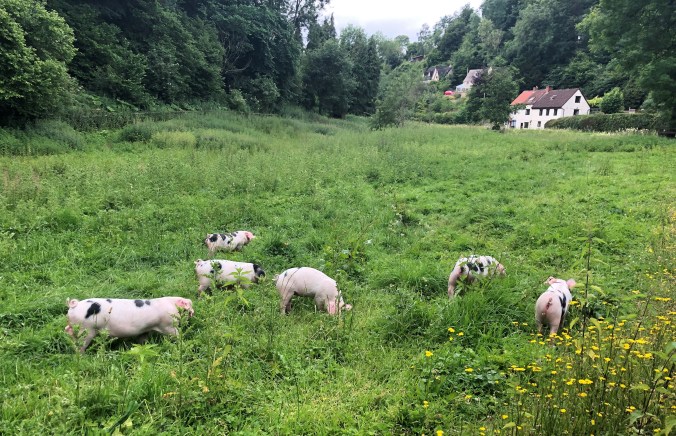
Jolly Newcomers - Just For A Week - In A Field On The Way To Nailsworth

Jolly Newcomers – Just For A Week – In A Field On The Way To Nailsworth

Distractions Amid The Wreckage

It’s been nearly two weeks since Middle Son’s (MS’s) accident on a pedestrian crossing.  LSW and I are popping up and down to London to see MS while he is in hospital waiting for, and then recovering from, the operations to repair him.  We have the flexibility to be able to supplement and fit in around visits from his others.  Outside of visiting hours we are able to visit London-based exhibitions and in between trips to London, we tend the everyday of house and garden.

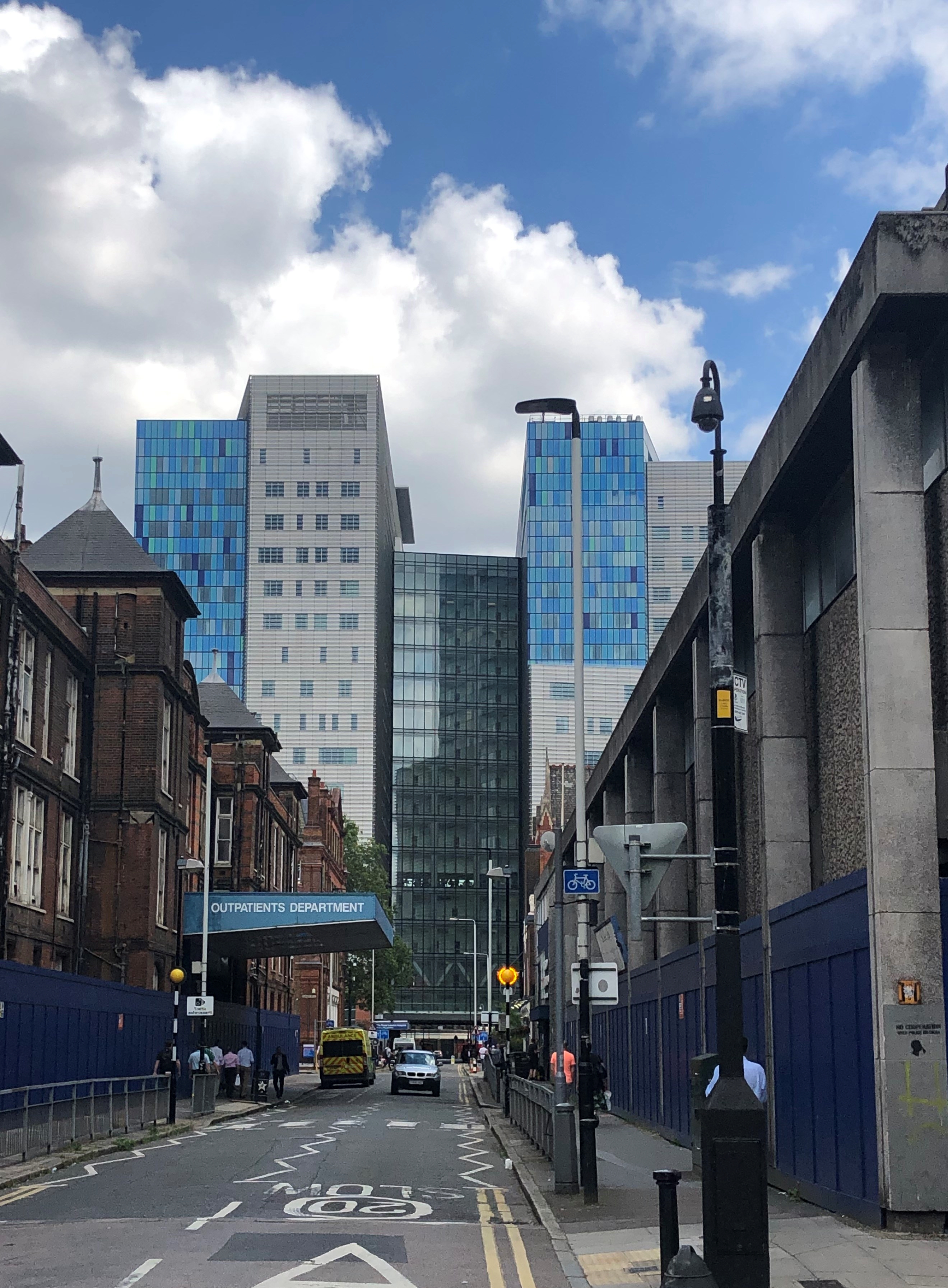
Royal London Hospital

Royal London Hospital

The garden is certainly looking full and colourful.  After an unusually slow start, the vegetable patch is starting to come to life.  The slugs, deer and pigeons are enjoying a lot of the potential vegetable and fruit produce.  However, I hope to pick the blackcurrants that survived the pigeon onslaught next week and chard, spinach and beetroot are now ready for the first harvests.

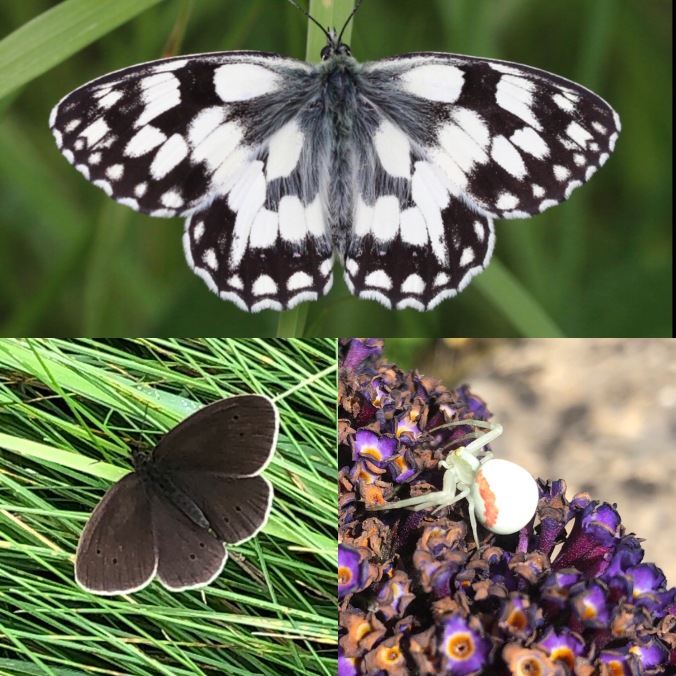
Marbled White and Ringlet Butterflies and A Crab Spider

Marbled White and Ringlet Butterflies And A Crab Spider

The meadow is also looking healthy and, in this last week’s sunshine and warmth, it has been full of butterflies and other insects.  Youngest Son (YS) and his partner have been staying with us and have been able to enjoy the garden before swapping the rural peace for their new life in London.  It has been great to have had their cheery demeanour around the place.

The London exhibition LSW and I went to see in a few spare hours was the Dior: Designer of Dreams exhibition at the Victoria & Albert Museum.  The ostentation on show was perhaps the least appropriate thing to appreciate while our minds were wrestling with the gritty practicalities of MS’s circumstances.  However, it is a very stylish and well-presented show covering Dior’s clothes, perfumes, partnerships with makers of accessories and seamstresses.

Ulysse Coat By Dior (1952)

Ulysse Coat By Dior (1952)

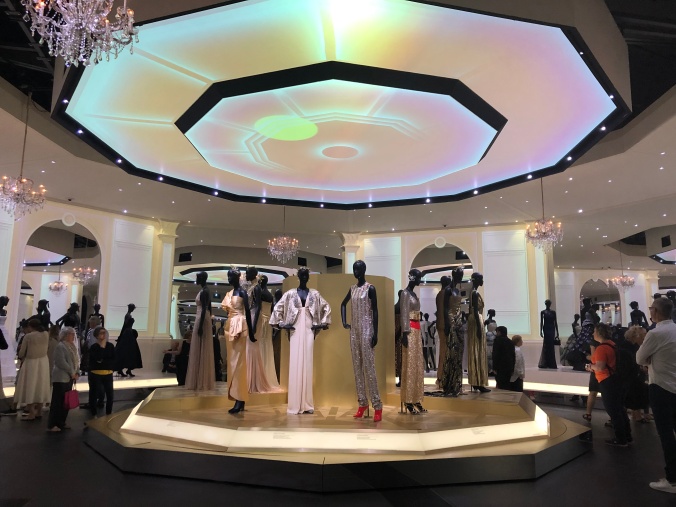
The outfits on show demonstrate Christian Dior’s career and then the contributions of the lead designers who followed him in driving forward the Dior brand.  The clothes are consistently beautiful or dramatic or both and the rooms showing his ball gown and garden-influenced designs were particularly impressive.
Dior Ball Gowns 1950 To Today

Dior Ball Gowns 1950 To Today

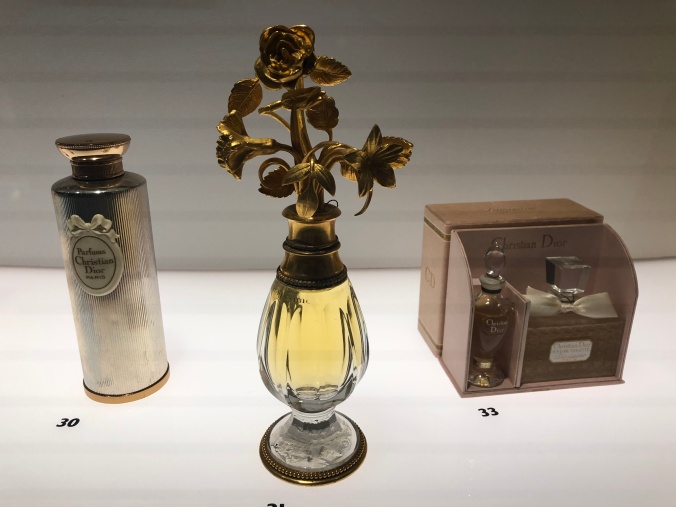
Dior Perfume Bottles And Travel Set From The 1950s

Dior Perfume Bottles And Travel Set From The 1950s

At the end of the exhibition was a wall with a quote from Christian Dior: “In the world today, haute couture is one of the last repositories of the marvellous”.  The show managed to underline that.

Exotic Dior Dresses Influenced By His Travels in Japan and Egypt

I also managed to get to see a free gig by D’Voxx at Rough Trade East.  I knew nothing about this electronic duo before turning up but it was another temporary but welcome distraction from reality.  The music they played was interesting and got me nodding away to the beats, but what made the gig unusual was that both performers were using modular synthesisers that looked ancient and that seemed to require a lot of wire waving and plug swapping alongside the normal knob-twiddling.  It was quite a sight and a fun experience.

IMG_3804

LSW and I are heading back to London tomorrow.  Maybe we will find a couple more diverse distractions like Dior and D’Voxx to divert us before MS’s final operations and discharge.  Fingers crossed for him.

Nice And Nasty Birthday Surprises

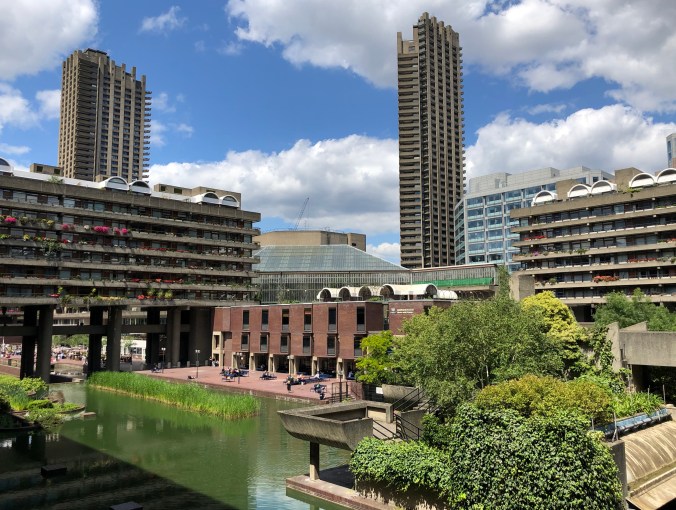
Long-Suffering Wife (LSW) and I have made two trips to London in the last week. The first was to celebrate LSW’s birthday.  That was very enjoyable.  We stayed in the Barbican flat and the surrounding gardens and the window-boxes of many of the flats look lovely at this time of year.

View Of The Barbican Complex In The Sun

View Of The Barbican Complex In The Sun

The second was much more traumatic surprise.

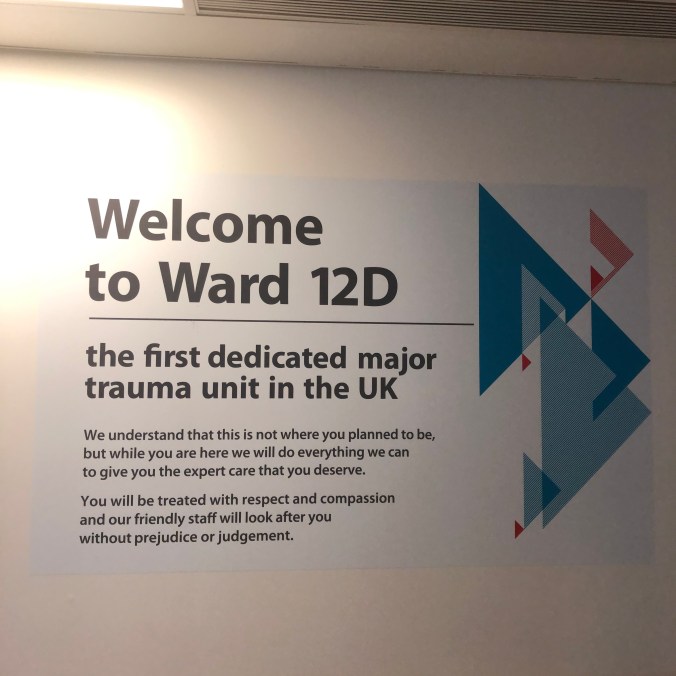
This was a rapid and urgent scoot up to Royal London Hospital to be with Middle Son (MS).  He had been knocked down by a car in a hit-and-run accident during a police car chase.

MS is recovering but has some seriously broken bones and a lot of bruises, so he will probably spend his own upcoming birthday in hospital and has a few frustrating months of rehabilitation ahead of him.  At least now I am retired I can lend full physical as well as moral support.  MS also has great support from his partner, brothers and friends.  He’s a tough cookie too, he’s in a good hospital and he will bounce back.

IMG_3793

London has great museums, art galleries and restaurants.  We experienced while celebrating LSW’s birthday by visiting the Natalia Goncharova exhibition at Tate Modern, the Lee Krasner exhibition at the Barbican and eating out with Youngest Son (YS) at the buzzy and lovely Morito restaurant.

We also visited Walthamstow to get a feel for one of the areas MS and his partner have been looking to buy a house in – a project I suspect will be on hold for a bit now.  Plus I visited the Foundling Museum.

Sitting here in a hospital waiting room I can’t compose much about those visits; my head is too distracted with recent events.  However here is a quick view of the high points with some pictures added since I got back home.

The Foundling Museum was interesting but while there are some fascinating items and facts on show, the topic based layout didn’t work for me.  I struggled to build up the chronology of the way the Foundling Hospital developed from 1741 through to the modern day from the exhibits although, half way round, I did find a clear timeline in the free paper guide pamphlet so my issue was mostly my fault.

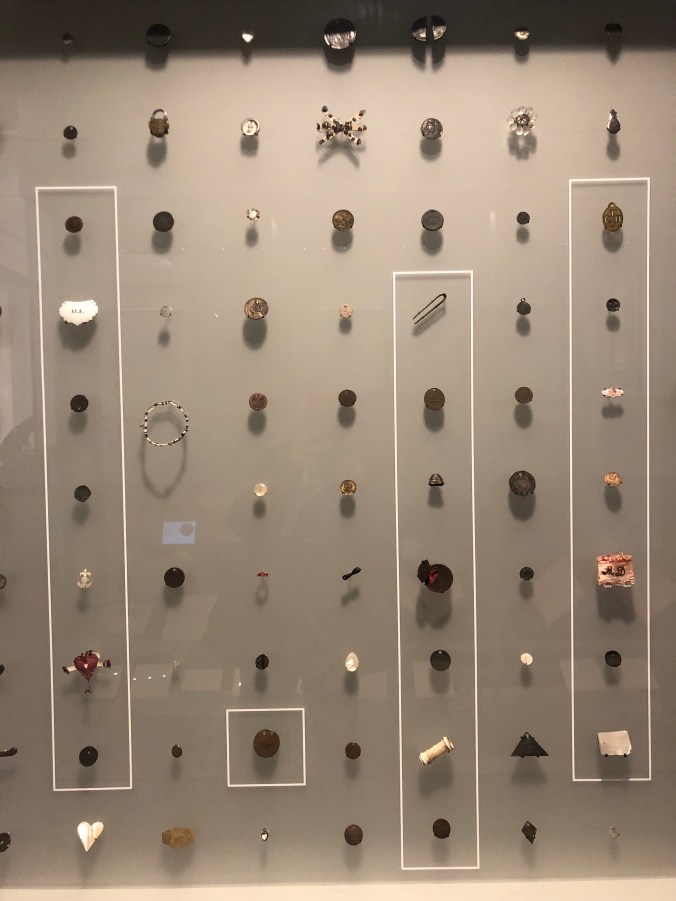
A Selection Of Tokens On Show At The Foundling Museum

A Selection Of 18th Century Tokens Used To Identify Orphaned Babies Left With The Foundling Museum

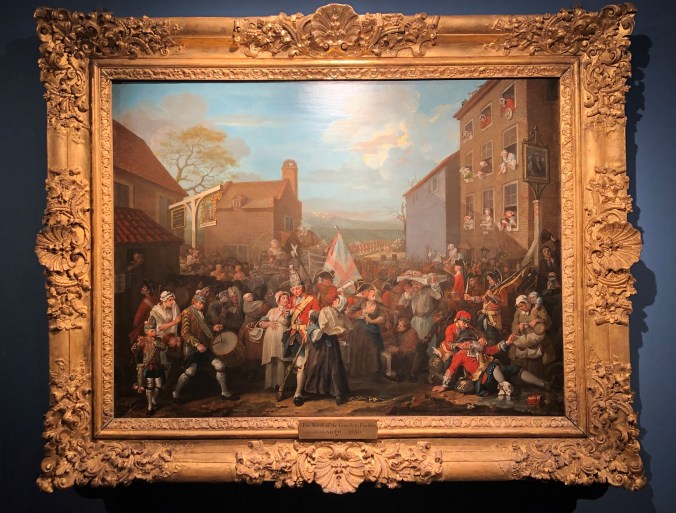
The museum’s temporary exhibit of Hogarth and his depiction of noise in his pictures and cartoons is set out more engagingly.  Different elements of a single painting by him are picked out to illustrate six different aspects of 18th century street life from street music to drinking, disease and prostitution.  There is also an exhibition of some of George Handel’s work (both Hogarth and Handel were early sponsors of the Foundling Hospital) which provided welcome comfortable chairs in which to listen to some snatches of his lovely music amid information about him and his muses.

img_3735-e1561538308695.jpg

Hogarth’s The March Of The Guards To Finchley

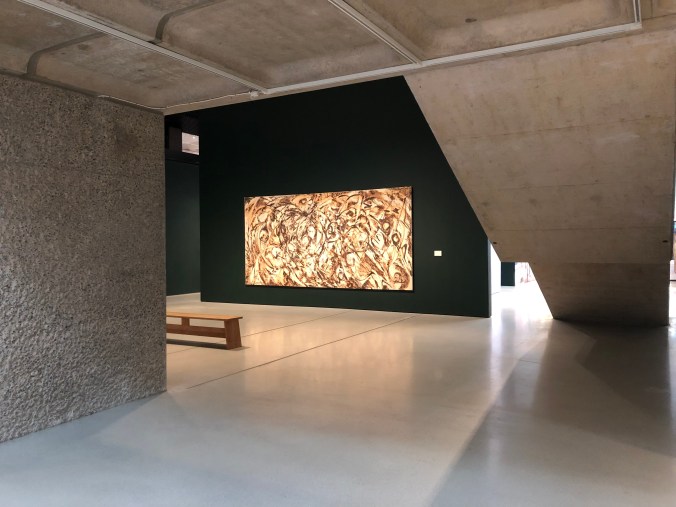
I had not heard of Lee Krasner before visiting the exhibition at the Barbican.  LSW was much more in the know than I and she was very keen to go.  She was spot on; it was a fascinating exhibition and full of very impressive art.  She was married to Jackson Pollock but embraced many more styles than I associate with him.  The narrative of her life, picked out by the different sections of the art on show, was compelling, the colours were terrific.  I think I will use my Barbican membership to visit again later this year.

Detail From Two Early Krasner Paintings

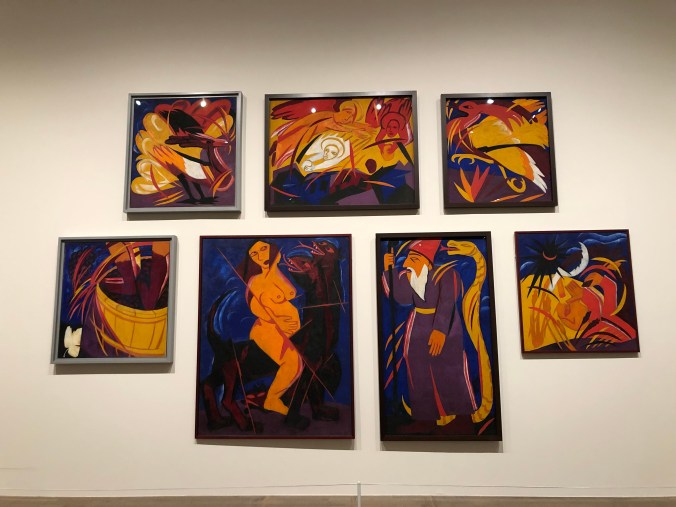
The Natalia Goncharova art exhibition at The Tate Modern was also worth seeing. Again there was a clear progression to her style through the early years of her life.  She was incredibly prolific during this period and it was noticeable that there was little on show from her later years except for examples of her work in designing theatre sets and costumes.  Interesting as that aspect is, I was more impressed by her earlier work.

Harvest By Natalia Goncharova

Harvest By Natalia Goncharova

So, back to thinking about MS and his recovery…. We will be back in London soon to see his progress first hand and to slip in a few more cultural treats.


From Writing to Artificial Intelligence

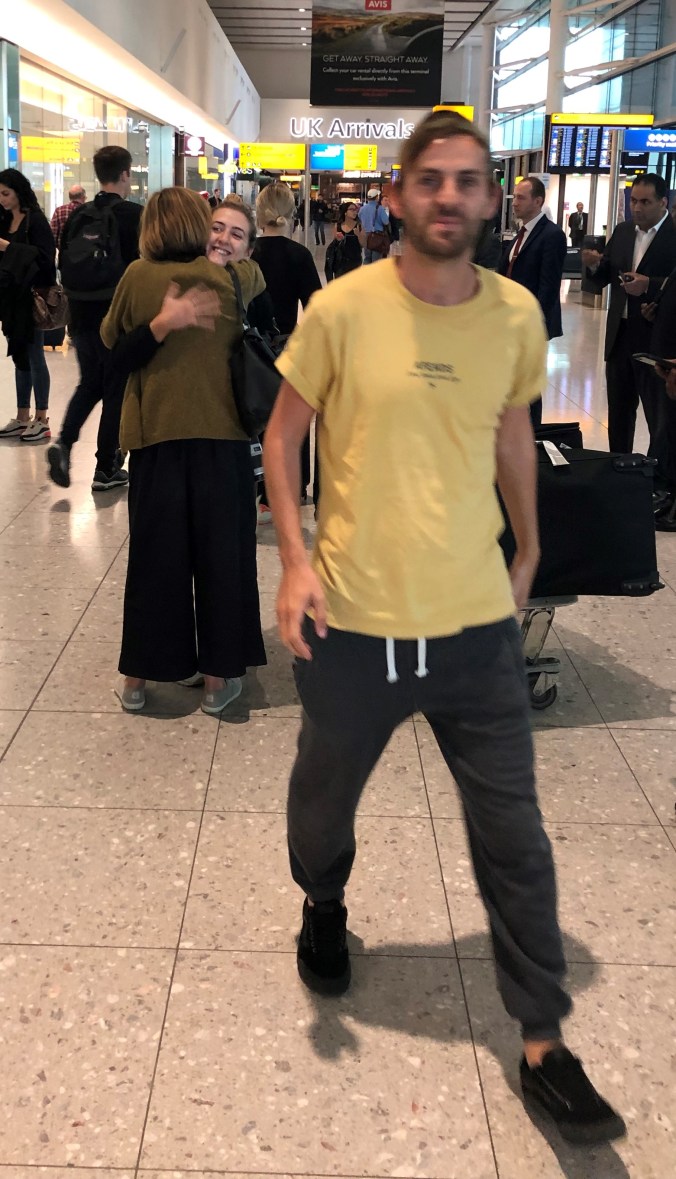
A relatively quiet week or so has been punctuated by another trip to London and the return from Australia of Youngest Son (YS).  YS and his Northern Irish girlfriend have been working (and playing) successfully in Australia for almost three years.  It’s great to have YS back in closer proximity after so long but I’m sorry we no longer have such a good excuse to visit Australia!

YS At Heathrow.  Big Hug Imminent!

YS At Heathrow. Big Hug Imminent!

It will be interesting to see how things work out for YS and his girlfriend in London during such a precarious time for the United Kingdom.  Fortunately, they very excited by the prospect and are far more optimistic about life in general than I.  They made a great life in Australia from a standing start and I’m sure they will employ their energy and contacts to do the same in London.

I continue to make the most of my opportunities to visit the excitement of London with overnight stays in my old flat.  I based my trip up to London this time around another reunion of old work colleagues – this time from a bank I worked at 15 years ago.  Once that get together was in the diary I could fit in other things around it.  I saw a film (High Life) with Eldest Son (ES) (which was more interesting than truly enjoyable) and, as has become my norm, went to The Lantern Society Folk Club and a couple of exhibitions.

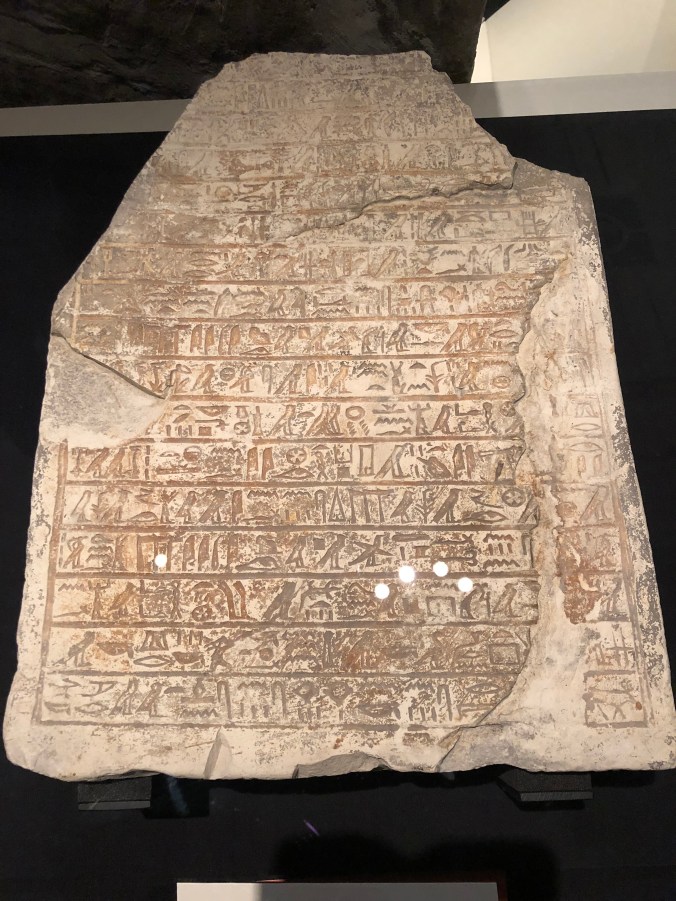
The first of these exhibitions was a history of Writing at the British Library.  This shows how different types of writing emerged amongst early human communities roughly simultaneously in a several different places across the globe.  This accounts for the huge variation in language types and structures and also the variety of writing styles and media through modern history and today.

A Limestone Stela With Classical Heiroglyphs

A Limestone Stela With Classical Hieroglyphs (The Oldest Object Held By The British Library)

The exhibition then focuses on the development of our alphabet from images (e.g. an ox head shape for the letter ‘a’) used in Egypt.  These were refined progressively through simplification and transformation by the Phoenicians, the Greeks then the Italians and, especially, the Romans (who got us writing from left to right).  Further evolution of our western writing styles, fonts and media to develop readability, speed of writing and then mass production are explained clearly and interestingly with lots of tangible examples.  I became thoroughly absorbed in the exhibition.

img_3582.jpg

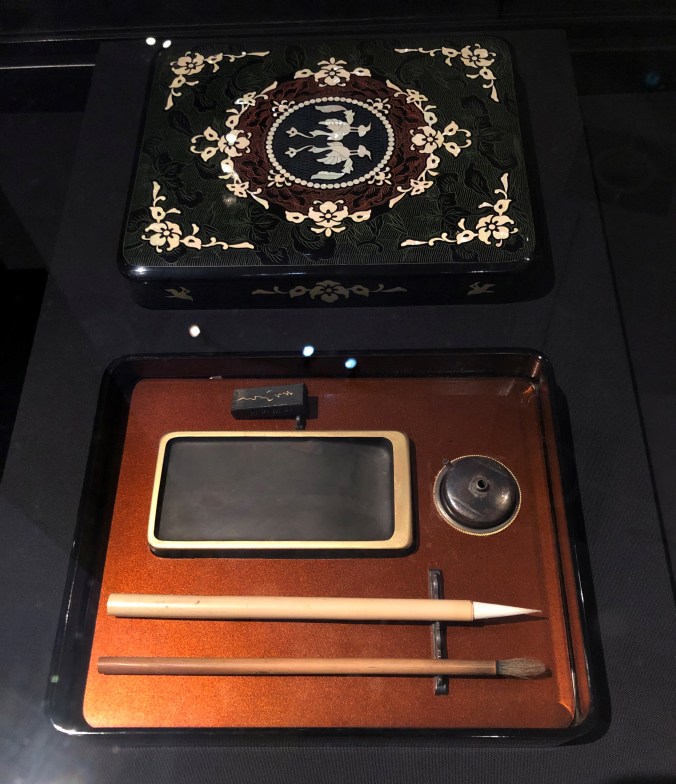
A Japanese ‘Four Treasures Of The Study’ – Ink (Made From Grinding An Ink Stone With Drops Of Water) And Brushes In A Beautiful Box

The British Library has such beautiful texts in its possession to illustrate every development in the art and science of writing.  In addition to the examples of writing, there were sections on writing materials spanning examples of use of clay, wax, metal, stone, skin, palm leaves and, of course, the early efforts to produce paper (by the Chinese).  Printing innovations, writing implements (including a comparison between mass produced BIC biros and Montblanc fountain pens) and much more is covered.  It is a multi-faceted and fascinating exhibition.

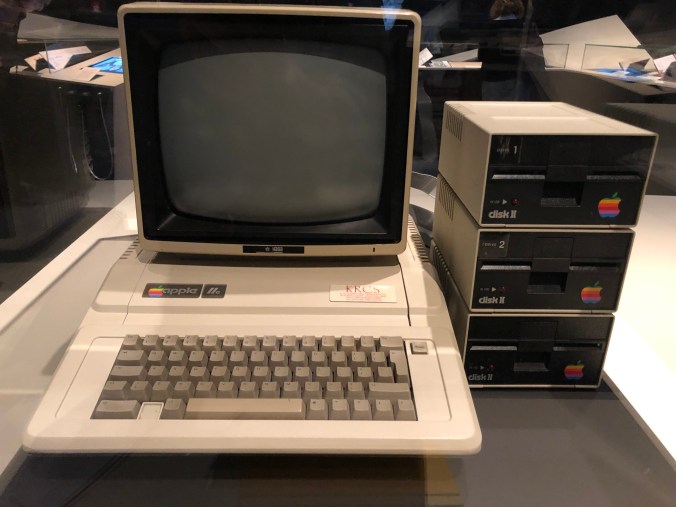
A 1977 Vintage Macintosh Apple II Computer

A 1977 Vintage Macintosh Apple II Computer (Part Of The Section Illustrating Progression of Typewriters to Computers And Word Processing)

Less successful is the exhibition of Artificial Intelligence (AI); More Than Human at the Barbican.  I am very interested in this topic and was looking forward to the exhibition.  It is large and I spent three hours viewing it.  However, I left vaguely unsatisfied; I’m not sure I have worked out all the reasons why yet.

I went on the first day of the exhibition and some of the interactive exhibits needed tweaking to be successful.  But a more fundamental weakness is the amount of space devoted to cultural roots relating to the human desire to animate the inanimate and to create non-human life (Frankenstein for example).  This meant that, for me, there was insufficient focus on current and future use of AI.

The history of AI is laid out in detail and was a little overwhelming.  I invested a lot of time in understanding the key developmental moments, the surges in optimism surrounding the AI technology (the ‘Golden Ages’) and the periodic ‘winters’ when that optimism seemed misplaced.  There is also good information that I recall from when I used to work in Information Technology on the differences between Expert Systems and Learning Systems, and between simulation, understanding and intelligence.

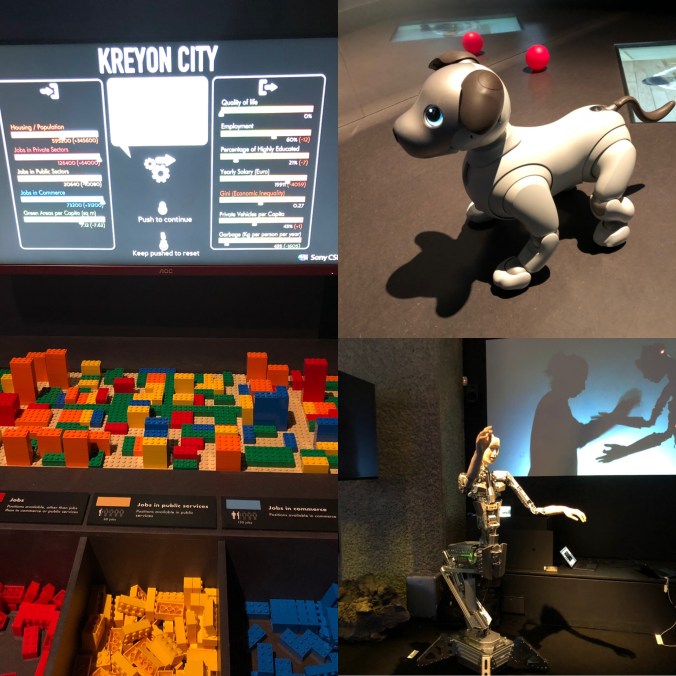
Exhibits In The AI: More Than Human Exhibition

Exhibits In The AI: More Than Human Exhibition (An Interactive Model For City Planning, Aibo The Robot Dog And A Robot Able To Mimic Human Movement)

That laid a good foundation for the latter sections of the exhibition which focus on current and, to a degree, future practical use of AI.  The examples on show, though, often seemed a little perfunctory and rather unconnected.  Some demonstrated what I would consider to be advanced computer power not, specifically, AI.

However, there were some good examples too.  These include those showing how AI is accelerating and improving areas as diverse as medical understanding and treatments, pedestrian and driver safety, city planning, customer problem solving, education and even dating.  There are also sections (too brief in my view) on the ethics of AI.  For instance, these include the dangers of AI in war, the risk of bias being built into the algorithms, and of AI being used to undermine our privacy, freedom and perception of the truth.  The exhibit showing AI helping lip-synching of Barack Obama was a rather chilling demonstration of the latter.

Since I’m a Barbican Member, I can go again for free and will plan to take ES who is also interested in the potential (and dangers) of AI.  Maybe with his insights alongside me, I will enjoy the exhibition more.

Back home, the focus is on catching up with YS (while he stays with us to gird himself for his move to London) and on gardening.  Long-Suffering Wife (LSW) has got large parts of the garden looking very full and attractive.

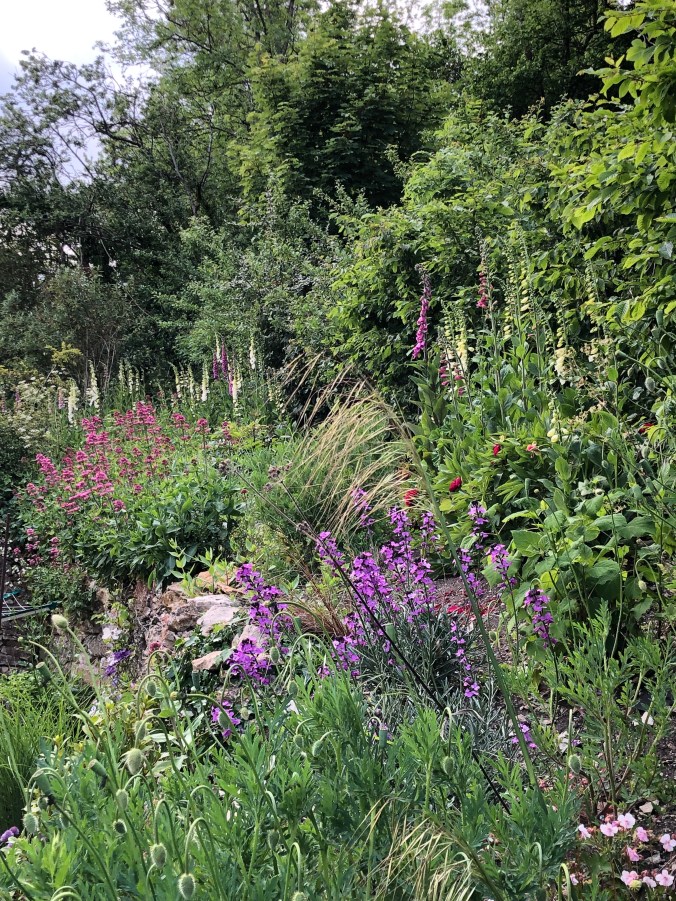
Foxgloves, Erigeron, Geraniums And Flowering Weeds At The Back Of Our House

Foxgloves, Erysimum, Geraniums And Other Flowers At The Back Of Our House

My vegetable seedlings are planted and just await proper rain and, no doubt, a slug onslaught.  The meadow is looking lush and healthy. Just a few more degrees of heat and summer will be here…..

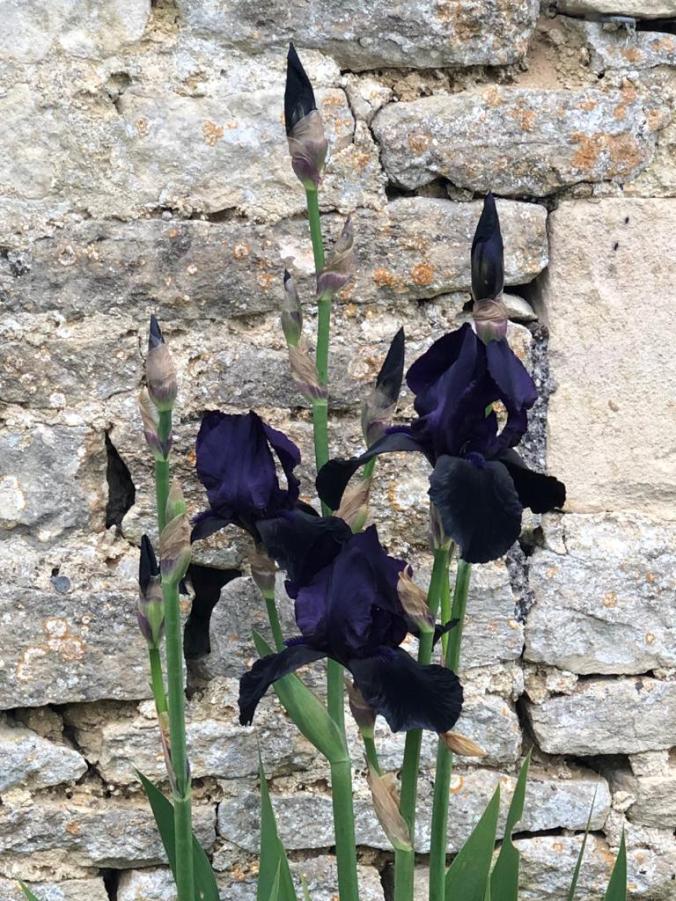
Our Favourite Irises In Our Garden

Our Favourite Irises In Our Garden


Two London Visits

I continue to be able to ameliorate my yearning for the buzz of living in London with one or two visits each month.  These are often based around meetings with old friends or gigs of bands that I like but can’t see out in the country.  That was the case this month and, once again, my ability to camp in my old flat on the sofa bed has proved very convenient.

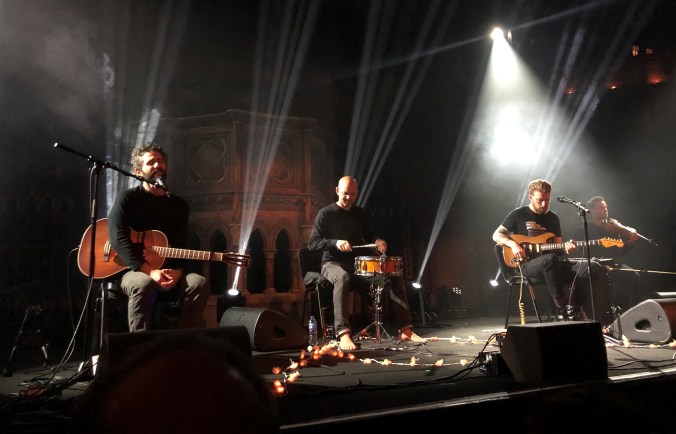
During the last week I saw a couple of gigs.  The first was The Antlers at Union Chapel with Middle Son (MS).  This was a celebration of the ten year anniversary one of my favourite albums: Hospice.  It’s a very sad album about domestic, emotional abuse (apparently) and (more clearly) terminal illness.  That may not sound appetising but it’s wonderfully powerful and the stripped back acoustic version The Antlers performed was moving and beautiful.  It drew on the hushed and respectful atmosphere the Union Chapel often generates and I love going there despite the unforgivingly hard pew seating.

img_3411.jpg

The Antlers At Union Chapel

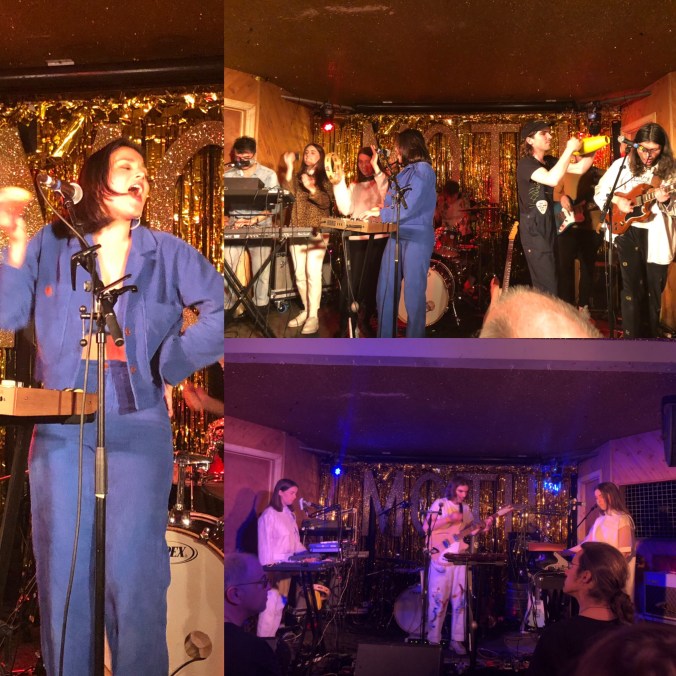
The next day, following a planned lunch with one old friend and then an impromptu meeting and beer with another outside Rough Trade East, I saw Malena Zavala at The Moth Club in Hackney.  This is a compact venue that is an ex-military veterans club with sparkling ceilings and amusing customer signs I have mentioned in previous blog posts.  The support band (Wovoka Gentle) and Malena were both good.  Malena mixed the tuneful, dreamy songs I knew with warm Latin rockers that indicated her Argentinian heritage.  I, and the rest of her audience, had a great, foot-tapping evening.

Malena Zavala and Support (Wovoka Gentile) at The Moth Club

Malena Zavala and Support (Wovoka Gentile) at The Moth Club

Earlier in April I had visited London for another gathering of old friends.  On the back of that I visited two places I had not been to before: The British Library and The Wallace Collection in Hertford House.

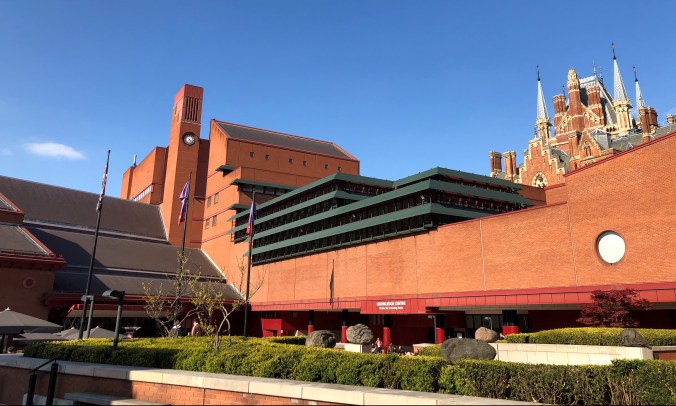
The British Library is vast and I limited myself to just the art exhibitions and the Library Treasury Gallery.  The latter provided an insight into the types of document that is held in the enormous reserves of the library.  There were beautiful illuminated books, religious texts representing all the main religions, historical documents (such as the book of Welsh Laws), important scientific papers and literature (such as the 14th century Gawain and The Green Knight) and sections covering Shakespeare and The Beatles.  I was drawn particularly to the old maps and I will look out for future special exhibitions that showcase the library’s holding of these.

The British Library

The British Library

One especially interesting section was on ‘Friendship Before Social Networks’.  This displayed many Friendship and Student Albums dating from the mid-16th century to Victorian times that individuals used to record the friends they met and the things they saw and did.  They were a little like artists’ sketch-books and many were really intricately completed and beautiful.  Their aim was to record, or even show off, the social networks and activities of their owners in much the way Facebook and Instagram often do today; fascinating!

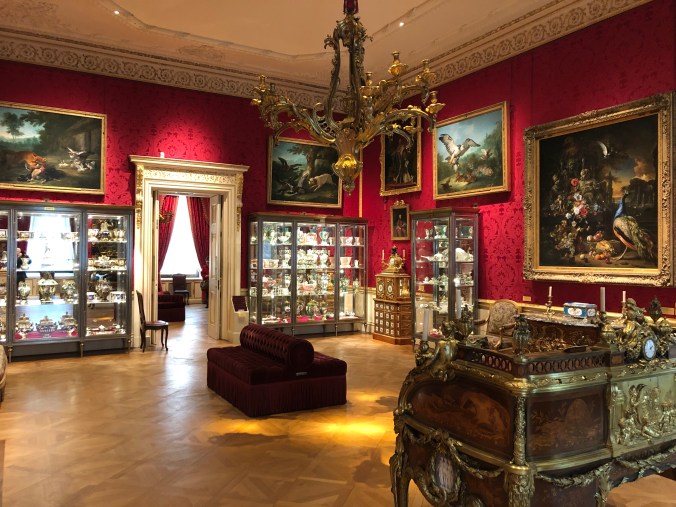
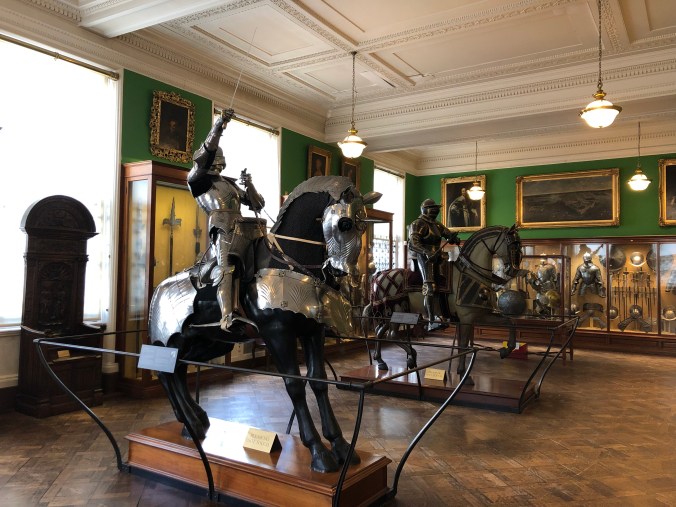
Long-Suffering Wife (LSW) tells me that I saw at least part of the Wallace Collection at Somerset House many years ago.  I barely recall that and, in any case, the collection is now in Hertford House in Manchester Square.  Like the British Library, the permanent exhibition of art, armour and weapons collected in the 18th and 19th centuries (and bequeathed to the British nation by Lady Wallace in 1897) is free.  I love it that such attractions are open to all without mandatory charge – not least because I could visit on consecutive days rather than struggle to take it all in in one go.

The Back State Room, Hertford House (Wallace Collection)

The Back State Room, Hertford House (Wallace Collection)

The armoury is particularly impressive although I rather hankered for the more selective and minimalist displays LSW and I had seen in Kolumba in Cologne and in the Museum of Islamic Art in Doha.  The Wallace Collection of armour and weapons is certainly comprehensive but also a bit overwhelming.

Part Of The Wallace Collection Armoury

Part Of The Wallace Collection Armoury

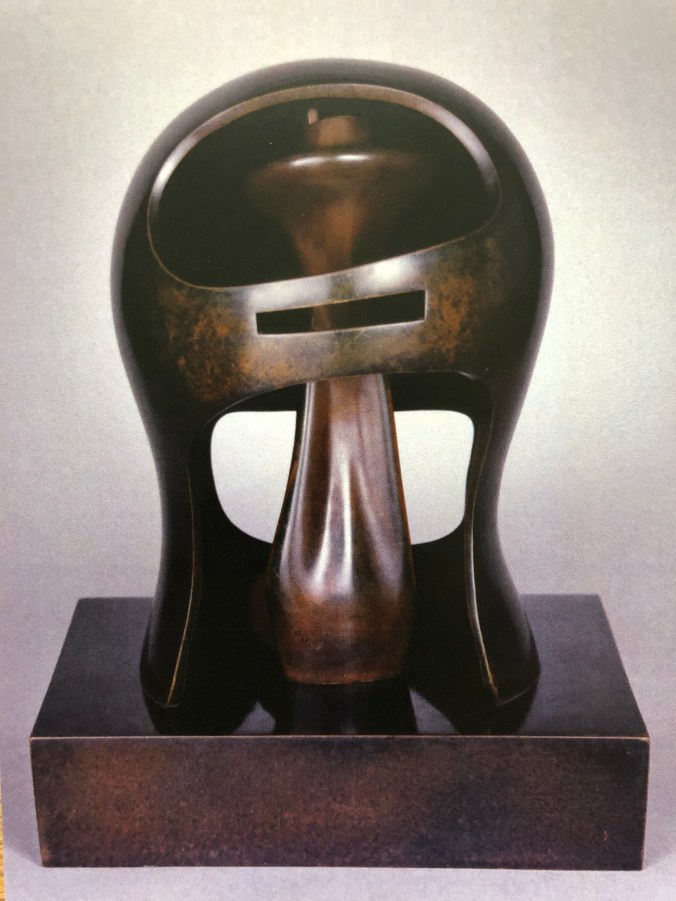
Not so, apparently, for Henry Moore the famous British sculptor.  He loved the armoury and visited it often during his time in London.  It inspired his development of the head and helmet as one of his iconic sculptural forms.  This was the subject of what I thought was a tremendous exhibition of his ‘Helmet Heads’ in the basement of Hertford House.  This wasn’t free but it was excellent in terms of the items on display and the information about how the helmets concept influenced his ideas throughout much of his life.  It’s on until 23 June 2019 and I recommend it.

One Of Henry Moore's Helmet Heads

One Of Henry Moore’s ‘Helmet Heads’

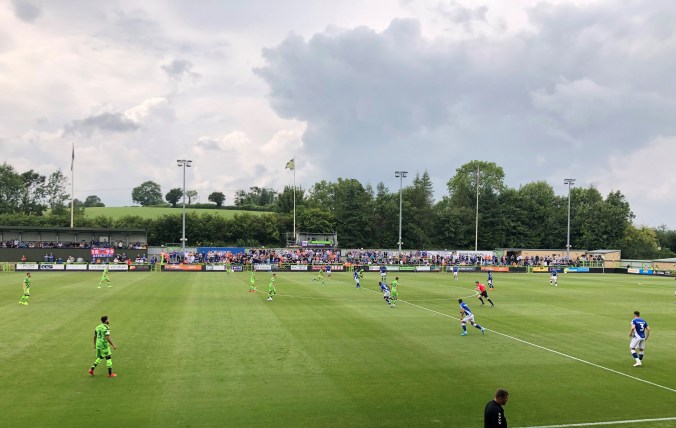
I’m back home now and the focus is on the last few games of Forest Green Rover’s unexpectedly successful and entertaining football season and on population of the vegetable patch and allotment.  Easter saw marvellous weather and it would be nice to see a return of that so gardening and football can be followed by wine in sun in LSW’s new garden.

Old Friends And Oxford

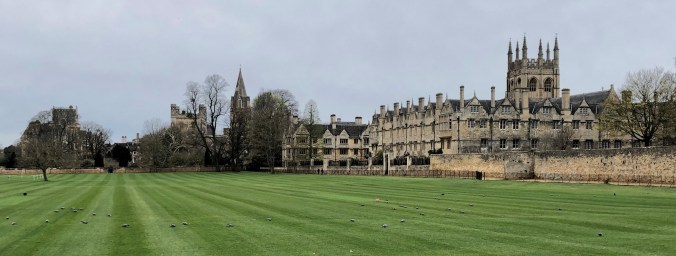
Christ Church College, Oxford

Christ Church College, Oxford

While Long-Suffering Wife (LSW) and I were in Australia, we met up with three of her long-standing friends: a school friend in Perth, a college friend in Hobart and a more recent friend in Sydney.  Each reunion was refreshing.

LSW has been continuing this sustenance of her friend network since our return.  Three friends who we knew when we lived in Kew near London have dropped in to see us.  She has also been with other friends from Kew to the People’s Vote March in London and to Bristol to see another long-term acquaintance from work.  It is time for me to match her relationship maintenance!  I have the time now I am retired, and the only issue is fitting in with the diaries of my old friends who are still working.

For many years, a small group of friends who I got to know shortly after I first moved to London over 40 years ago have been getting together on a regular basis.  For the last few years we have been meeting up every few months in a restaurant chosen alphabetically based on country of cuisine.  We are up to P for Portugal.  I travelled up to London last week for the latest instalment of catching up with personal developments, railing against the inequities of the world and solving (in theory) a few current newsworthy issues.  It was fun and informative as usual, and an excellent excuse to spend time in London.

Also, I have also managed to get together with two friends from my college days.  My goodness; now we are talking about 45 years ago!  We have stayed in touch intermittently since then.  Some years we have been completely out of contact with each other and then we have had periods when we have been close.  One of these friends was my Best Man (BM) at my wedding and, as those who have read earlier posts will know, I see him off and on at his house near Cambridge.  The other now lives with his wife in Oxford and that is where all three of us met.

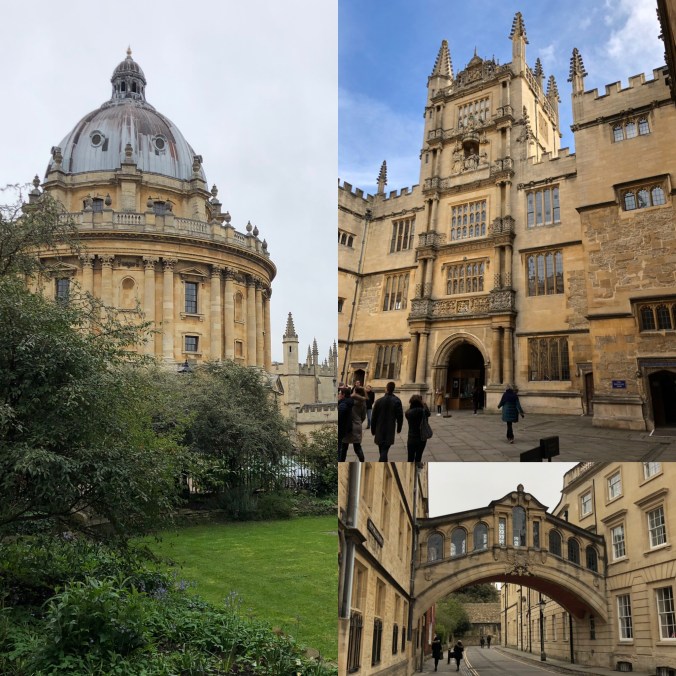
I have only been to Oxford a few times in recent years.  Then, the visits have been mainly to the outskirts to see Forest Green Rovers Football Club play Oxford United or to drop off or pick up Youngest Son from Oxford Brookes University.  This latest visit allowed me an almost full day wandering the city alone and then further sightseeing with my mates the next day. It’s a lovely city.

Scenes In Oxford

Oxford Scenes (Ratcliffe Camera, Bodleian Library, Bridge Of Sighs)

Upon my arrival, the weather was cold and I decided to go for a brisk walk to warm up.  I ended up walking a few miles up and down the Oxford canal.  This is a much scruffier walk compared to that along the Thames which we did together the following day.  Along the canal are mainly dilapidated barges.  Some sustain human life but almost all are covered in detritus and the romanticism of living independently on water looked rather battered.  The wildlife was plentiful though and the oblique view of the city through small canal-side workshops and back gardens was interesting.

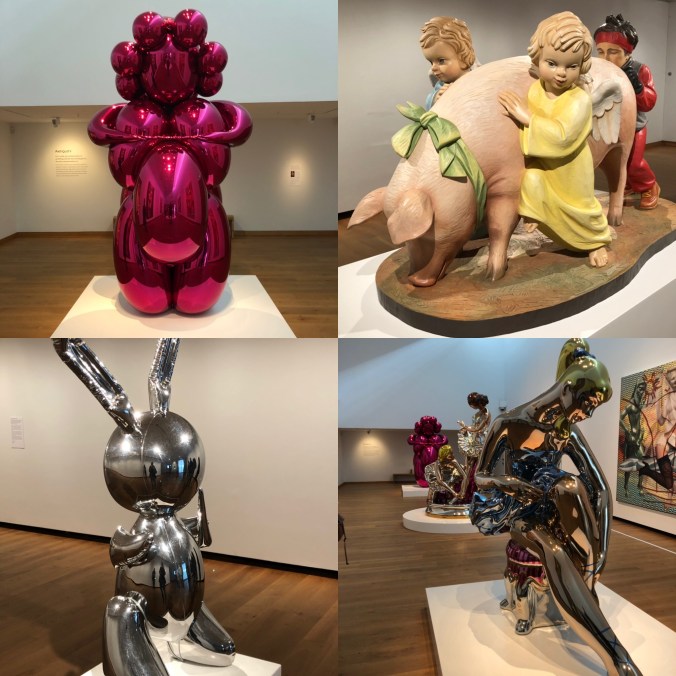
I went to an exhibition of Jeff Koons’ work at the Ashmolean Museum and continued to warm up.  I am not sure I like Koons’ work but it is certainly striking.  Regardless of whether the pastiche or banality is deliberate, his work isn’t the sort of thing I would want in my home.  However, the exhibition explanations of the pieces on show, and a short video interview with the artist, helped me understand at least some of what he is trying to achieve.

Pieces By Jeff Koons At The Ashmolean Museum

Pieces By Jeff Koons At The Ashmolean Museum (Balloon Venus, Ushering In Banality, Rabbit And Ballerinas)

Much of the rest of the Ashmolean Museum – apparently the world’s oldest museum – is rather like a stately home with sumptuous furniture, display cases and huge paintings.  I didn’t explore all of it but wandered a little aimlessly though impressive collections of porcelain, musical instruments, and modern art by a number of artists I admire such as Bacon, Kandinsky, Matisse and Hepworth.

I dwelt only in two galleries.  The first held a small but lovely, lush collection of 12th and 13th century Italian art which had some unusual pictures (one apparently depicting God himself and another showing a time lapse series of poses following the crucifixion).  The second covered the Pre-Raphaelites and included accounts of some of the salacious and scandalous relationships between the artists and their partners.  I saved the rest of the museum for another visit.

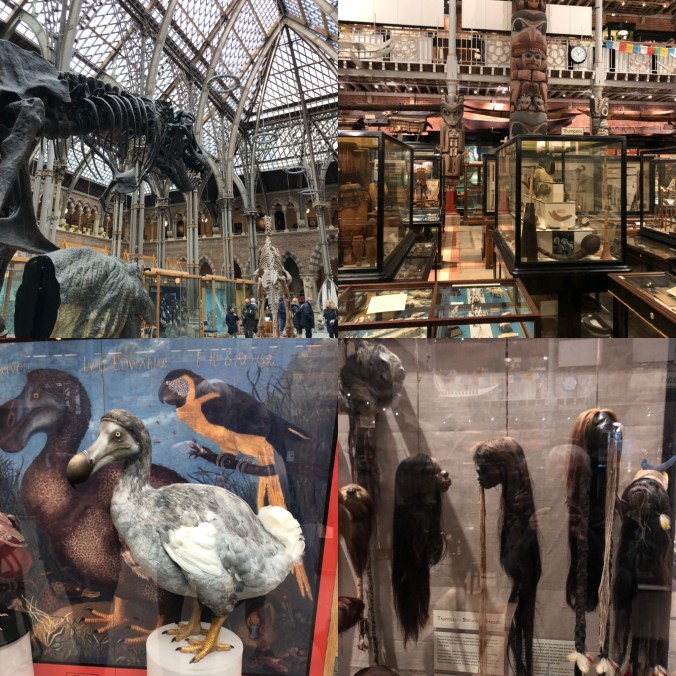
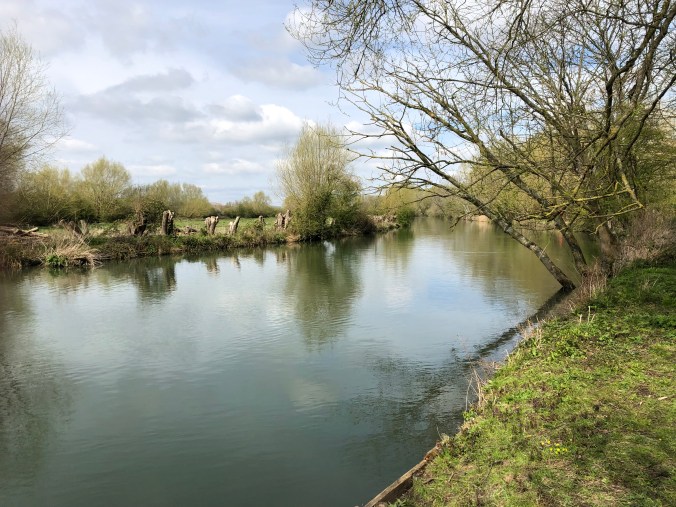
We ate well in Oxford but I walked many miles to work off the calories.  The sun came out for our walk around the north end of the city (including a brief stop at the remarkable and rather thrillingly cluttered Pitt Rivers Museum at adjoining the back of the Natural History Museum) and then along the Thames to a pub called The Perch.  It was great to get together with these university alumni, together for the first time in years, and to catch up with our ups and downs (in my case, thankfully, almost all ups).

Inside The Oxford Natural History Museum and Pitt Rivers Museum

Inside The Oxford Natural History Museum And Pitt Rivers Museum (Dinosaurs, Stuffed Dodos, Stuffed Human Heads And Other Marvellously Higgledy-Piggledy Collections)

Walking By The Thames At Oxford

Walking By The Thames At Oxford

Today LSW and I are off to Cheltenham to see some more old friends.  How personable I have become since retiring!

Marvellous MONA

Long-Suffering Wife (LSW) and I have been back from our Australia trip for about two weeks.  Those weeks have been spent quietly slotting back into a daily routine.  I have been getting a fork into the vegetable patch, strolling around the neighbourhood to spot the small changes that took place while we were away, catching up on a couple of Forest Green Rovers FC games, and recovering from the jet lag.  Once again I feel so relieved that, having retired, I can do all this without the worry of having to catch up at work while negotiating jet lag muzziness.

Though these two weeks, the memories of Australia have lived on pretty vividly.  They are reinforced by each retelling of our exploits down under to friends and relatives.  We’ve had some very good holidays in recent years but our Australia trip was one of the best.

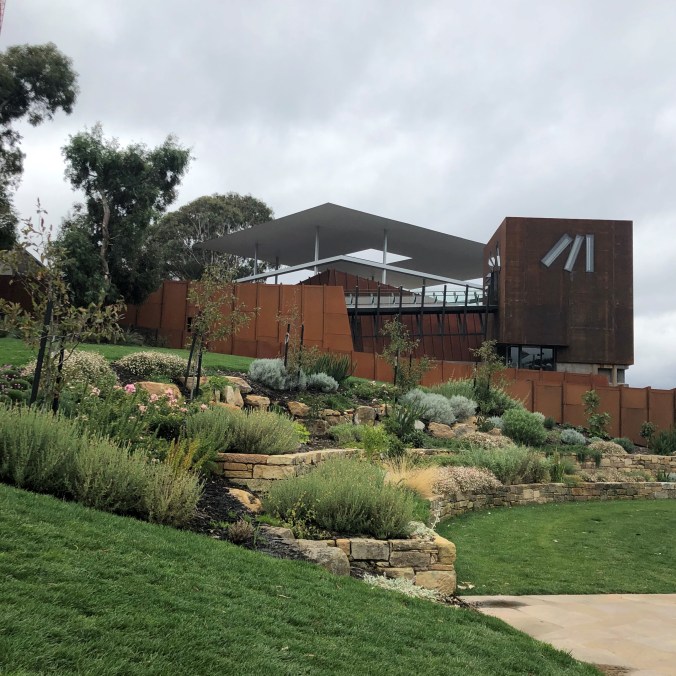
One of the most exhilarating days that we had in Australia was that we spent in Hobart visiting the Museum of Old and New Art (MONA).  This was set up by and is run and financed by David Walsh, a millionaire Tasmanian who made his fortune through gambling.  He is passionate about art and giving something back to Tasmania.  Visiting the gallery is free for Tasmanians and it has become a huge tourist attraction.

MONA

Museum Of Old And New Art (MONA)

The visit started on a purpose-built jetty from which Youngest Son (YS) (who paid for the excursion), Long-Suffering Wife (LSW), and I boarded a strangely shaped and coloured ferry.  As we boarded we were invited to load up a MONA app on our phones and, as we started to look through the web site pages, we could see we would be in for a fun time.  This feeling was underlined by the presence of a full size cow sculpture on the boat and seats that looked like sheep.

The journey itself, up the Derwent River, gave us a new, interesting view of Hobart’s industry and huge river side mansions.  Then, as we approached MONA on its own island in the middle of the river, we could make out a series of balconies, walkways and low-slung, rather strange looking buildings.  As we left the ferry and entered one of these I was reminded of Thunderbirds and Tracy Island; it all felt slightly off kilter and unreal.

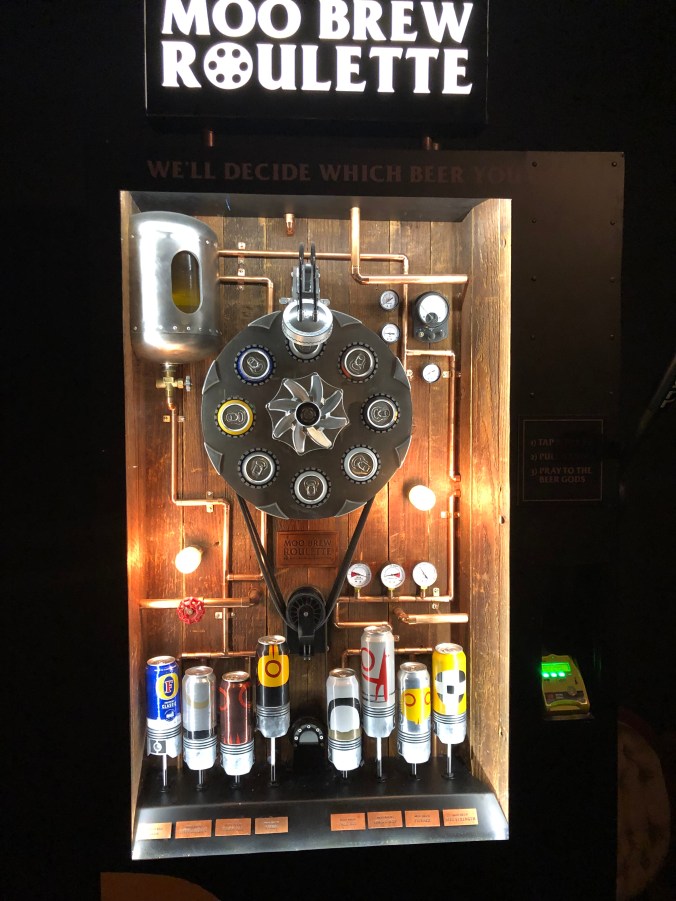
Inside it quickly became apparent that the bulk of the cavernous space for the art, the bars and the selection of restaurants is carved deep into the sandstone rock of the island.  There are spiral staircases, long corridors, small and huge rooms and, everywhere, fascinating sights.  I loved, for example, the slot machine beer dispenser which took one’s money and took its time to decide whether to dispense a lovely, expensive craft beer or a can of bog-standard Fosters lager.  I didn’t try it but was entertained by the relief or the frustration of others who did.

IMG_2721

Lucky Dip Beer Dispensary

As we moved around, so all the art was labelled, described and explained by the location sensitive app on our phones.  This provided various levels of detail – as much or as little as you wanted – on whatever was nearby.  I experienced something similar at the Opera exhibition at the Victoria and Albert just over a year ago but nothing as slick, comprehensive or amusing as this.

Screenshots From The MONA App

And so onto the art!  Incredible!

The first exhibit, Mummy and Coffin of Pausiris, required application for entry on the MONA app.  When my turn came I was let into a dark room, alone, and made my way around a platform with black water on either side.  In the middle of the room was, on one side of the platform, an Egyptian mummy in its shroud.  On the other side was a CAT scan of the same mummy that presented layers of the mummy progressively so that the mummified flesh was peeled back gradually to reveal organs then bones.  Some of these were damaged and indicated the cause of death and that, plus the irregular drips of water in the silent, dark room, made this lone experience really eerie and memorable.

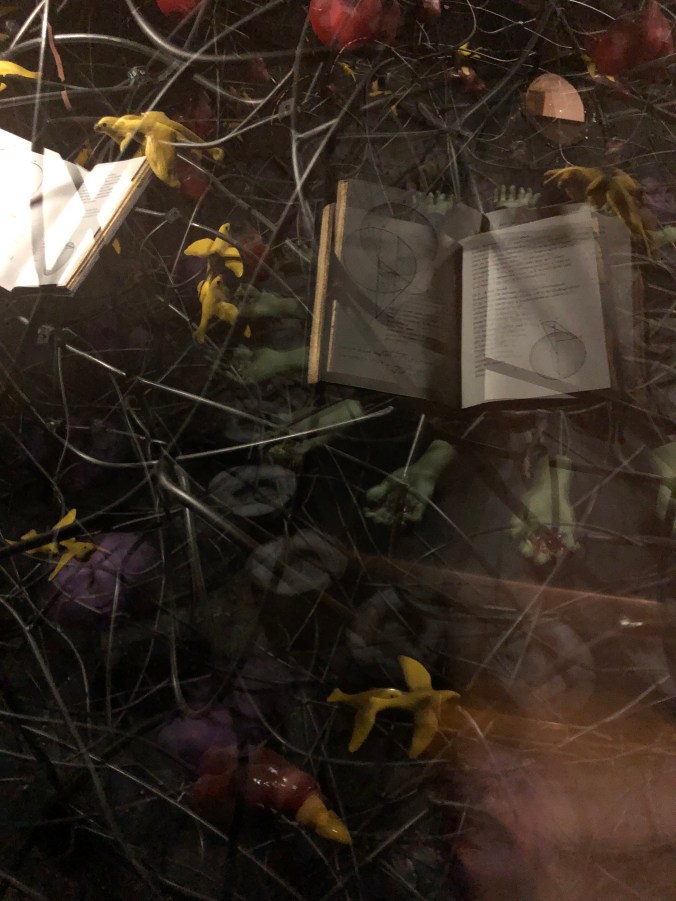
Perhaps the best exhibit was Artifact by Gregory Barsamian.  I think it was YS’s favourite too.  It was a large bronze head on its side with several portals so you could see inside.  From each portal one got a different view of what resembled a rotating machine with birds, balls, hands, heads and wheels all moving around in sync in a quiet whirlwind of stroboscopic light.  It was riveting but I couldn’t grasp what I was seeing then and can’t hope to describe it adequately now.  It was astonishing and brilliant.

Inside Artifact by Gregory Barsamian

Inside Artifact by Gregory Barsamian (But I Just Couldn’t Capture Any Of The Movement or Impact Of It Here)

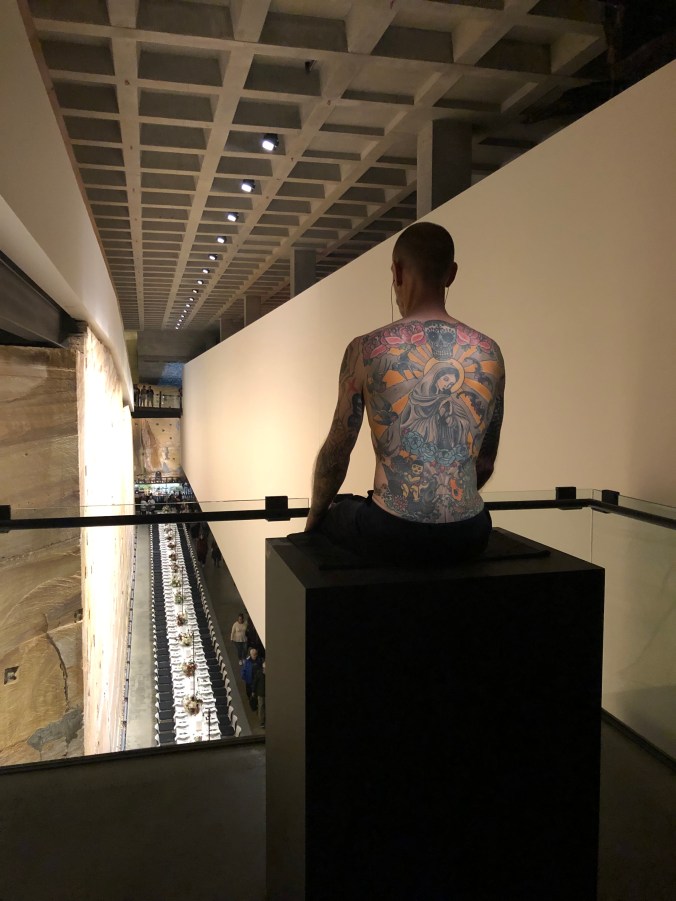
That was unsettling but even more so was the tattooed man, Tim.  The gallery has bought the tattoos on the back of this man and he is paid to sit all day, silently and still, to exhibit it.  It raised some deep ambiguity about ownership, slavery and art.

Tim, The Tattooed Man By Wim Delvoye

Tim, The Tattooed Man By Wim Delvoye Overlooking One Of The Restaurants Cut Deep Into The Sandstone

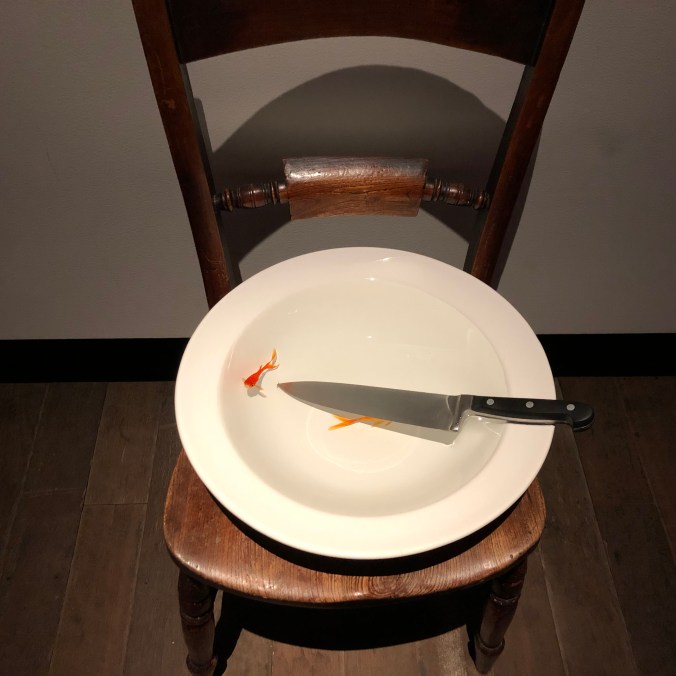
Other exhibits were also designed to keep one off balance.  Near Artifact was a bowl of water on a chair with a large sharp knife and two red and orange goldfish in it.  It was a simple piece (by Jannis Kounellis) but unnervingly reminiscent of blood in water.

Untitled, By Jannis Kounellis

Untitled, By Jannis Kounellis

Another exhibit (Kryptos by Brigita Ozolins) was a room set up as a small black maze with niches holding ancient vases.  When one got to the middle of the maze there was something unconscious that prompted one to look up.  Above was a mirror reflecting my upturned face; it scared the living daylights out of me.

I could go on.  There was the room half full of dense, black oil by Richard Wilson.  There was a grave stone at which we could throw glass bottles.  There was a huge room of tables with moving pellets, stroboscopic lighting, vast noise and hundreds of digital displays filled with alphanumeric characters (Supersymmetry by Ryoji Ikeda).  There lovely set of pieces by an Australian artist called Patrick Hall with opening drawers with recorded sounds, words and inscriptions.  There was a room with smelly hanging bowls linked by tubes and being fed food so that they reproduced the workings of the human digestive tract from start to finish (Cloaca Professional by Wim Delvoye).  There were skeletons making love, corridors with ever changing wall colours, a fat red car and hundreds of other works of art that surprised, enthralled and unsettled.

Fat Car By Erwin Wurm and Cloaca Professional In Action

It was simply the most engaging and enjoyable art exhibition I have ever seen.  It was huge but my attention didn’t drop once over about 4 hours. I’d love to go back and I recommend it to all.

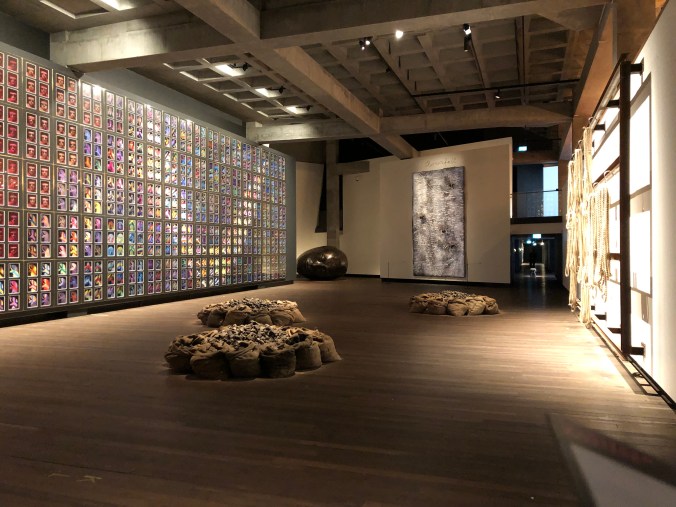
One Of The MONA Rooms (Artifact In The Corner)

One Of The MONA Rooms (Artifact In The Corner)

Views Around MONA


Bright, Shiny Perth (And Freemantle)

The third city in Australia that we visited, after Sydney and Hobart, was Perth plus its twin, Freemantle, way out on the west coast.  During our five hour flight over the south coast of Australia we got a sense of Australia’s huge scale.  We had previously admired the 9 mile beaches in Tasmania but now we could see we were flying over beaches on the south coast more than 100 miles long.

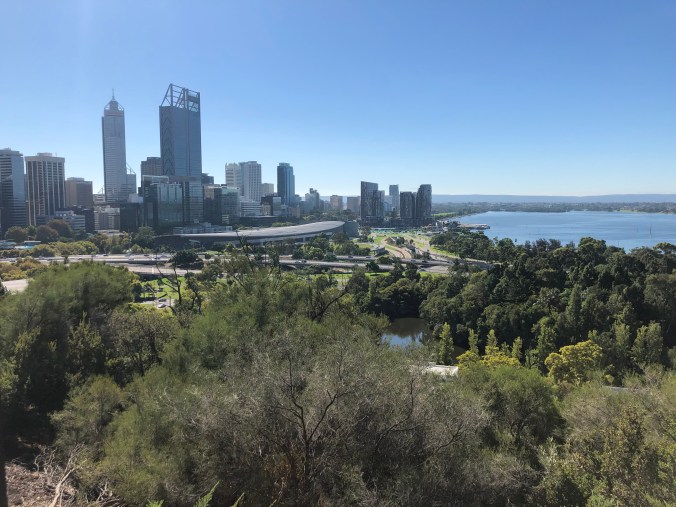
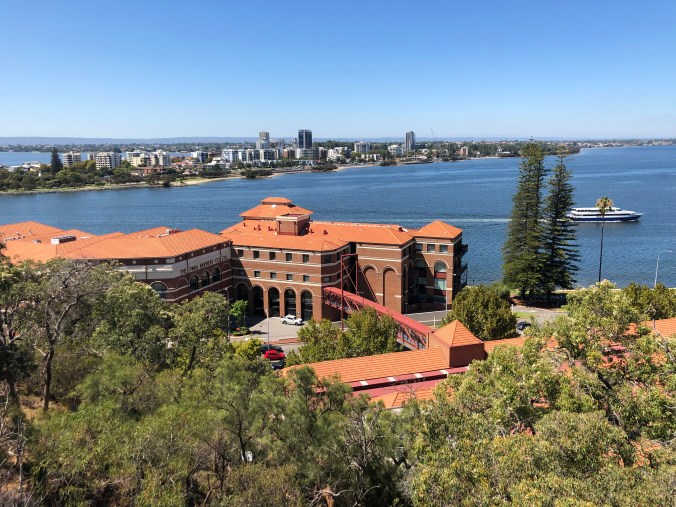
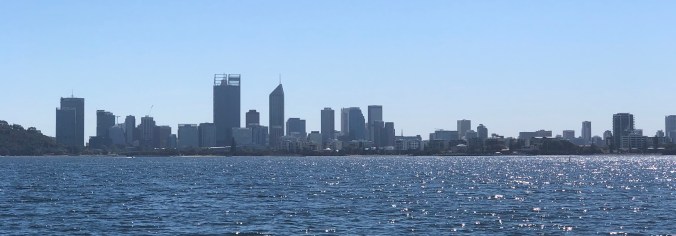
View Of Perth Centre From Kings Park

View Of Perth Centre From Kings Park

Long-Suffering Wife (LSW) had booked us into the Alex Hotel in Perth as the base for our stay in Western Australia.  It was excellent – probably the best value hotel I can remember staying in.  It was central, modern, cool, informal and very comfortable.  The friendly and helpful staff, the buffet breakfast and the honour bar systems in the lounge and roof top seating area were very trusting and relaxing.

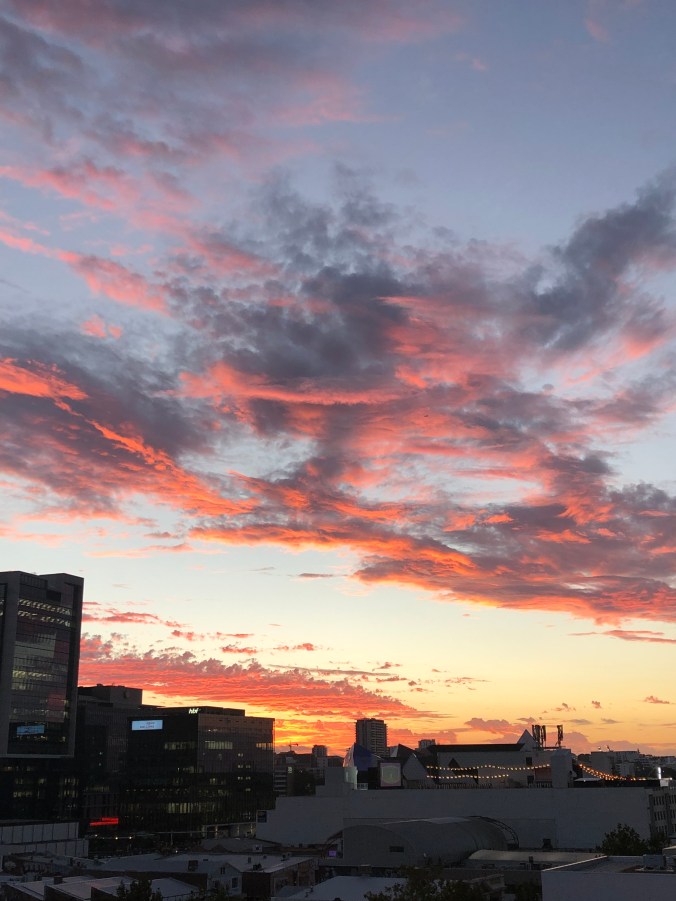
Sunset Over The Alex's Roof Top Bar

Sunset Over The Alex’s Roof Top Bar

We were initially disappointed that breakfast was included in the room rate since we had been looking forward to finding the best breakfasts Perth could offer.  However, the breakfast was so good – the fig bread was especially tasty and the coffee was predictably excellent – that we indulged every morning.  These substantial breakfasts plus, I think, the 30 degrees of heat outside, meant that we rarely felt like more than light meals for lunch or dinner.  Not that stopped us sampling the excellent food that seems the norm in Australia (for example at NoMafia, Shadow Bar and Gordon Street Garage).

On our first morning LSW and I walked to Kings Park. This is a 1000 acre site overlooking the Swan estuary and the central business district that contains the botanical gardens and a large tract of native bushland.  It was a good introduction to the plants and, especially, the trees of Western Australia and the views were great across brilliantly sunny, clear air. We flagged after a few hours in the heat.  Fortunately, the Swan Brewery, with its view across the shining Perth Water, is adjacent to the park so planning for refreshments was relatively easy!

Swan Brewery From Kings Park

Swan Brewery From Kings Park

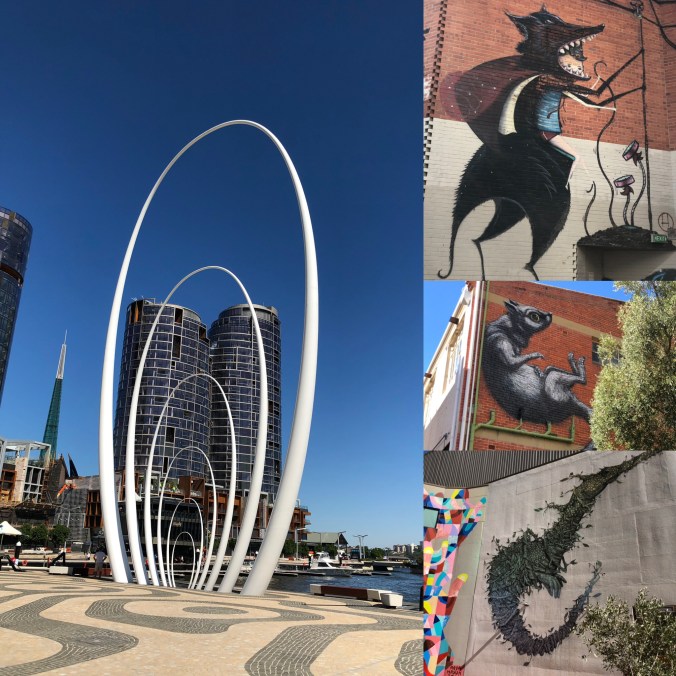
We strolled around the waterfront which is undergoing a huge transformation.  Everywhere we looked the city seemed bright, shiny and vibrant.

Perth Waterfront And Typical Graffiti

Perth Waterfront And Typical Graffiti

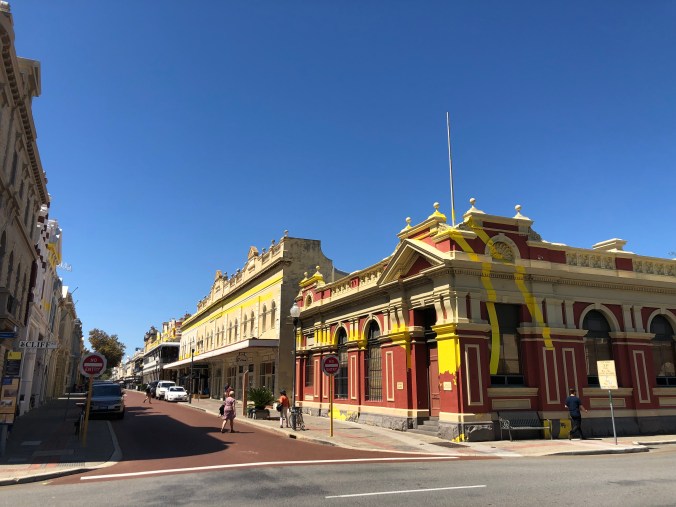
The following day we took a ferry to Freemantle, the port out on the coast at the end of the Swan River.  Again, the city was clean, tidy and looked great in the brilliant sun.  The historical buildings were rather more grouped together than we had seen in Perth’s centre and the strips of late 19th century and early 20th century colonial buildings were busy with independent businesses but well preserved.

On The Way To Freemantle

On The Way To Freemantle

High Street, Freemantle

High Street, Freemantle

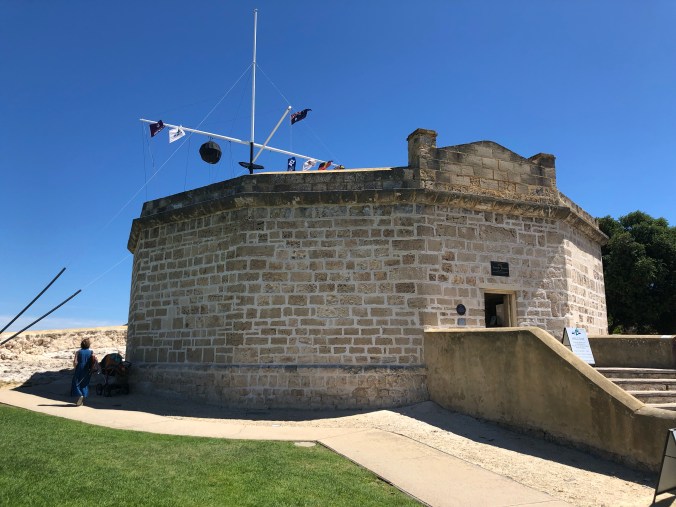
We visited two historical prisons and the Freemantle Shipwrecks Museum and each held our interest for an hour or so.  The Roundhouse opened in January 1831 to hold those convicted of a crime in the settlement and was used until 1886.  We were fortunate enough to be visiting just as a demonstration was taking place of the Freemantle Time Ball and Cannon.  This was used daily until 1937 to indicate the precise time to sailors off the coast so they could navigate successfully through the islands and reefs.  The cannon was a good deal noisier than either LSW or I expected!

The Roundhouse, Freemantle

The Roundhouse, Freemantle

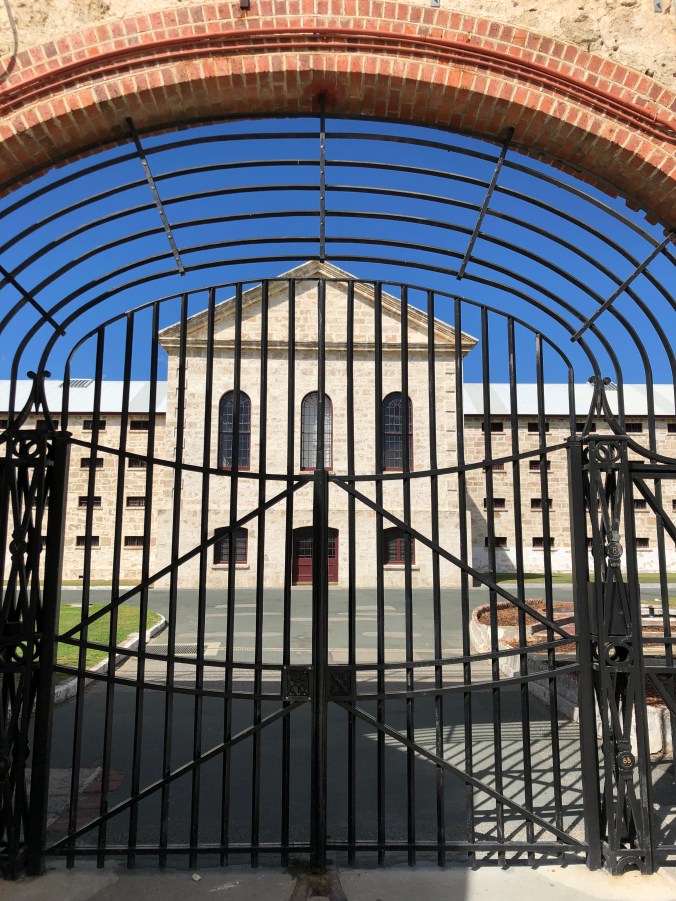
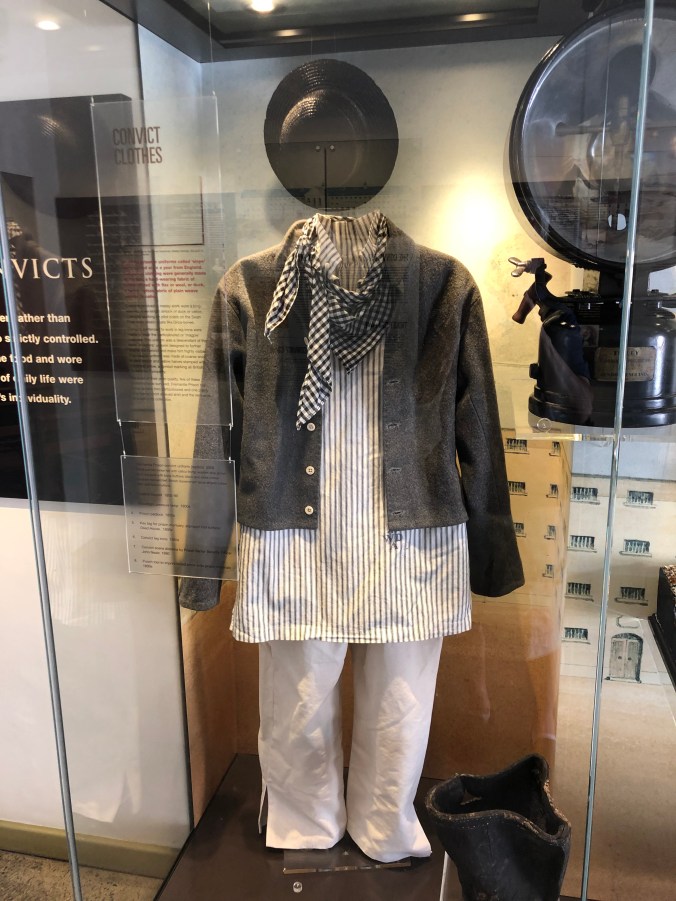
The Freemantle Convict Prison was built in the 1850s by convicts shipped from England and was then used to house them as they continued to be sent to Australia until 1868.  The building was impressive and LSW was rather taken by the standard prison uniform which was rather like some of her own best outfits.  Over 10,000 convicts passed through the prison and helped build the settlement’s infrastructure.  Some convicts served their sentence and went on through various levels of freedom to be successful outside the prison.  Of course, many did not and the exhibition showed how tough conditions were for the convicts, especially those undertaking hard labour in welded-on manacles in over 30 degrees of heat.

The Convict Prison, Freemantle

The Convict Prison, Freemantle

'The Slops': Convict Uniform

‘The Slops’: Convict Uniform

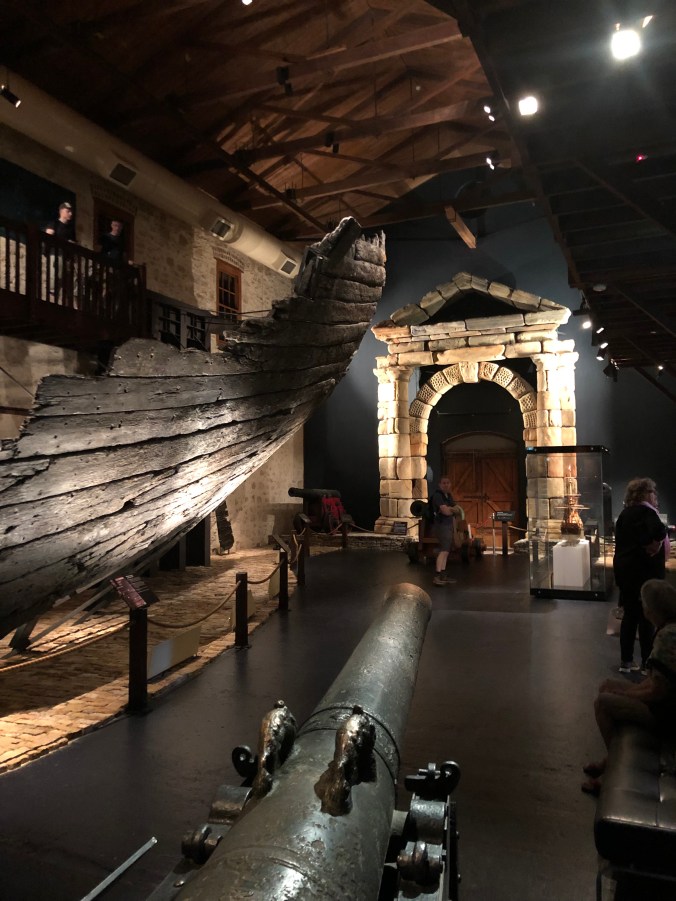
The Shipwreck Museum was stuffed full of information and exhibits and, frankly, we were ready for another nice lunch (which followed very pleasantly at Hush).  I focused on learning about James Stirling who explored the Swan River in 1827 and made the case to the British government for establishment of the Freemantle settlement.  He is an ancestor of LSW’s brother in law so there was an extra twist of interest in the material relating to him in the museum.

The Shipwreck Museum, Freemantle

The Shipwreck Museum, Freemantle

Back in Perth, we went to the Institute of Contemporary Arts which, apart from a nice looking café and an interesting exhibition by Cassils (a Canadian performance artist), was rather empty.  I also went to the Art Gallery of Western Australia which was more conventionally full of Australian, Aboriginal and European art.  A collection of European sculptures by Jean Arp, Henry Moore, Auguste Rodin, Lynn Chadwick and Antony Gormley) was impressive.

Our last full day in Perth ended at one of Australia’s iconic beaches: Cottesloe Beach.  Here was more sculpture; this time, a temporary exhibition of international, modern sculpture in a collection called ‘Sculpture By The Sea’.

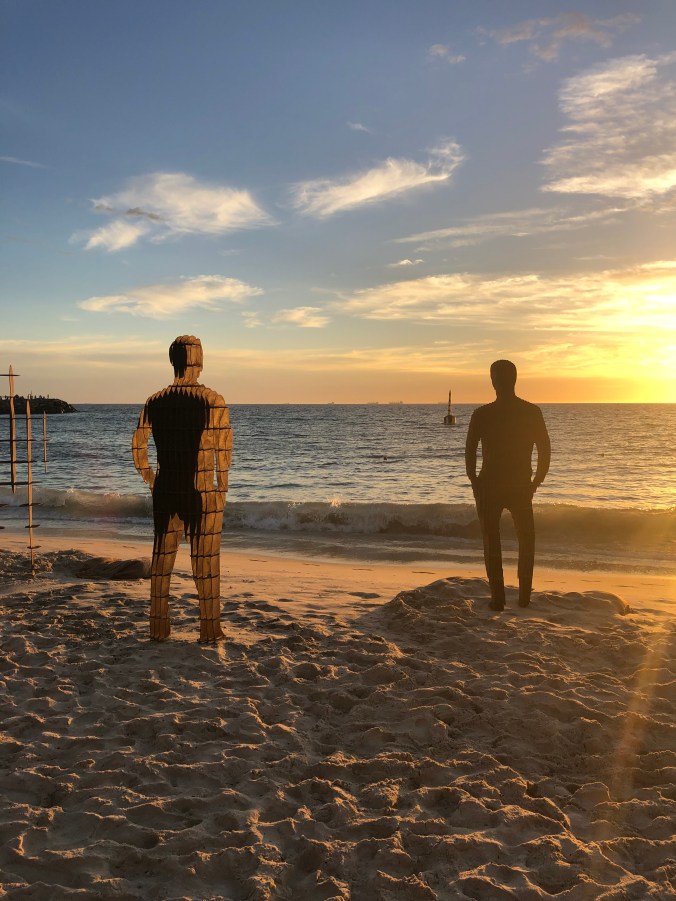
Sculpture By The Sea, Cottesloe Beach

Sculpture By The Sea, Cottesloe Beach

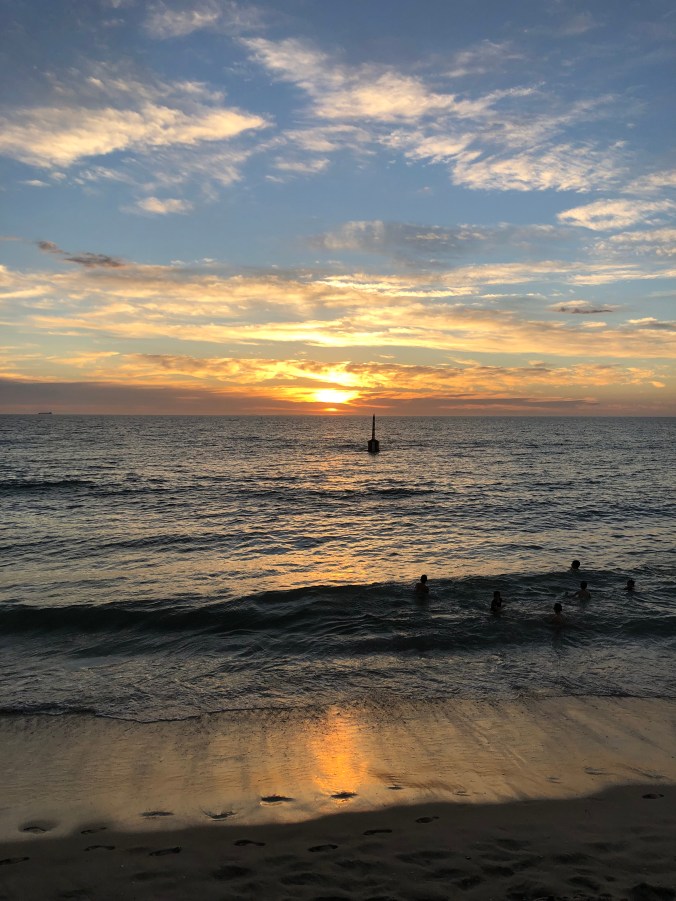
This exhibition, and Perth’s love of the beach, attracted big crowds.  Navigating these was a novelty given that everywhere else we had been on this trip had been very sparsely populated or entirely empty.  We simply retreated to a bar and watched the lovely sunset.  It was a beautiful way to round off our time in bright, lively and seemingly confident Perth.

Sunset, Cottesloe Beach

Sunset, Cottesloe Beach

We used Perth as a base for travel south, north and east in the south-west corner of Western Australia.  I’ll cover my thoughts on some of those journeys in the next post.

Secret Santa Scores A Hit

Last Christmas, Long-Suffering Wife (LSW), our three sons and I, decided to replace the tradition of us each giving everyone else a present, with a Secret Santa arrangement.  In this, each person draws a lot to determine which single person they should buy a Secret Santa present for up to a (relatively small) price limit.  This allows more focus and so reduces considerably the stress of (useful) present buying and the chance of getting something unwanted.

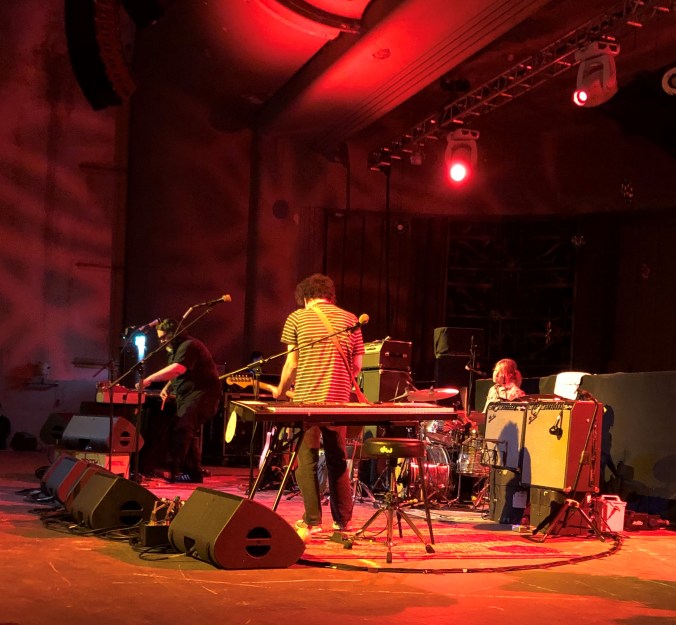
The reason I recall this now is that last week I was able to act upon my Secret Santa present: a ticket to a gig by Yo La Tengo at Hackney Arts Centre.  Actually, the giver, Eldest Son (ES), was no secret and, indeed, I went with him.  But Secret Santa was, for me as a receiver, a great hit.

Yo La Tengo is a band I have loved since I started buying albums by them in 2000.  In fact, they have been together as a three piece since the mid 1980’s and, as ES said after the gig, they have become very proficient at what they do.  Their music varies from gentle muses to Velvet Underground-like wig outs.  Unfortunately they didn’t rock ES’s boat but I loved almost all of the two-and-a-half hour performance.  I’m still humming their tunes to myself every day.

The venue is a gutted old cinema with bare walls and the seats taken out (contrary to the picture of comfortable seating on their website!).  We had to sit on nicely preserved, but very hard, wooden steps.  My back and bum could only take hour of that but then I was able to stand at the front and the two halves of the gig from the two vantage points was nice variety.

Yo La Tengo

Yo La Tengo At Hackney Arts Centre

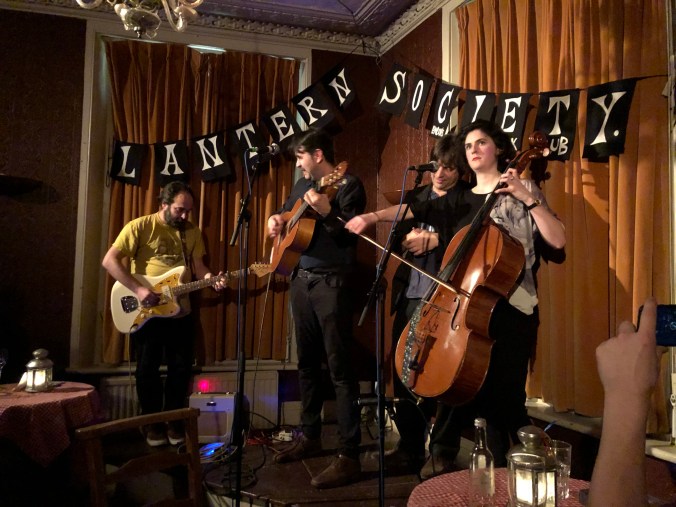
I made two separate trips to London last week.  During these I met with a fellow retiree ex-work colleague for lunch, caught up with Middle Son (MS) for breakfast and met up with ES and his girlfriend.  I also went once again to my favourite folk club – The Lantern Society – which was once again consistently good across 10 brief but high quality and varied acts.

Live At The Lantern Society

Live At The Lantern Society

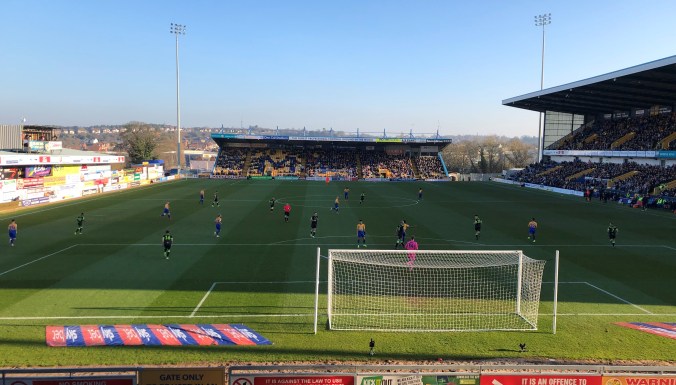
I then travelled up to my parents in Nottingham and jumped on from there to Mansfield to see my football team (lose entertainingly again).

Forest Green Rovers At Mansfield Town

Forest Green Rovers At Mansfield Town (With 170 Fellow Travelling Supporters)

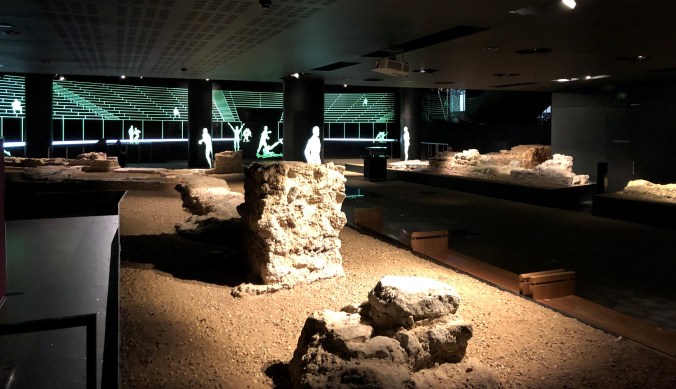
The most surprising element amid all this was a visit I made to the Guildhall Art Gallery.  Although it is only a 10 minute walk from where I lived for 20 years, I had never been before.  I went to see an exhibition of Victorian art portraying lives and perceptions of children.  However, I also walked around the rest of an impressive gallery and the very well exhibited remains of a Roman amphitheatre in the bowels of the building. London never ceases to surprise.

Guildhall Art Gallery

Guildhall Art Gallery (Pre-Raphaelite Section)

Roman Amphitheatre Under The Guildhall, London

Roman Amphitheatre Under The Guildhall, London

The main exhibition at the gallery, called Seen and Heard was interesting, informative and well presented.  It resonated well with a book I’m just finishing called A House Unlocked by Penelope Lively.  As it happens this was another Christmas present, this time from LSW’s Aunt. Lively uses her memory of artefacts and aspects of a rather grand childhood home in west Somerset to launch narratives on how various elements of social life have changed in the last 150 years or so.

The First Sermon and The Second Sermon By Millais

The First Sermon (Girl Sleeping) and The Second Sermon (Girl Not Sleeping) By Millais At The ‘Seen And Heard’ Exhibition

Lively covers childhood, gardening, hunting, immigration and marriage and much more.  The chapters covering childhood and parenting interlocked with some of what I saw at the Guildhall and it all rang true.  In particular, the section on her marriage got me nodding my head in agreement.  Here is an extract of one paragraph:

“Every marriage is a journey, a negotiation, an accommodation.  In a long marriage, both partners will mutate; the people who set out together are not the same two people after ten years, let alone thirty or more…… Our marriage was like most; it had its calm reaches, its sudden treacherous bends, its episodes of white water to be navigated with caution and a steady nerve…… We meshed entirely in tastes and inclinations, could always fire one another with new interest, and laid down over the years that rich sediment of shared references and mutual recognition familiar to all who have known long companionship. You are separate people, but there is a shadowy presence which is an entity, the fusion of you both.”

I’m expecting LSW and I to build another layer of sediment of shared memory over the next few weeks as we travel to Qatar and then tour Sydney, Tasmania and Perth in Australia.  Watch this space.

Retirement Time

Now I am retired, and no longer have to spend 50-60 hours a week working or travelling to and from work, I can extend what used to be rushed tasks at home over longer periods.  I can also take a few more risks with events that I invest time in.  There have been some good examples of both in the last week or so.

I have spoken before in this blog about what I called ‘speed gardening’.  This was the result of the pressure I felt to get substantial tasks in the garden done in the slivers of time available at the weekends before my Sunday commute back to work in London.  I rushed around trying to get things done and, while it kept me fitter than I am now, it wasn’t altogether satisfactory enjoyment.  Now, if a job doesn’t get done as planned on one day, well, there is always tomorrow!

This week’s example was ‘doing the bonfire’.  The pile of garden detritus requiring disposal – and burning it is the most convenient if not the most environmentally friendly way – had become huge following some recent tree maintenance.  I had the time to salvage logs and ‘loglets’ pretty thoroughly but there was a large amount of brash together with a solid mass of other woody matter.  I moved the base of the bonfire pile (so any small creatures could escape) and organised the brash so Long-Suffering Wife (LSW) and I could load it easily onto the flames in batches.

We managed to clear half the waste in a couple of hours before darkness descended.  The process was very satisfying in some base animalistic way.  In my more relaxed and retired mode, I wasn’t concerned that we didn’t finish.  There is always another day.

The example of having more time to take risks with events was that, when I went up to London for a couple of days this week, primarily to see the Jusepe de Ribera exhibition before it closes at the Dulwich Picture Gallery, I also booked a couple of other events about which I knew very little.  One was successful the other rather less so but, either way, I have so much more leisure time now that success or otherwise seems less crucial.

Of course, a successful event is still to be aimed at (time and energy is not infinite, after all). Certainly the Ribera exhibition, entitled ‘Art of Violence’, was riveting and impactful.  There weren’t many large paintings but those that were on show really conveyed the pain of martyrs on the way to their martyrdom.  As impressive were the numerous, much smaller sketches and wash and ink drawings of torture and martyrdom.  These were so intricate and compelling that they drew you into close inspection despite the horror they depicted.  My visit was complemented by the chance to catch up briefly with Eldest Son’s (ES’s) previous girlfriend who works at the gallery; we remain friends.

img_1875

The Martyrdom Of St Bartolomew By Jusepe de Ribera (sorry the picture fails to capture the piercing look of the Saint)

Examples Of Ink And Wash Drawings By Ribera

Another, more unexpected success, was that ES and I went to a lecture on, and demonstration of, how Russians in the Cold War created illicit copies of western music during Stalin’s regime (and often went to jail when caught).  The fascinating twist was that, because materials were scarce, the early copies were made by creating grooves on discarded x-rays with home-made lathes.  The resulting ‘records’ therefore had x-ray pictures on them.  Although the sound quality wasn’t great, the recordings were much sought-after snatches of the forbidden jazz and rock and roll of the west and each was unique.

Stephen Coates Explaining The X-Ray Audio Project

Stephen Coates (Ex-The Real Tuesday Weld) Explaining The X-Ray Audio Project And The History Of Illicit Music Recording In Cold War Russia

Pictures and video footage of interviews with some of the protagonists in the schemes to create the lathes, to procure the x-rays (being discarded by hospitals because they were inflammable and presented a fire risk) and to cut the recordings added extra life to some well told stories about the copying process.  These stories recalled, and tied in neatly with, aspects of the film Cold War by Pawel Pawlikowski that I saw with ES recently, books I read years ago by Josef Skvorecky about underground music in Czechoslovakia, and also an excellent book I read recently called A Gentleman in Moscow by Amor Towles.

The evening culminated in Thurston Moore – a guitarist previously with Sonic Youth – recording a couple of things onto x-ray disks so they could be played back to us.  It was pretty visceral stuff – in a very different way to the Ribera exhibition – and ES and I will remember it for a long time.

The X-Ray Audio Project With A Thurston Moore Demonstration

Less successful, but entertaining nonetheless, was a gig I went to in one of my old stomping grounds in Homerton, Hackney.  Chats Palace was the venue and it seemed much the same as I could remember from when I was last there in the early 1980’s.  I saw William Doyle who I liked in his incarnation as East India Youth a few years back and who has produced some interesting ambient music recently.  He now has a new band who are preparing to release their first album together.  They were good in parts but, I felt, still finding their feet.

William Doyle In Full Flow At Chats Palace

William Doyle In Full Flow At Chats Palace

I may have much more leisure time now but, when I’m in London, I have to squeeze in plenty of activity.  Fortunately ES and Middle Son both had time for breakfast with me.  I also walked around Dulwich Park, visited Rough Trade Records (as usual), went to Southwark Cathedral for the first time, snacked in Borough Market and, in lovely weather, took in the scale of London from London Bridge.  I still love London and have the time to enjoy it.

Views From London Bridge

Views From London Bridge