For much of my working life, I was in London while the family were in Gloucestershire. I usually only got to see Long-Suffering Wife (LSW) and our three sons during weekends when work often intruded and I wanted to rest. Then the sons grew up and each of them spent time with me sleeping on the floor of my London flat while they took their first steps into the world of work. The flat is very small so, although I got to know each so much better, the close proximity and sleeping arrangements were sometimes a stress.
Now, Eldest Son (ES), Middle Son (MS) and Youngest Son (YS) are all based in London and I have entered something of a golden period as a parent. Now I am able to see them in short spells and in a relaxed way – over dinner, at breakfast, at a gig or in an exhibition. All I have to do is schedule the rendezvous around their diaries and enjoy the moment. I plan to make the most of these arrangements while they last.
Last week, I was up in London again and was able to see all three sons. The main reason for visiting London was to see a gig by Nuria Graham. I first saw her in 2015 at Rough Trade and have now seen her twice since. She is Spanish with some Irish heritage and writes some great tunes with intriguing English lyrics. YS and I saw her at Jazz Servant Quarters which was just the type of venue I like: tiny (capacity for only 40 people) with a great sound system. I loved the whole evening and plan to visit Jazz Servant Quarters again and also see Nuria once more next April.

Nuria Graham At Jazz Servant Quarters
Next morning, having stayed with YS overnight on their ailing inflatable bed, we went with his girlfriend for breakfast at the new Ozone Cafe in Hackney. I love the treat of breakfast in London. It often includes unusual and quality ingredients, it sets me up for the day of city exploration and usually obviates the need for lunch.

Ozone, Hackney
The previous day I had breakfasted at one of my favourite cafes – Ask For Janice in Smithfield – and had felt full most of the day. At Ozone, I was a little more restrained since I was meeting an old friend for lunch at The Coach in Clerkenwell later. Nonetheless, breakfast was ample and excellent and, of course, given its Ozone pedigree already tried elsewhere in the City, achingly trendy.
While in London I also went for dinner at Smokestak with MS, ES and his girlfriend. Smokestak is only one or two steps up from fast food – we were in and out in an hour – but the food was great and the atmosphere was buzzy. As MS said, despite the restaurant being famous for its meat dishes (and I loved the fried ox cheek), the vegetarian plates were perhaps the best. I certainly ate well during my London visit.
Across the two days I was in London I went to four exhibitions. On LSW’s recommendation from the previous weekend, I went to the Royal Academy to see the large Antony Gormley exhibition (now finished). It was certainly impressive – not least the engineering that had gone into making several of the rooms dramatic, single-piece displays.
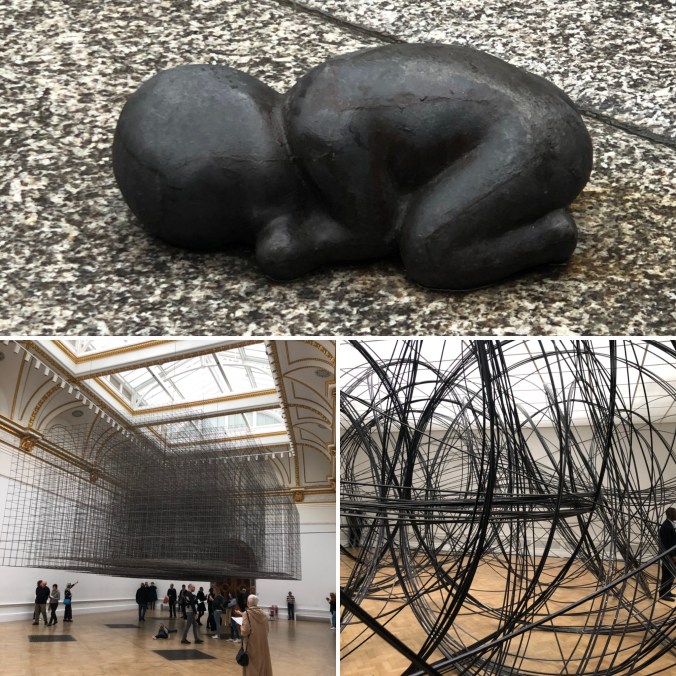
Iron Baby (1999), Matrix (2019) and Clearing VII (2019) By Antony Gormley At The Royal Academy
One room was filled with seemingly continuous loops of metal (8 kilometres worth) resembling a huge circular scribble. Another was a room filled with silt and water. Another had two huge cast iron baubles hanging from the roof. And then another had Gormley’s trademark human forms, also cast in iron, set at various angles and amongst which the crowds could meander.
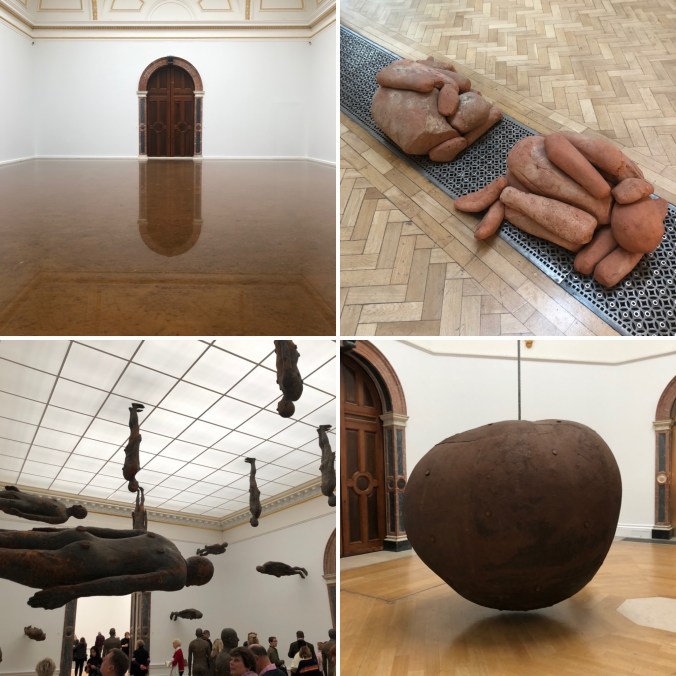
Host (2019), Piles (2018), Lost Horizon (2008) and Fruit (1993) By Antony Gormley At The Royal Academy
These were all certainly memorable but, at the time, I confess I enjoyed looking at his numerous workbooks more. These showed how the ideas were generated rather than the final forms and it was more calming to look at these rather than negotiate the crowds in the rooms holding Gormley’s main works.

Some Of Antony Gormley’s Workbooks

Subject II By Antony Gormley At The Royal Academy
The Bridget Riley Exhibition at the Hayward Gallery was also impressive. Photos of much of her work don’t work because they play with our way of seeing so much. For example, Horizontal Vibration (1961) really does seem to vibrate before your eyes. ‘Current’ (1964) is like an optical illusion that feels destabilising if looked at for more than a few seconds. These are clever and, I’m sure, were ground-breaking in their time but I love her brightly coloured works with stripes and diagonals more.
Though organised by topic rather than chronologically, the exhibition did a good job of tracing her thinking from her early drawings and the influence of Seurat on her work. It covered her black and white visual exercises, her moves into curves and then colour and, finally, recent works that resembled Hirst’s dot paintings but which were clearly rooted in what she has done before. The exhibition was an enlightening and cheering way to pass an afternoon.


Currents (1961) And Stripes And Diagonals By Bridget Riley At The Hayward Gallery
I squeezed in a visit to the British Library to see the Buddhism exhibition there. Most of the exhibits were brilliantly, brightly coloured 19th century picture books showing the events in the life of the historical Buddah. There were also much older scrolls, wood panels and palm leaves inscribed with delicate texts and images. Once more, it was hard not to be impressed but, for me, the exhibition lacked a theme and was little more than the sum of its parts.
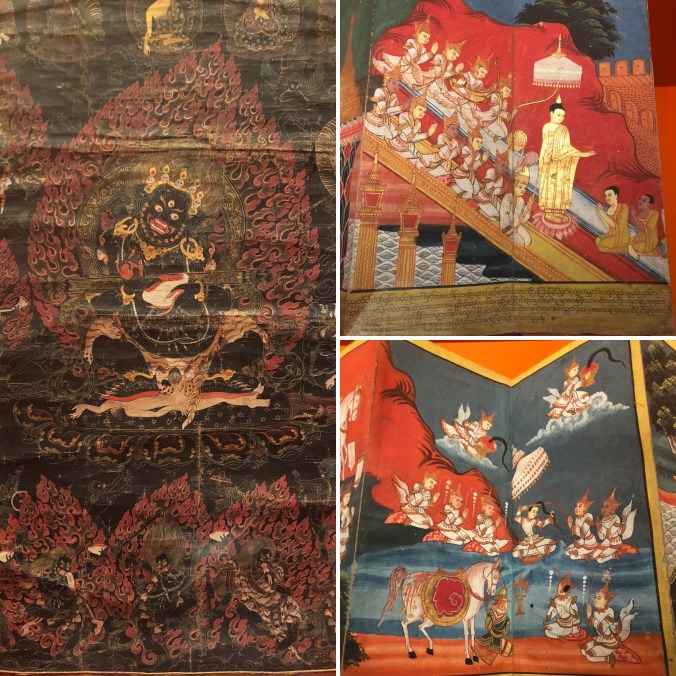
A 16th Century Tibetan Scroll Depicting Mahakala (A Protector Deity) And Tales From The Historical Buddha’s Life In 19th Century Folding Books
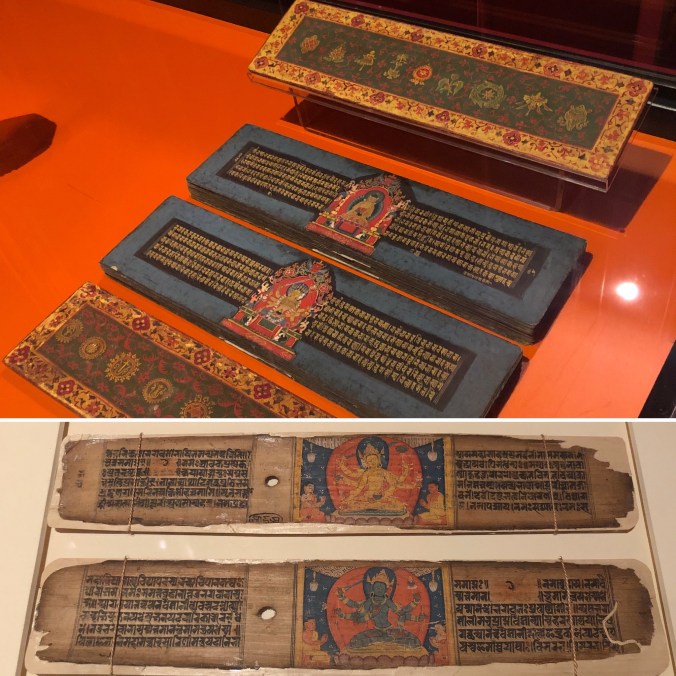
Nepalese Buddhist Palm Leaf Texts (17th and 12th Century)
The fourth (and, in my view, best) exhibition I saw was that of a recent body of work by Anselm Keifer at White Cube Gallery in Bermondsey. Anselm had been featured the day before I visited in the Guardian newspaper and the exhibition had been recommended by a friend. I had not heard of Anselm previously and I went with no great expectations.
As soon as I entered the gallery I was blown away by the rhythm and enormity of the work in the central hall and then, as I moved into the adjoining rooms, by the scale of the paintings, their depth and the overall sense of brooding dystopia. The paintings worked from a distance and right up close and I was fascinated even though I didn’t really understand what I was seeing.
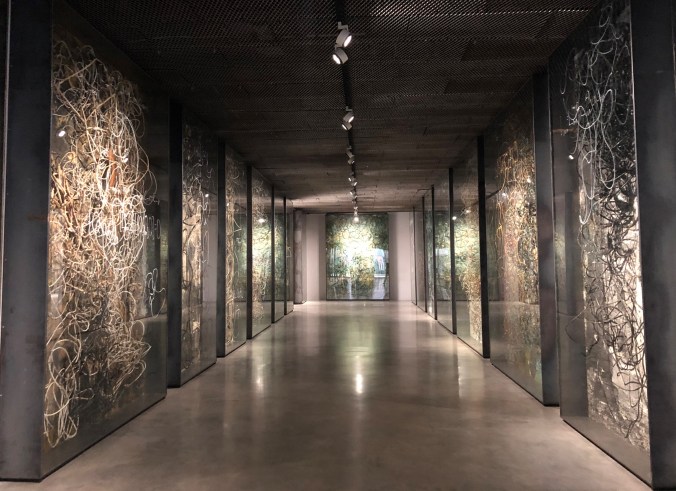
Superstrings, Runes, The Norns, Gordian Knot By Anselm Keifer (Here Showing Just Part Of A 30 Vitrine Installation)
The White Cube is a tremendous, huge space; it needed to be to accommodate the work. The exhibition is on until 26 January next year and I would like to go again (unlike the other exhibitions I saw, its free!).
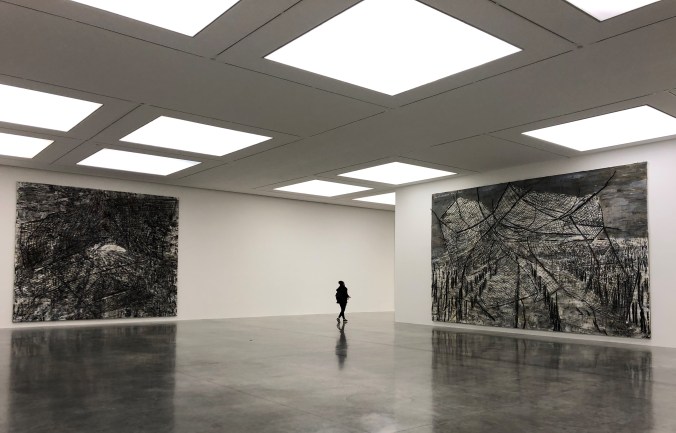
The White Cube Gallery With Anselm Keifer Paintings
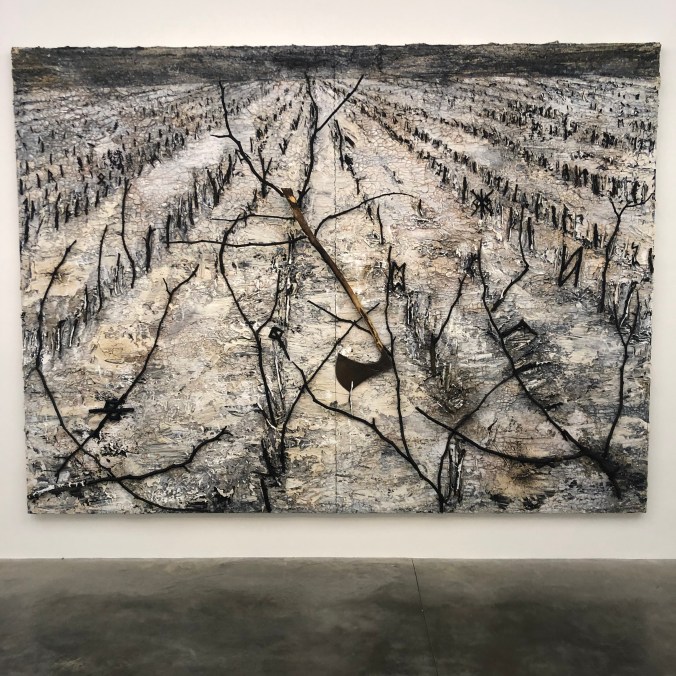
The Gordian Knot By Anselm Keifer At White Cube (With A Real Axe And Real Blackened Branches)

Superstrings By Anselm Kiefer At White Cube Gallery
I’m planning one more visit to London before Christmas. I’m looking forward to another round of exhibitions, breakfasts and meeting up with one or more of our sons.

 My Retirement Journey