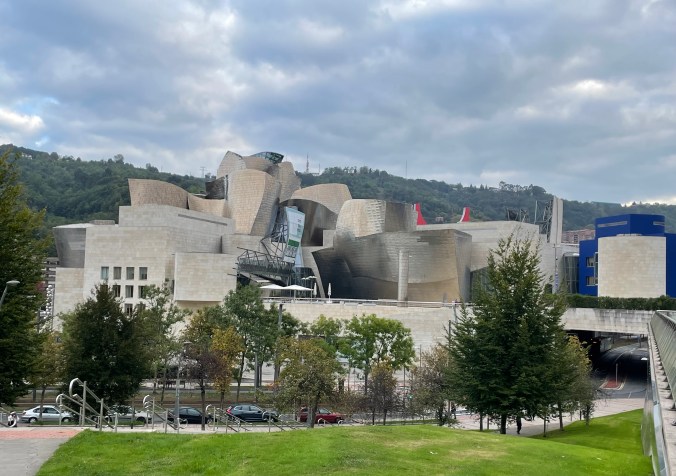
The attraction of the Guggenheim Bilbao Museum was the main reason for us choosing to visit Bilbao. It is certainly the main tourist magnet in the city and a centrepiece that dominates views downstream from the Old Town and from the slopes to the north of the city. We visited it straight after breakfast on our first day and, after a quick wander around the amazing building, were ready for entry at opening time.
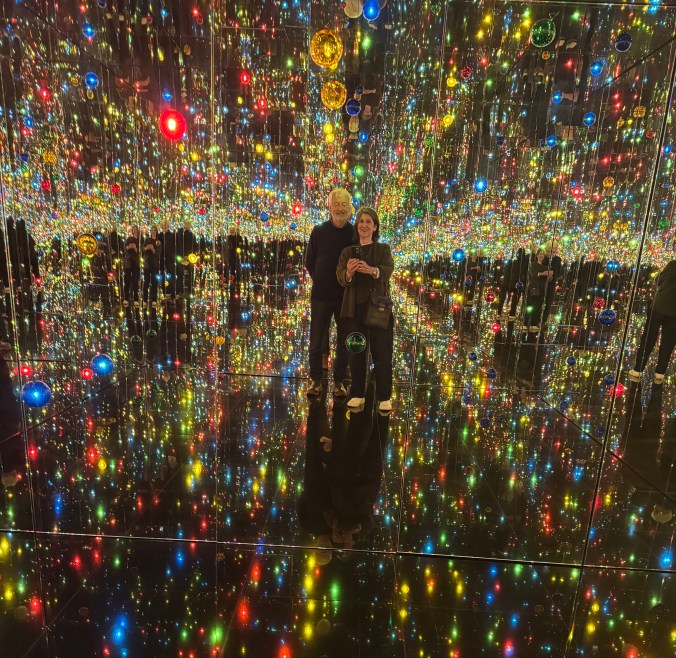
Fortuitously and a little randomly, we went straight to the top floor with a plan of working our way down. That avoided the initial rush of visitors and enabled us to visit Yayoi Kusama’s ‘Infinity Mirrored Room’ before any queue had built up. Jane knew what to expect but I didn’t and when we got inside the room containing the work, I was taken aback. Unfortunately, I then spent more time posing for a picture of the two of us in the mirrors than understanding what I was looking at before we were ushered out with our visiting time having expired. Our visit made for an interesting photo though….
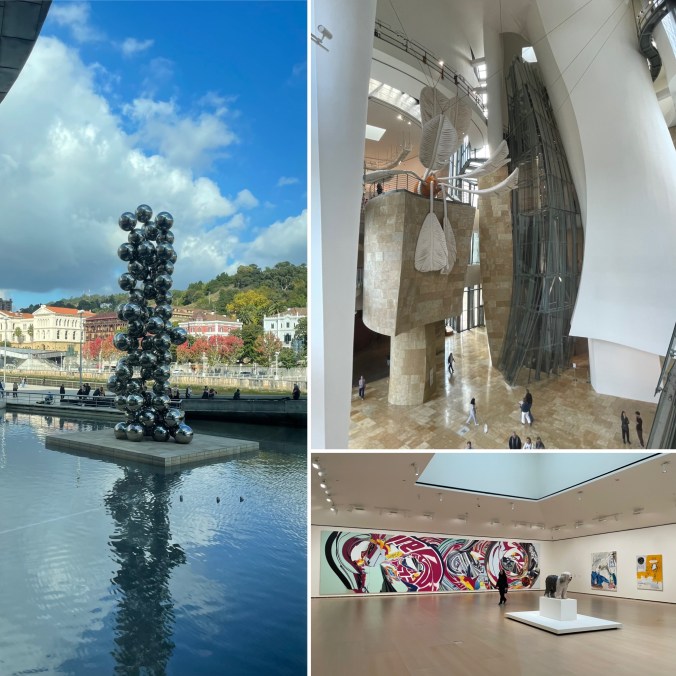
After that rather helter-skelter experience, we were able to take our time perusing the top floor. It became clear that some of the permanent collection was not on show at this time. While that was disappointing, there was plenty to see.
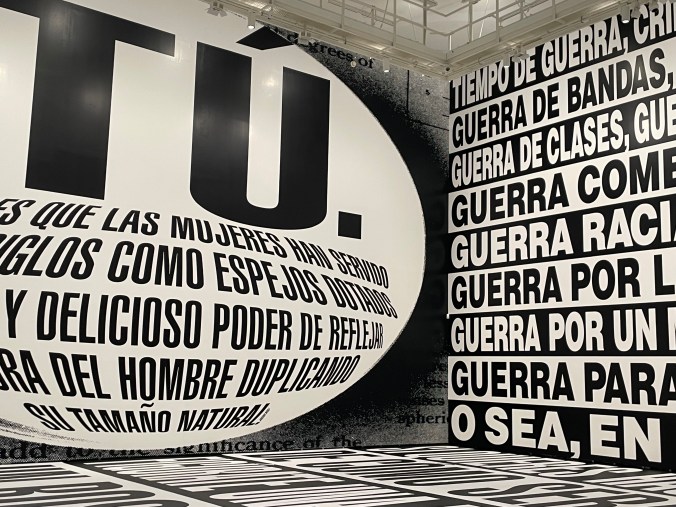
Much of the space on the first floor was taken up by an exhibition custom-made for the Guggenheim by American artist Barbara Kruger called ‘Another day. Another night’. This was dominated by multiple words and phrases stuck to the walls, ceilings and floors. These were in Spanish (not unreasonably given we were in Spain!) so I absorbed the overall effect rather than the meanings. Elsewhere there were video artworks that probed the ambiguity of word meanings and one of these was a rather timely and captivating analysis of the words (and their imagined alternatives) in the US Constitution.
Another temporary exhibition by Sky Hopinka called ‘No Power’ was also a series of videos but I confess I didn’t stay to the end.
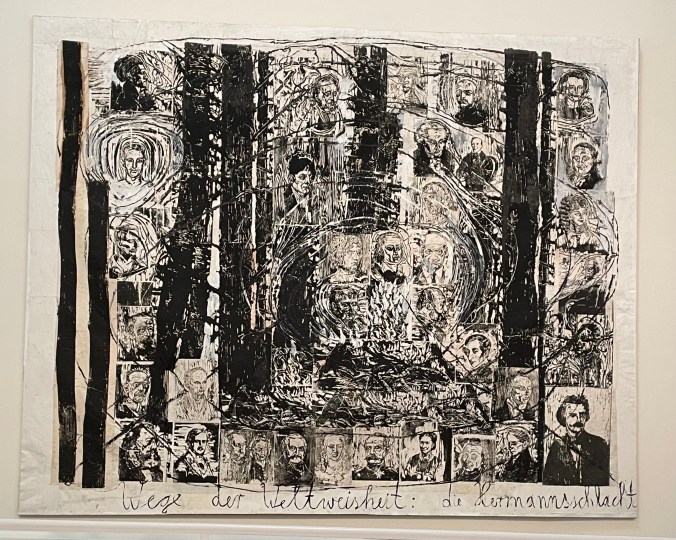
Better, I thought, were the large spaces devoted to variety of artists’ works from the permanent collection though none really gripped me. The flower sculpture, ‘Puppy’ by Jeff Koons at the entrance to the Guggenheim was undergoing renovation but another of his works was inside alongside art by Jean-Michel Basquiat and a number of artists I hadn’t heard of before. There was also a typically large painting by Anselm Kiefer who is one of my favourite artists (though this one was a rather dull compared to others I have previously enjoyed).
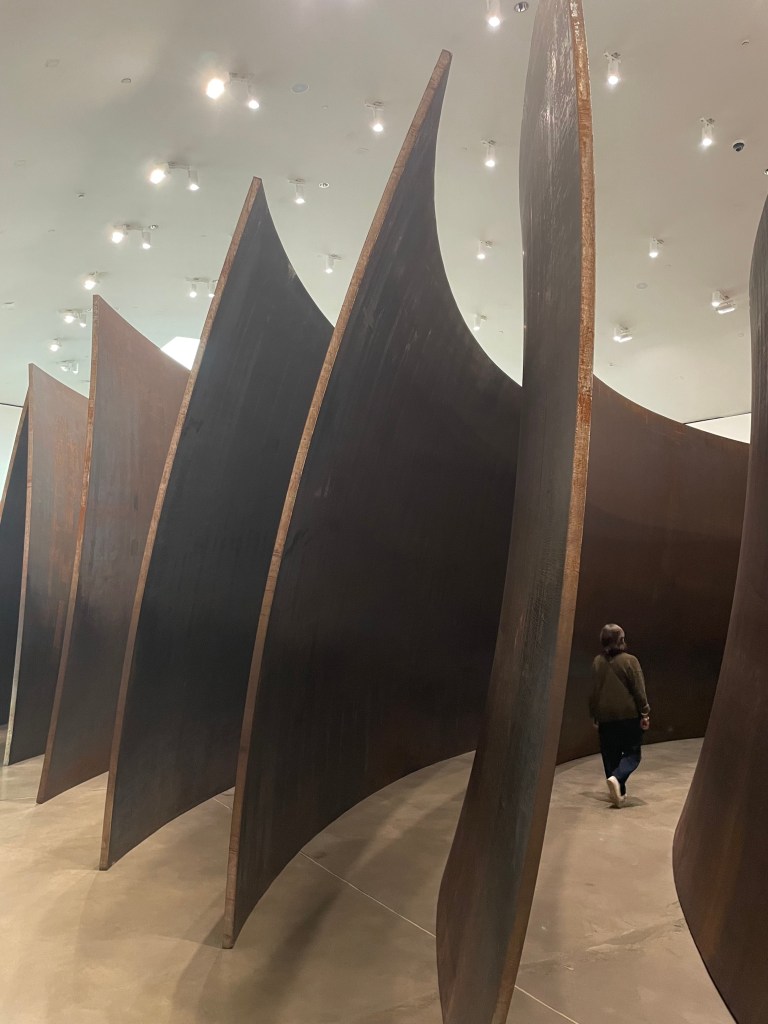
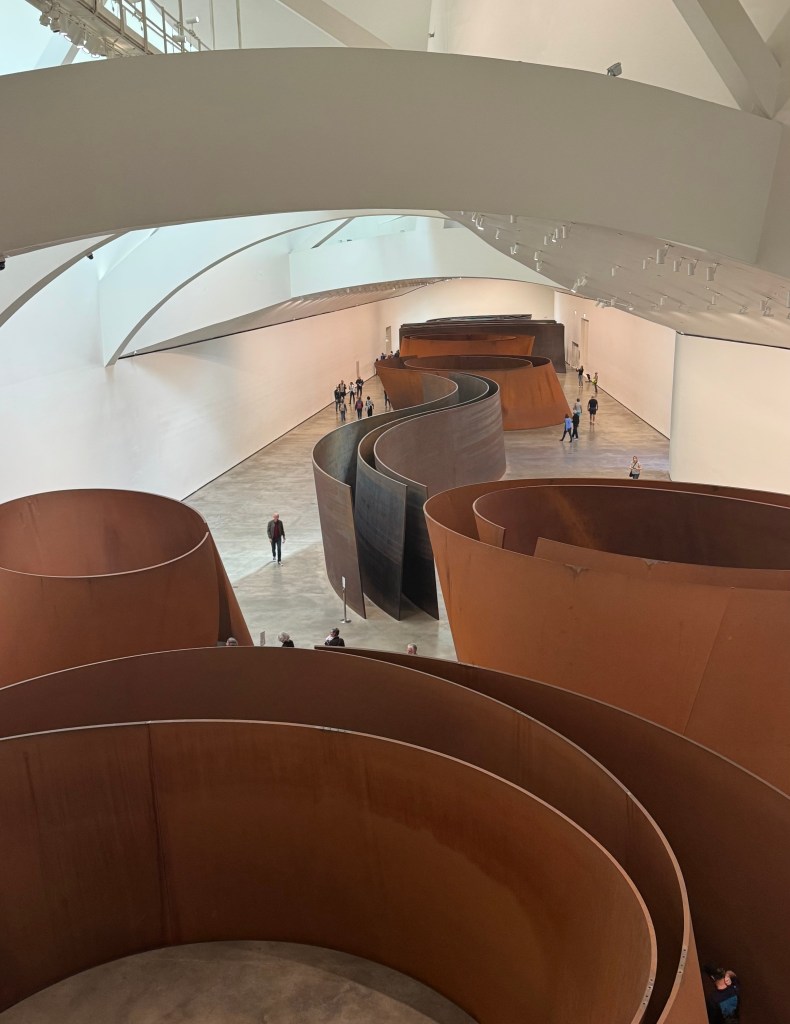
The best exhibit for me was the huge composite sculpture by Richard Serra called ‘The Matter of Time’. It occupies a vast dedicated space on the ground floor of the Guggenheim and was great fun to walk through and around. The balcony above provided an opportunity to take in the scale and entirety of the work while close inspection of the surfaces of the sculpture showed fascinating differences on colour and texture of the Corten (or weathered) steel of which it is made. It’s a highly memorable aspect of the Guggenheim.
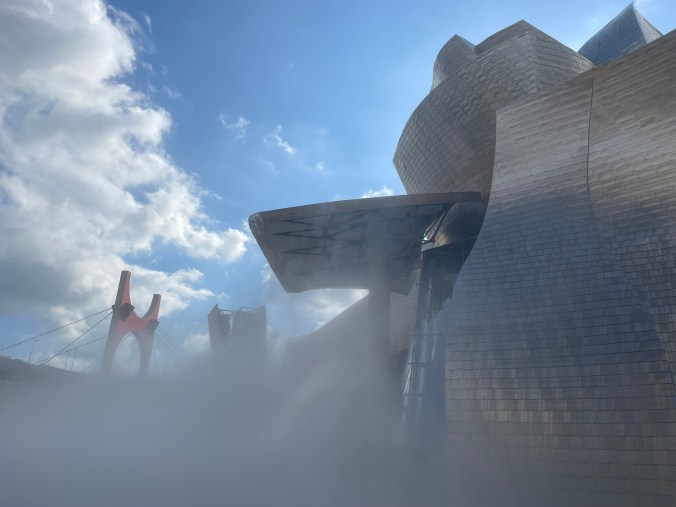
As we emerged from the Guggenheim, we experienced one of the periodic ‘fog sculptures’ designed by Fujiko Nakaya. For a few minutes, the water and promenade next to the museum fills with a mist. Walking through this is an interesting experience and it creates some ghostly views of the museum and its surrounds.
We then walked along the river bank past one of Louise Bourgeois’s Spiders (see below) and made our way to the Bilbao Fine Arts Museum.
This gallery has a lovely Art Deco façade which appeared to be undergoing some restoration. Inside, all was peaceful and spacious and I really enjoyed the visit.
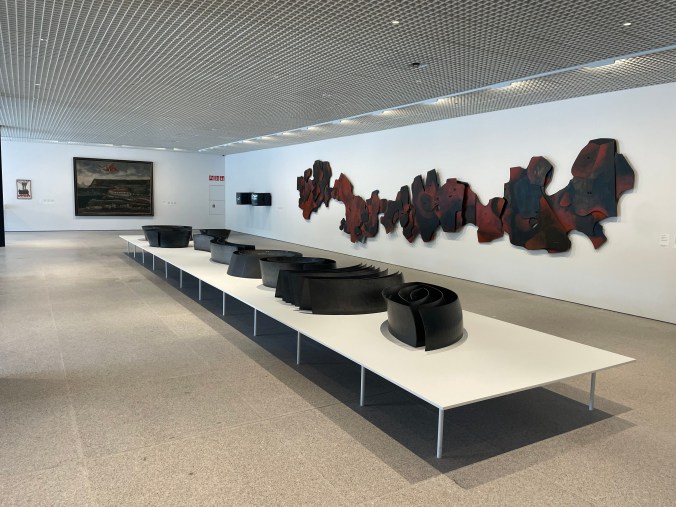
The entrance hall has a wide variety of work which, most interestingly, contained Richard Serra’s model for ‘The Matter of Time’ sculpture we had just seen in the Guggenheim. It was a little weird to see the same work we had just experienced in the Guggenheim on such a smaller scale.
The highlight of the Fine Art Museum was a large exhibition of work by Georg Baselitz, a German artist. I had only vaguely heard of him before; indeed, I had seen and liked a couple of his works that we had seen earlier in the day in the Guggenheim. Here was a very large collection of his portraits.
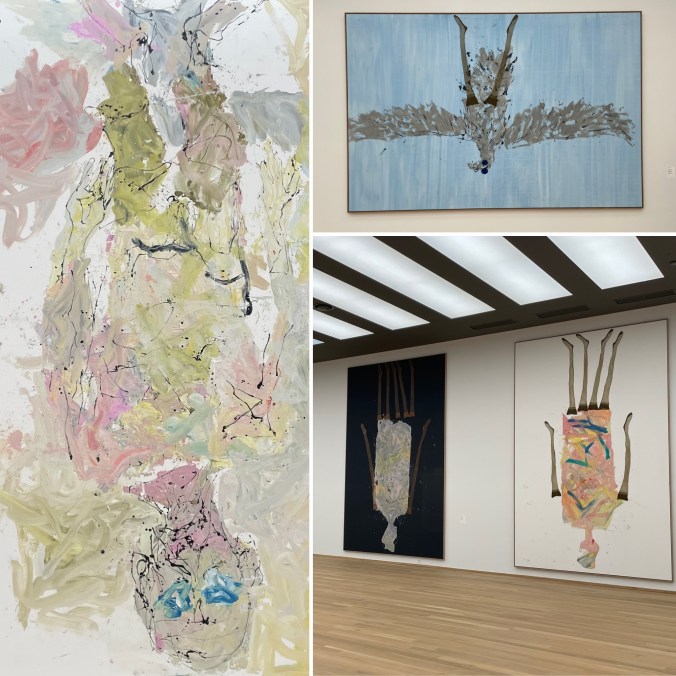
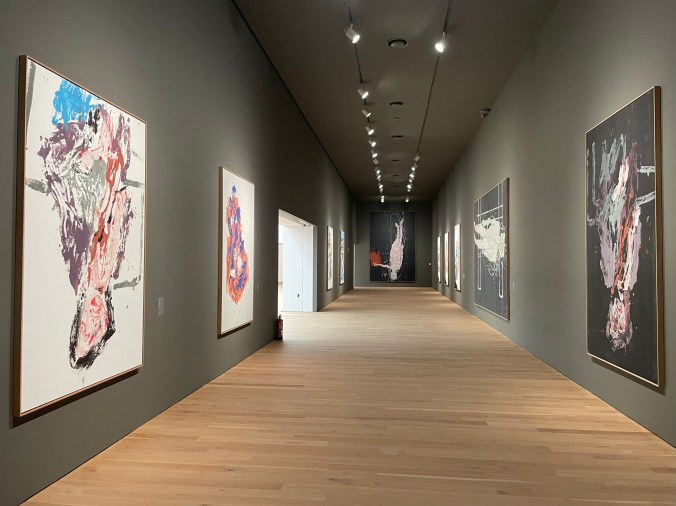
These were mainly of people portrayed either upside down or on their side. Many appeared as figures akin to skeletons. Some had been painted while a disabled Baselitz scooted across the canvas in his wheelchair thereby creating strange tyre track markings across the canvas. This was initially all a bit disorienting – I think that was Baselitz’s objective – but as we walked from huge room to huge room, I got in tune with his paintings and really enjoyed the collective feel of them.
As we left the museum with our culture fix complete, and still two whole days in sunny Bilbao to go, we felt very satisfied with our choice of Bilbao as a city to visit.
 My Retirement Journey