Art in Bilbao

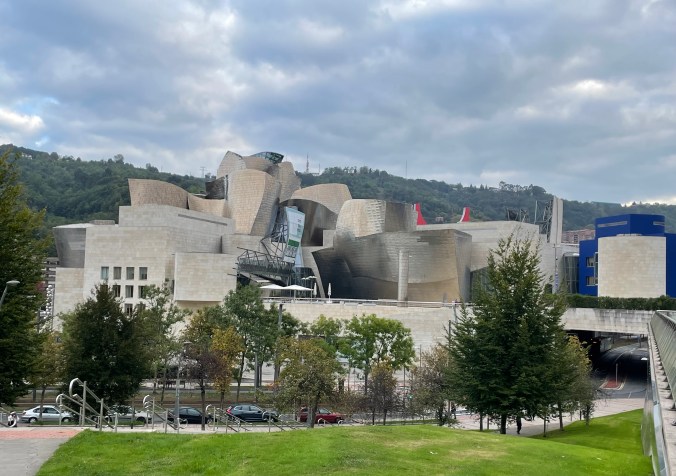
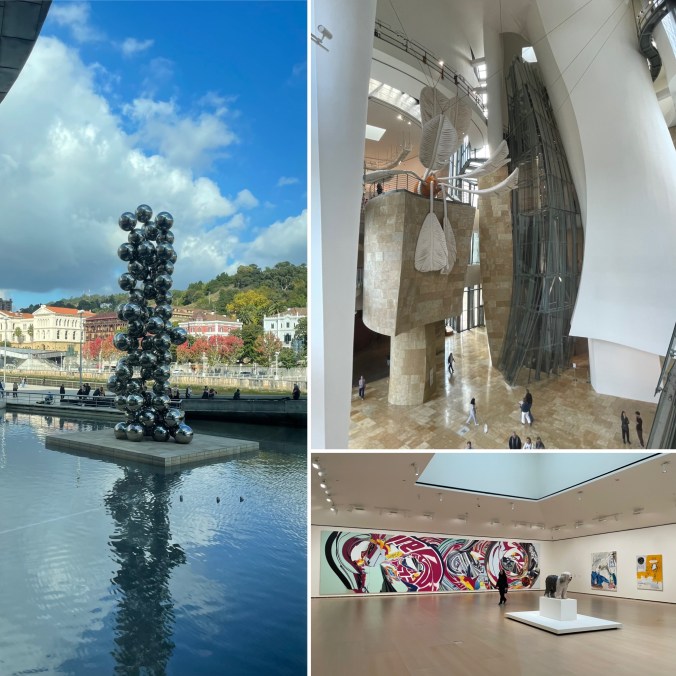
The attraction of the Guggenheim Bilbao Museum was the main reason for us choosing to visit Bilbao.  It is certainly the main tourist magnet in the city and a centrepiece that dominates views downstream from the Old Town and from the slopes to the north of the city.  We visited it straight after breakfast on our first day and, after a quick wander around the amazing building, were ready for entry at opening time.

Approaching The Guggenheim Museum

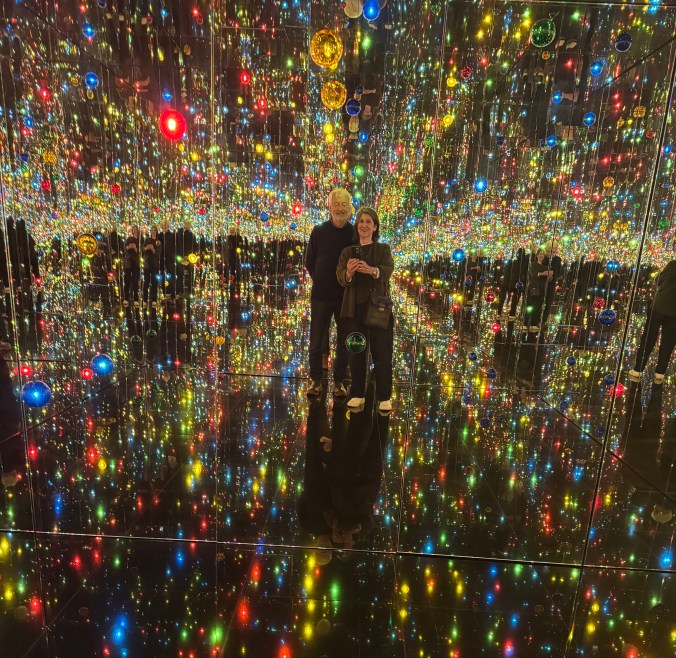
Fortuitously and a little randomly, we went straight to the top floor with a plan of working our way down.  That avoided the initial rush of visitors and enabled us to visit Yayoi Kusama’s ‘Infinity Mirrored Room’ before any queue had built up.  Jane knew what to expect but I didn’t and when we got inside the room containing the work, I was taken aback.  Unfortunately, I then spent more time posing for a picture of the two of us in the mirrors than understanding what I was looking at before we were ushered out with our visiting time having expired.  Our visit made for an interesting photo though….

After that rather helter-skelter experience, we were able to take our time perusing the top floor.  It became clear that some of the permanent collection was not on show at this time.  While that was disappointing, there was plenty to see.

Views From Inside, And Of The Inside, Of The Guggenheim

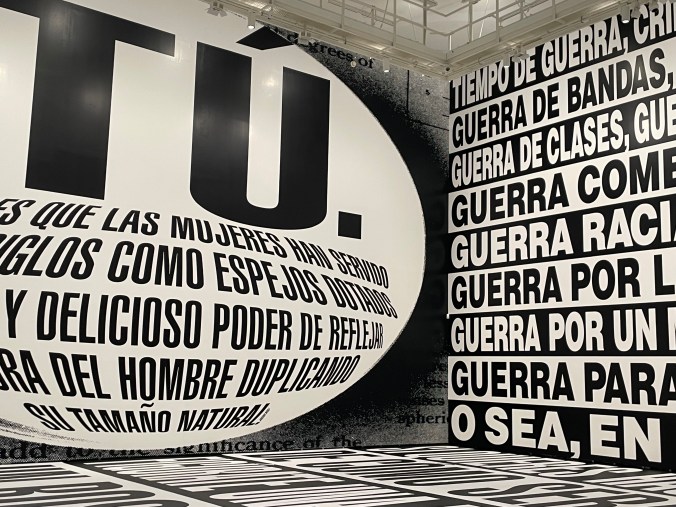
Much of the space on the first floor was taken up by an exhibition custom-made for the Guggenheim by American artist Barbara Kruger called ‘Another day. Another night’.  This was dominated by multiple words and phrases stuck to the walls, ceilings and floors.  These were in Spanish (not unreasonably given we were in Spain!) so I absorbed the overall effect rather than the meanings.  Elsewhere there were video artworks that probed the ambiguity of word meanings and one of these was a rather timely and captivating analysis of the words (and their imagined alternatives) in the US Constitution. 

Barbara Kruger At The Guggenheim

Another temporary exhibition by Sky Hopinka called ‘No Power’ was also a series of videos but I confess I didn’t stay to the end.

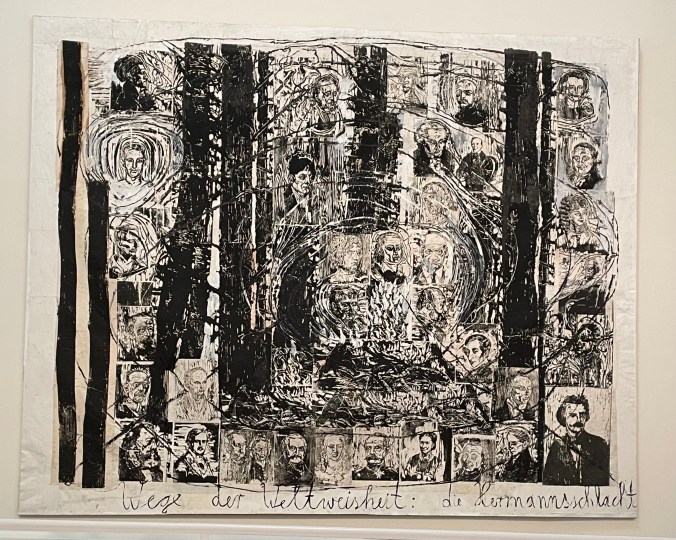
Better, I thought, were the large spaces devoted to variety of artists’ works from the permanent collection though none really gripped me.  The flower sculpture, ‘Puppy’ by Jeff Koons at the entrance to the Guggenheim was undergoing renovation but another of his works was inside alongside art by Jean-Michel Basquiat and a number of artists I hadn’t heard of before.  There was also a typically large painting by Anselm Kiefer who is one of my favourite artists (though this one was a rather dull compared to others I have previously enjoyed).

Familiar Territory - Anselm Kiefer's The Paths Of World Wisdom'
Familiar Territory – Anselm Kiefer’s ‘The Paths Of World Wisdom’

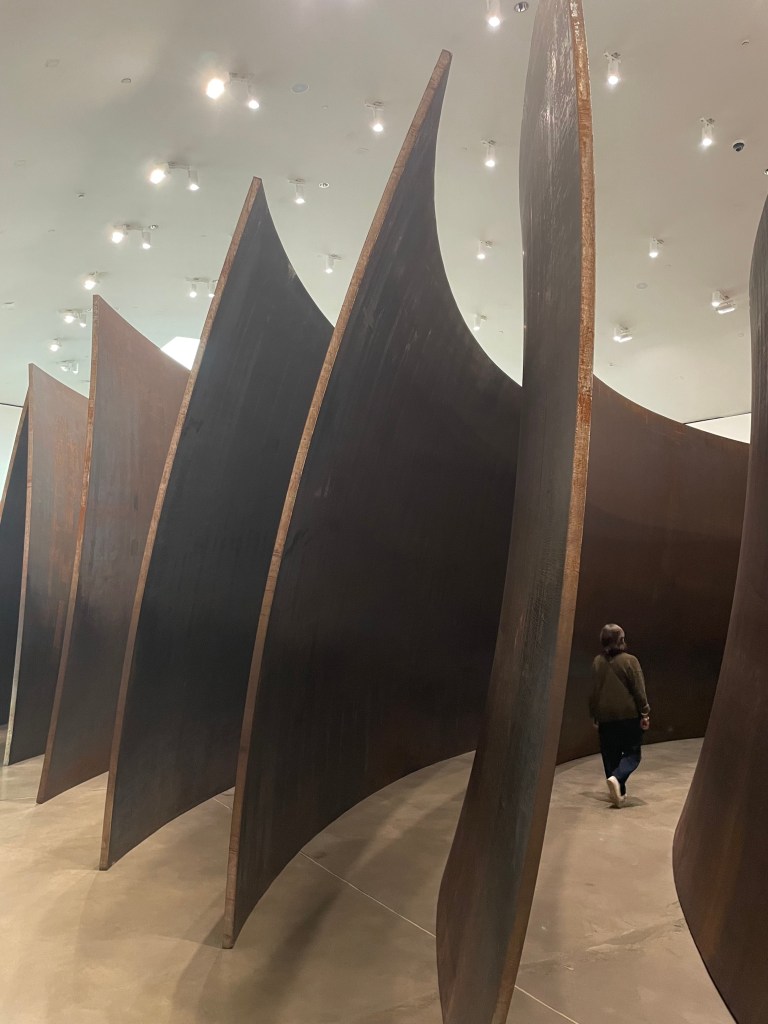
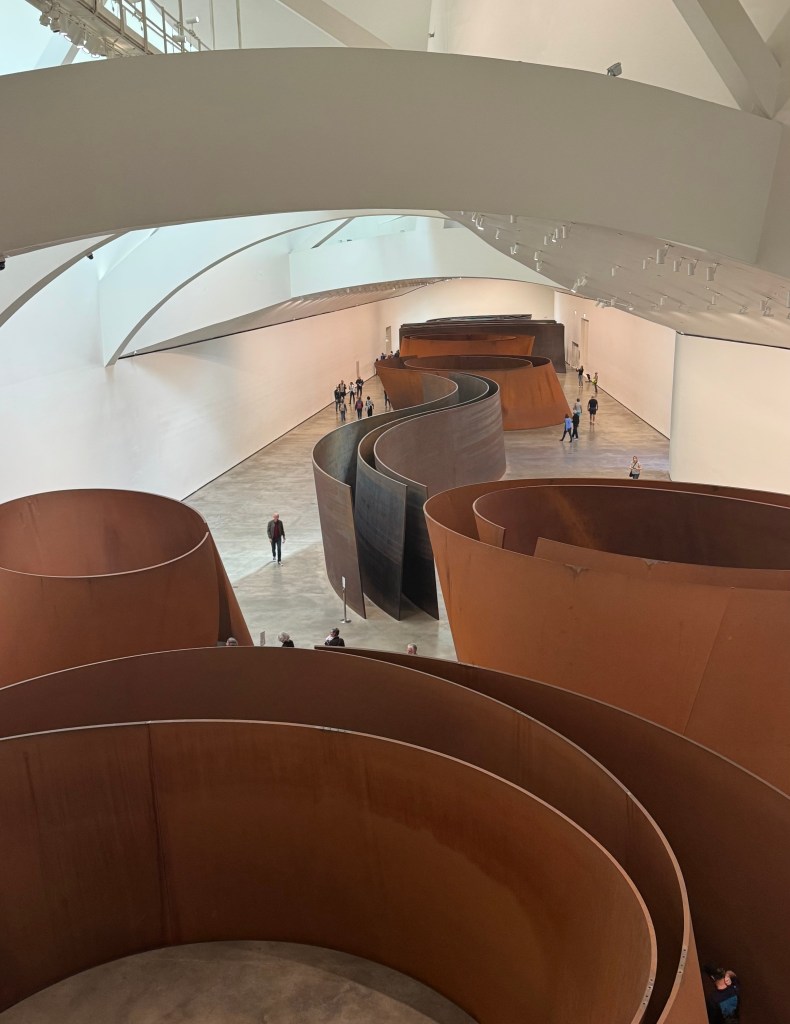
The best exhibit for me was the huge composite sculpture by Richard Serra called ‘The Matter of Time’.  It occupies a vast dedicated space on the ground floor of the Guggenheim and was great fun to walk through and around.  The balcony above provided an opportunity to take in the scale and entirety of the work while close inspection of the surfaces of the sculpture showed fascinating differences on colour and texture of the Corten (or weathered) steel of which it is made.  It’s a highly memorable aspect of the Guggenheim.

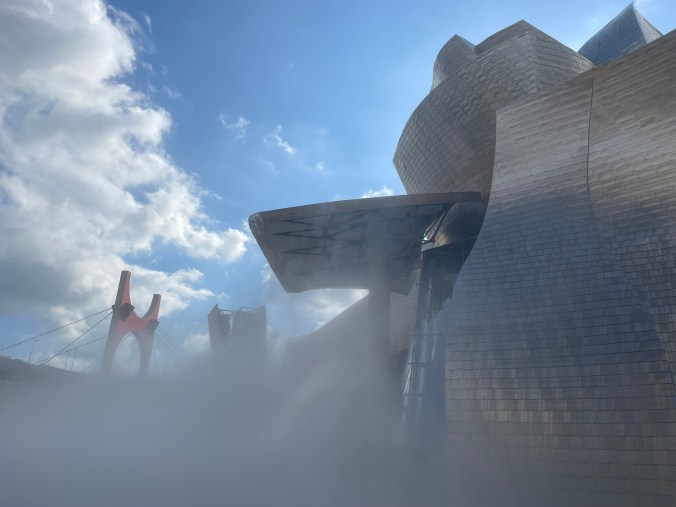
As we emerged from the Guggenheim, we experienced one of the periodic ‘fog sculptures’ designed by Fujiko Nakaya.  For a few minutes, the water and promenade next to the museum fills with a mist.  Walking through this is an interesting experience and it creates some ghostly views of the museum and its surrounds.

Fujiko Nakaya Fog Sculpture
Fujiko Nakaya Fog Sculpture At The Guggenheim

We then walked along the river bank past one of Louise Bourgeois’s Spiders (see below) and made our way to the Bilbao Fine Arts Museum

This gallery has a lovely Art Deco façade which appeared to be undergoing some restoration.  Inside, all was peaceful and spacious and I really enjoyed the visit.

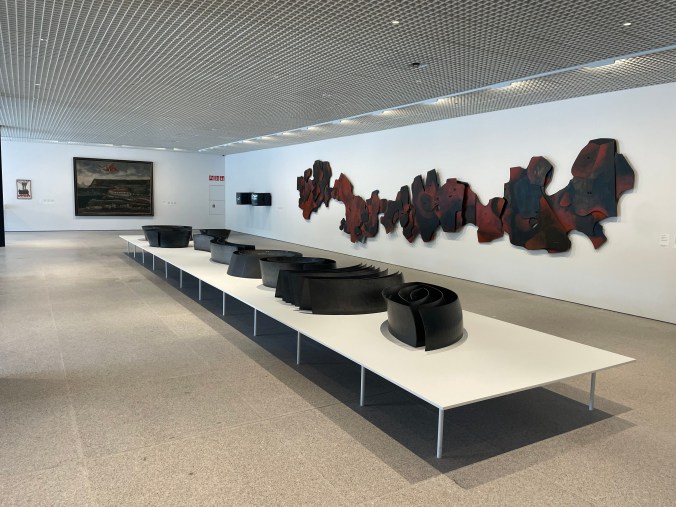
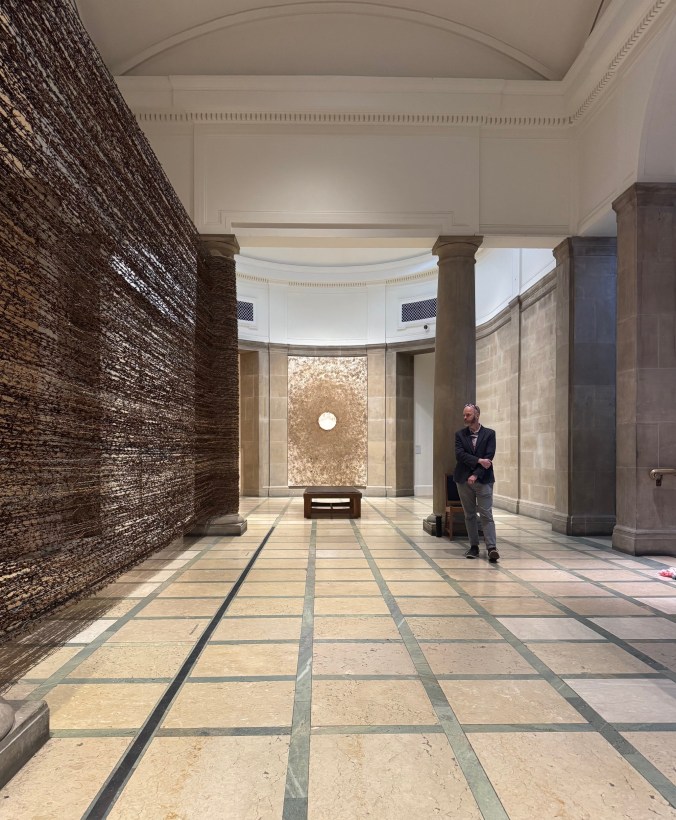
The entrance hall has a wide variety of work which, most interestingly, contained Richard Serra’s model for ‘The Matter of Time’ sculpture we had just seen in the Guggenheim.  It was a little weird to see the same work we had just experienced in the Guggenheim on such a smaller scale.

Bilbao Fine Arts Museum Including The Model Of 'The Matter Of Time' By Richard Serra
Bilbao Fine Arts Museum Including The Model Of ‘The Matter Of Time’ By Richard Serra

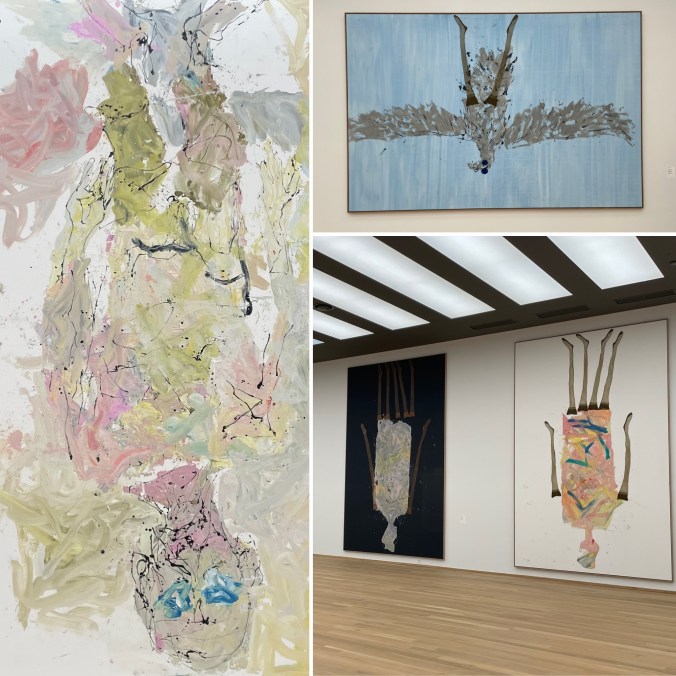
The highlight of the Fine Art Museum was a large exhibition of work by Georg Baselitz, a German artist.  I had only vaguely heard of him before; indeed, I had seen and liked a couple of his works that we had seen earlier in the day in the Guggenheim.  Here was a very large collection of his portraits.

Paintings By Georg Baselitz, Bilbao Fine Arts Museum

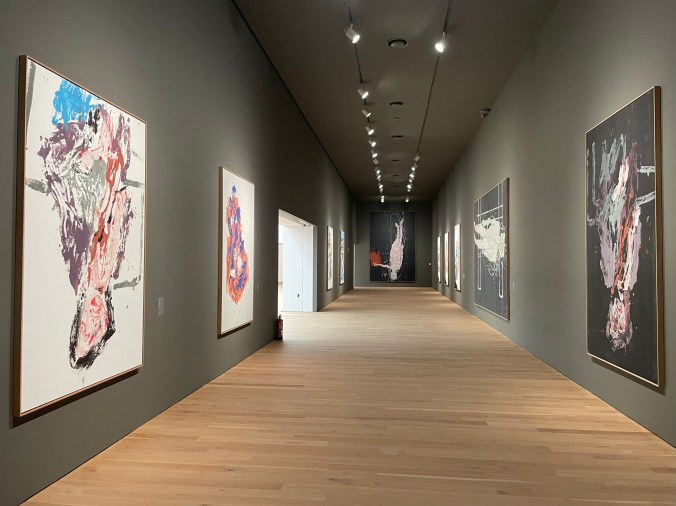
These were mainly of people portrayed either upside down or on their side.  Many appeared as figures akin to skeletons.  Some had been painted while a disabled Baselitz scooted across the canvas in his wheelchair thereby creating strange tyre track markings across the canvas.  This was initially all a bit disorienting – I think that was Baselitz’s objective – but as we walked from huge room to huge room, I got in tune with his paintings and really enjoyed the collective feel of them.

Paintings By Georg Baselitz, Bilbao Fine Arts Museum
More Paintings By Georg Baselitz, Bilbao Fine Arts Museum. A Particularly Good Room I Thought

As we left the museum with our culture fix complete, and still two whole days in sunny Bilbao to go, we felt very satisfied with our choice of Bilbao as a city to visit. 

Andrew Goldsworthy In Edinburgh

In my last post, I mentioned that, during our latest Edinburgh stay, both Jane and I enjoyed the exhibition of Andy Goldsworthy’s art at the National Gallery of Scotland.  This was a celebration of fifty years of his work with natural materials such as clay, reeds and stones and even sheep poo.  I thought it was a tremendous display and I’m only sorry I haven’t paid more attention to him before.

The entrance to the gallery immediately thrusts you into Andy Goldsworthy’s world of sustainable, largely transitory art, and his relationship with nature.  The entrance stairway is partly covered by discarded and stained sheep wool stitched together into a stair runner.  At the top of these stairs was a dramatic piece made of reclaimed barbed wire.  Immediately to the left and right were canvases caked in mud and sheep droppings around a blank space where once there was a sheep lick that attracted the unknowing sheep as participants in the work.  It was an arresting start to the exhibition.

'Fence' (left) And One Of Two 'Sheep Paintings' (2025) by Andrew Goldsworthy at The Scottish National Gallery
‘Fence’ (left) And One Of Two ‘Sheep Paintings’ (2025) By Andrew Goldsworthy at The Scottish National Gallery

Many of the works were constructed by Goldsworthy specifically for the space afforded by the Gallery.  For example, one room was filled with rocks gathered from 108 graveyards in Dumfries and Galloway where piles of surplus stone have built up as graves have been dug.  (I confess that this was actually the only work I was not impressed by).  Another room, with a lovely skylight, was hung with hundreds of bullrush stalks.  Elsewhere, an entire wall was covered with dried and, therefore, cracked mud that is bright red/orange from the iron it naturally contains.

'Red Wall' By Andrew Goldsworthy (2025)
‘Red Wall’ By Andrew Goldsworthy (2025)

The centrepiece on the first floor of the exhibition was a corridor of oak branches.  At one end was a beautiful twisted collage of fern leaves and at the other a circular array of long reeds.  The whole room was very memorable.

'Oak Passage' by Andrew Goldsworthy (2025)
‘Oak Passage’ by Andrew Goldsworthy (2025)

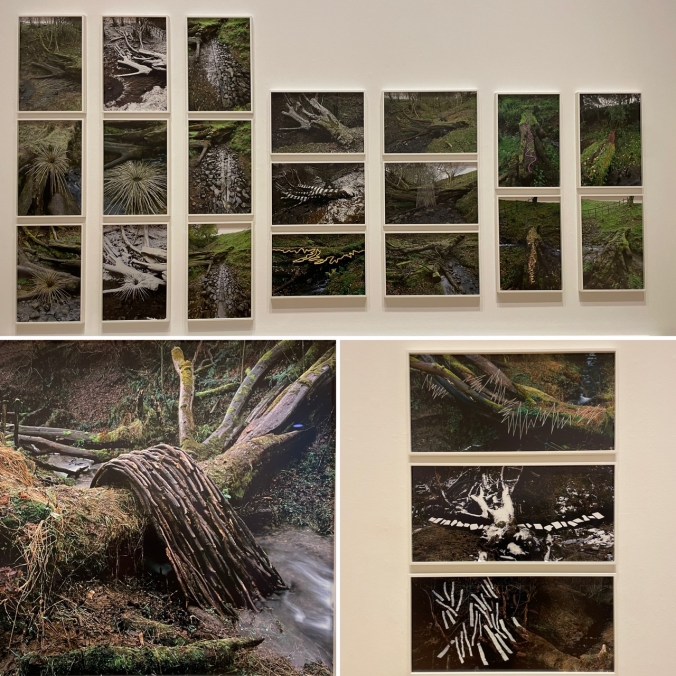
Indeed, every room was memorable.  I particularly liked the room devoted to photographs of Goldsworthy’s manipulations of sheep wool, stones, reeds and leaves to develop images of a fallen, dead elm tree.  I presumed that all the photographs here were shot by Goldsworthy himself but there were other videos and photos that involved others; I wondered who they were.

'Fallen Elm' By Andrew Goldsworthy (2009 And Ongoing)
Examples Of The ‘Fallen Elm’ Series By Andrew Goldsworthy (2009 And Ongoing)

Throughout the exhibition there were unpretentious explanations of what we were seeing and what Goldsworthy was trying to do – even the three works made from dripping hare blood and snow onto paper. 

By the time I got to the end of the exhibition where Goldsworthy’s early work was shown, I felt that perhaps these might have been shown at the start to show the chronological development of his ideas.  But, as Jane pointed out, that would have made the exhibition entrance less impactful.  Fair point; anyway, it was one of the best art exhibitions I have seen and I recommend it to anyone in Edinburgh before very early November 2025.

Art and Architecture in Basel

I am not an art connoisseur but I do enjoy visiting art galleries; indeed, we both do.  Whilst we were in Basel for my birthday, and as the weather turned from sun to cloud to rain, we went indoors to see the Kunstmuseum, Fondation Beyeler and the Swiss Architecture Museum.  Each was impressive in different ways and we enjoyed visiting them all very much.

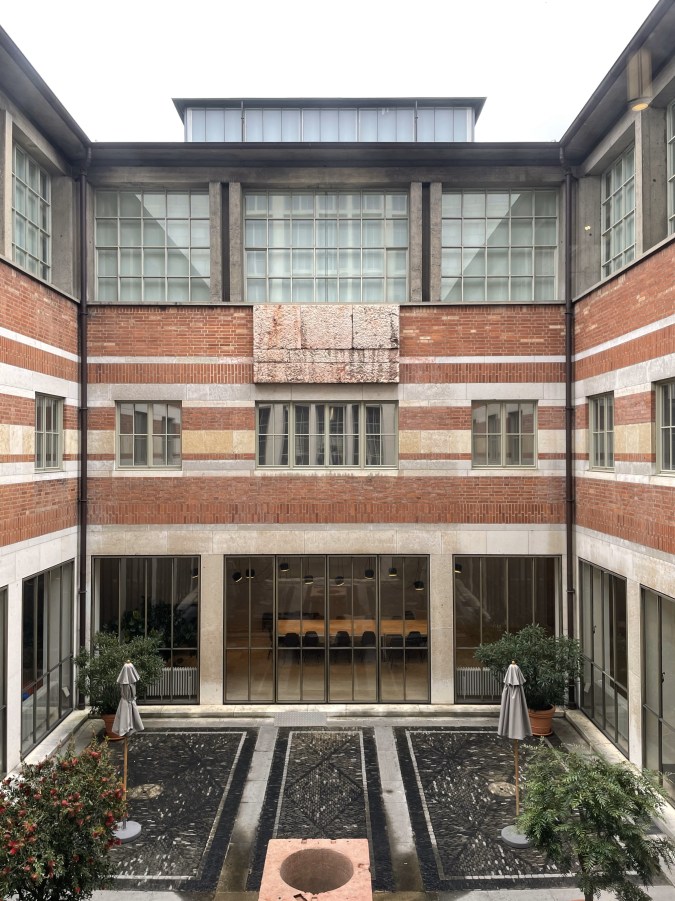
Basel Kunstmuseum (Hauptbau - Main Building)
Basel Kunstmuseum (Hauptbau – Main Building)

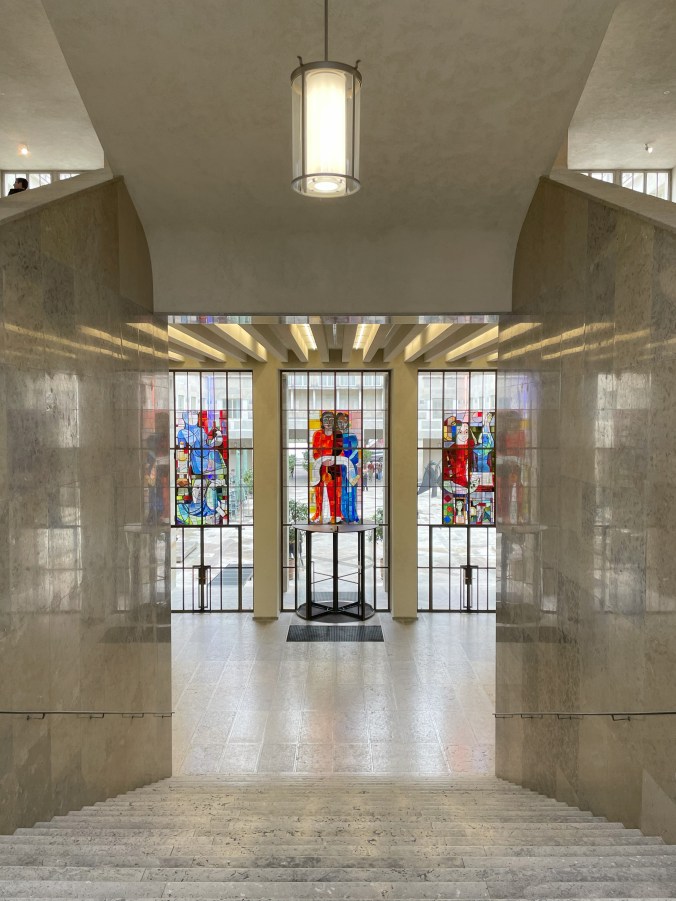
The collection at the Kunstmuseum Basel is very extensive and diverse.  It is housed in three different buildings.  The first was built in the 1930’s and is a beautiful building from that era that is full of great art from the 15th century to the middle of the 20th century.  The colours throughout the building are subtle and earthy, and the stairwell was as impactful as some of the art.

Inside Basel Kunstmuseum (Hauptbau - Main Building)
Inside Basel Kunstmuseum (Hauptbau – Main Building)

We started gently in a side room where the curators had paired pieces from different genres and periods and exhibited them side by side.  This was in an effort to trigger new comparisons and feelings that would not be prompted if the works were seen alone.  I didn’t always see the connections in the pairings but some were more obvious and fun to spot. 

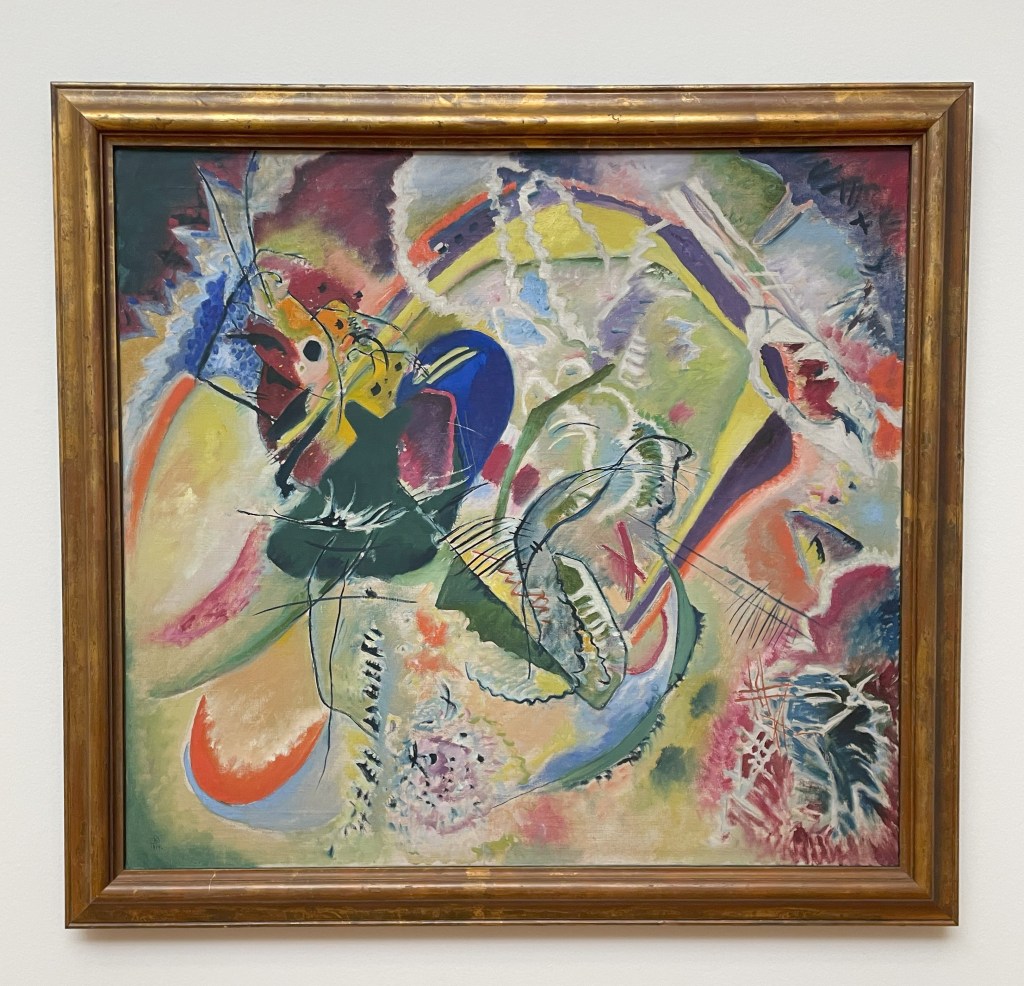
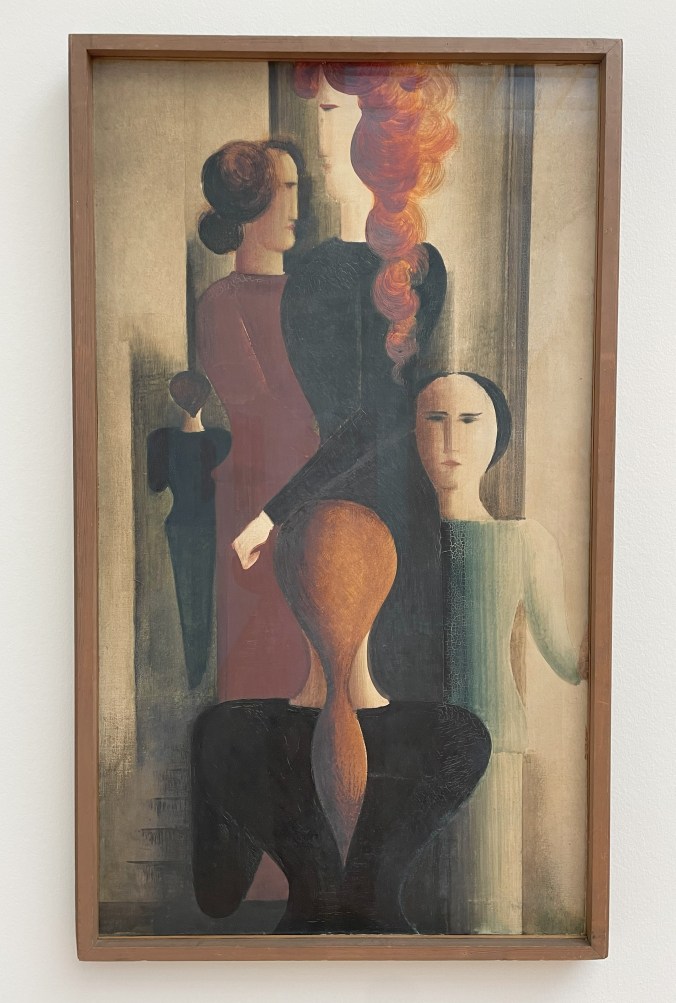
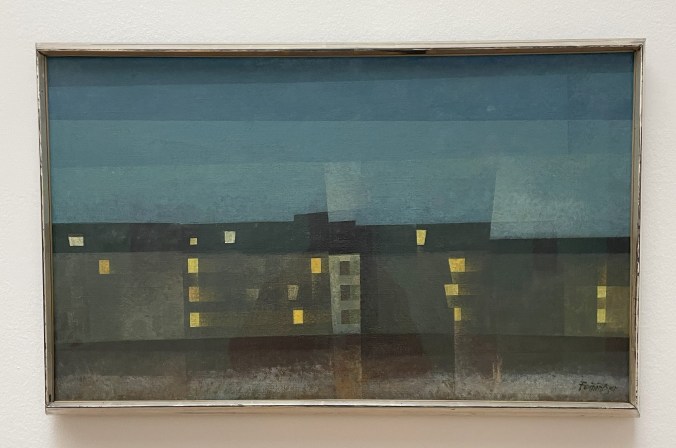
We both spent more time upstairs amid works from the early 20th century.  Here too I had fun recognising some of artists before reading the explanatory captions alongside the works.  There was representation of almost every western-mainland European artist I could think of plus many I was unfamiliar with. (I only spotted two works by English and American artists).  The quality was consistently very high and here are two I particularly liked….

'Women on a Stairway' By Oskar Schlemmer
‘Women on a Stairway’ By Oskar Schlemmer
'Illuminated Windows' By Lyonel Feininger
‘Illuminated Windows’ By Lyonel Feininger

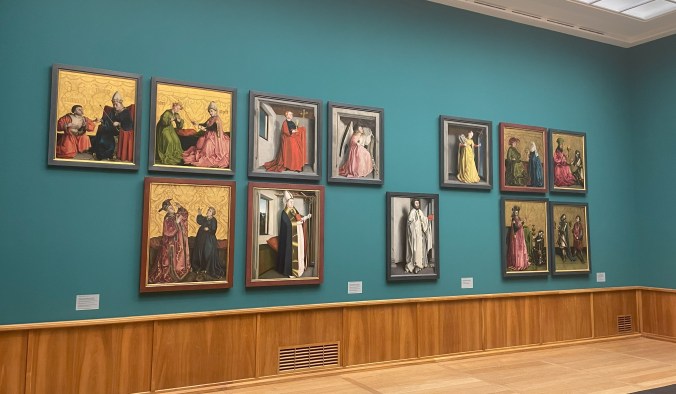
By the time I had finished with the 20th century art on the first floor, I was tiring.  However, as I moved into areas showing the 15th to 19th century art I was revitalised again by the range and quality.  I skipped through some of the rooms displaying early religious work – although, not for the first time, I was astonished by the vibrancy of the colour given that most of these works are over half a millennium old. 

Vibrant Religious Works In Kunstmuseum Basel
Brightly Coloured 15th Century Religious Works In Kunstmuseum Basel

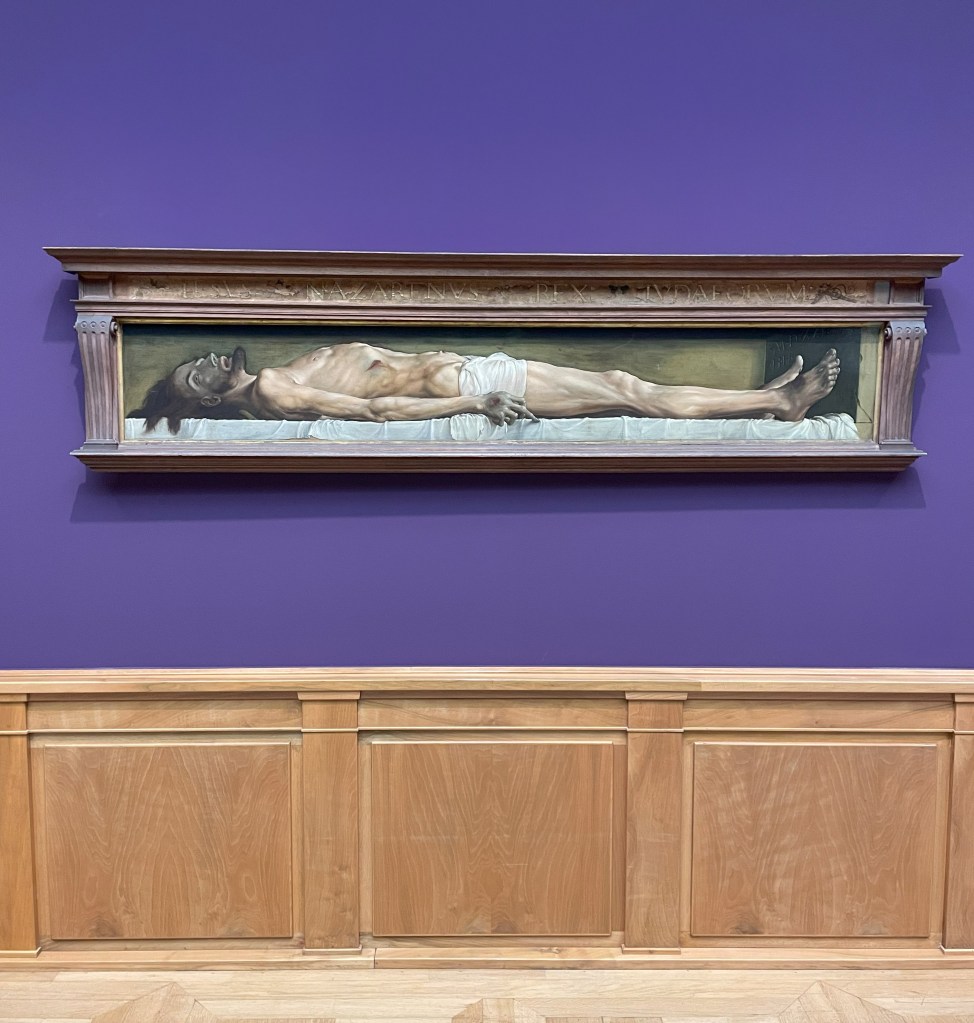
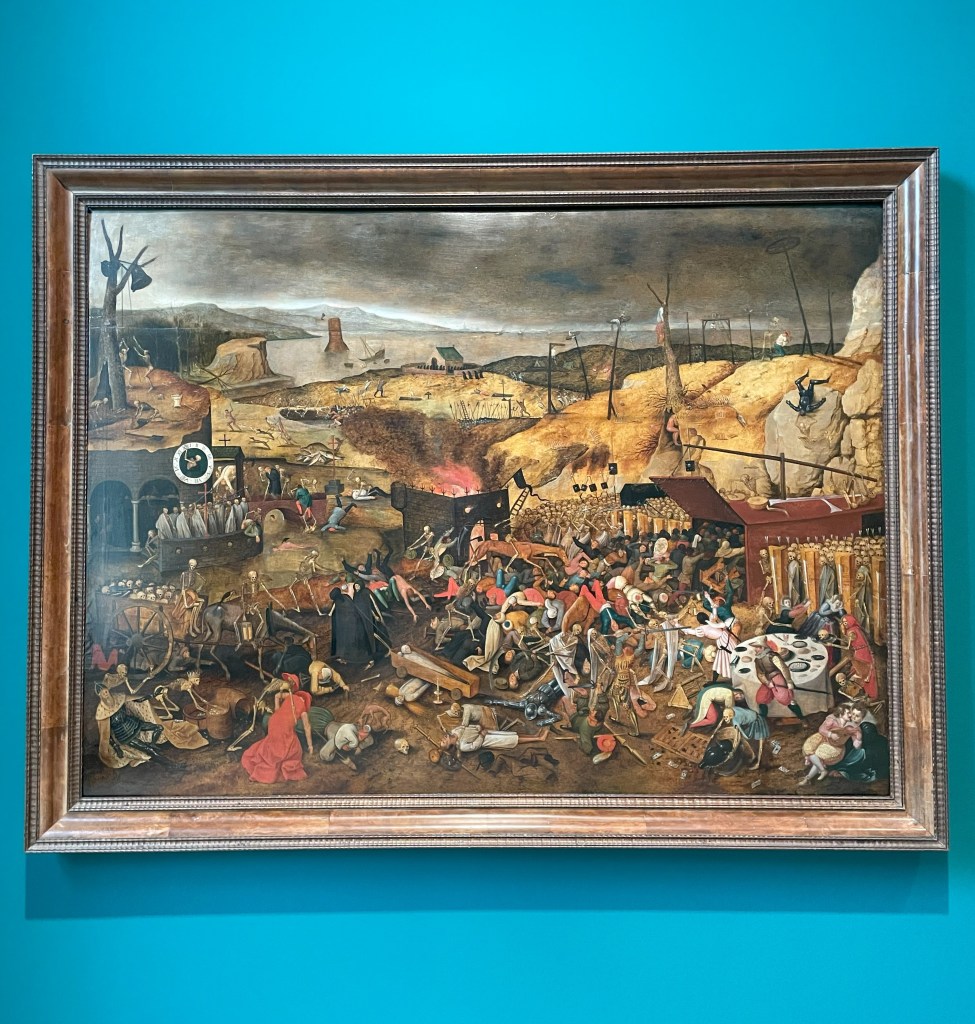
My favourite paintings in this section were one by Pieter Bruegel, whose detailed crowd scenes I always find interesting, and those by Hans Holbein (the Younger).

I slowed again as we came to the 18th and 19th century sections and really enjoyed painting after painting.  I especially enjoyed a room of Dutch still lives.

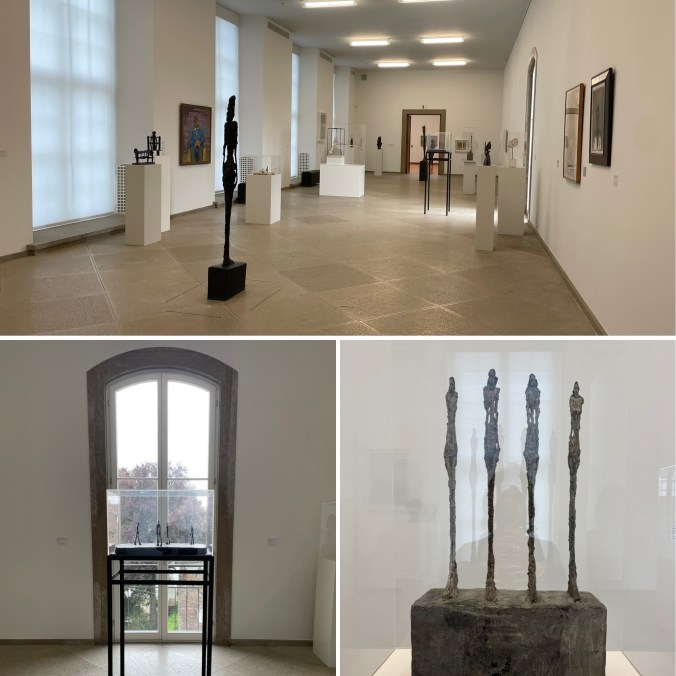
To be honest I thought I was done but there was still more early 20th century art to see including a whole room dedicated to Alberto Giacometti sculptures (I hadn’t previously realised that he was Swiss!).  And this was just the first building……

The Giacometti Room, Kunstmuseum Basel

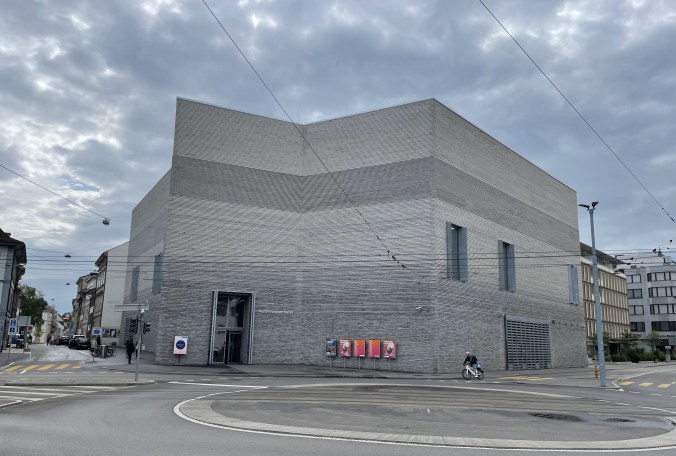
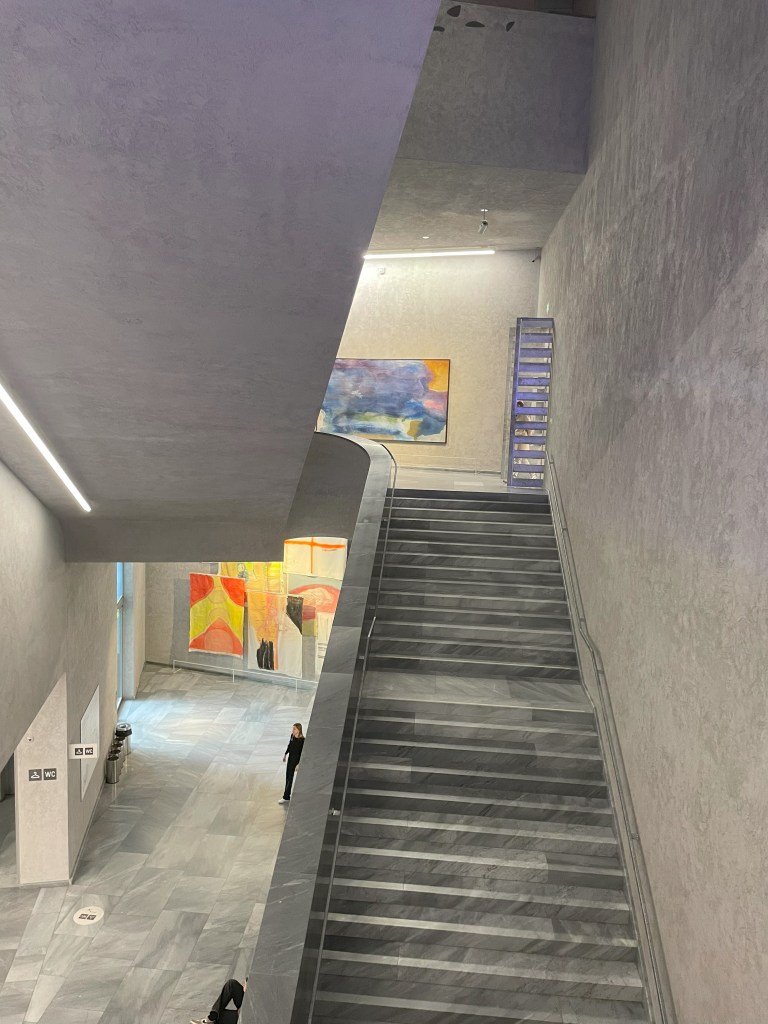
The second Kunstmuseum building was built in 2016 and is a radical design resembling a slightly crumpled grey box.  Inside, the look is very contemporary with bare grey surfaces and art dating from 1950. 

Basel Kunstmuseum (New Building)

Frankly, I was sated with art by this time.  I walked around the floors but found the modern art even harder to fully take in than usual, especially as not all the information was provided in English and so the backstory to the artists and work was harder to grasp.  However, I did like an Alexander Calder mobile in the entrance hall and the overall ambiance of the place.

We didn’t make it to the third Kunstmuseum building which is for temporary exhibitions.  Instead, we stopped off at the Swiss Architecture Museum.  This had a couple of ongoing exhibitions on display. 

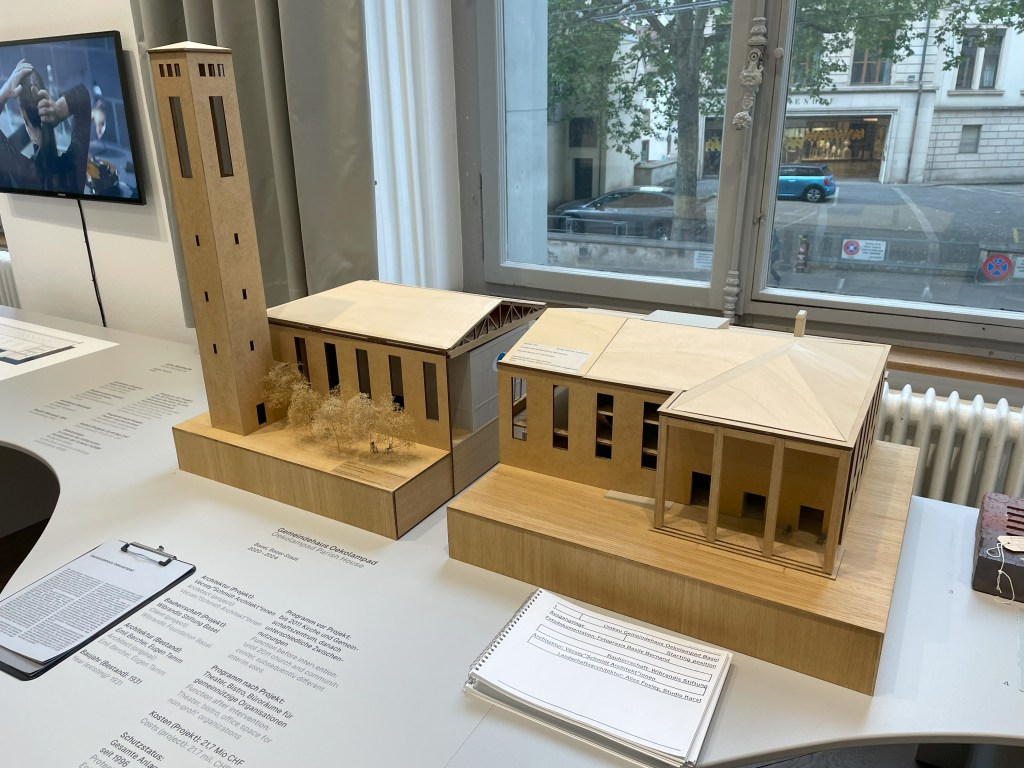
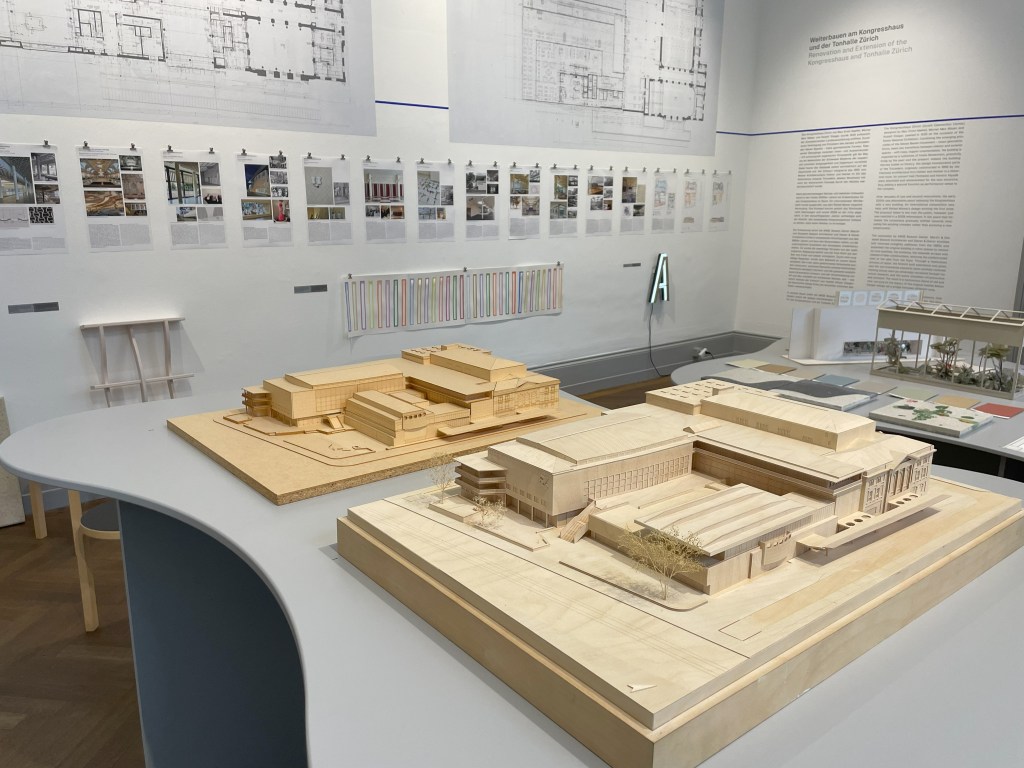
By far the most interesting was that showing recent Swiss developments demonstrating renewal and renovation of buildings rather than their demolition and replacement.  Not only is replacement more eco-friendly but it preserves a continuum of history. This was a theme of the European Architectural Heritage Year of 1975 and the exhibition we saw was a celebration of the 50th anniversary of that event.

Models of Renovated/Restored Buildings On Show At The Swiss Architecture Museum

Some of the developments portrayed were quite small – individual houses or community buildings – while others were large and included the Kongresshaus and Tonhalle in Zurich.  The museum was well worth an hour or so of our time even as laypeople in the architecture world.

Our last day in Basel was forecast to be wet and, indeed, it rained all day.  We had planned for this and set off on a tram to Fondation Beyeler a few miles outside the city.  We knew that the main art gallery – another very impressive collection apparently – was closed to visitors, but we were very keen to see the well-reviewed exhibition of art called ‘Northern Lights’.  This was focused on representations of the boreal forest around the Arctic Circle by Canadian, Scandinavian and Russian artists.

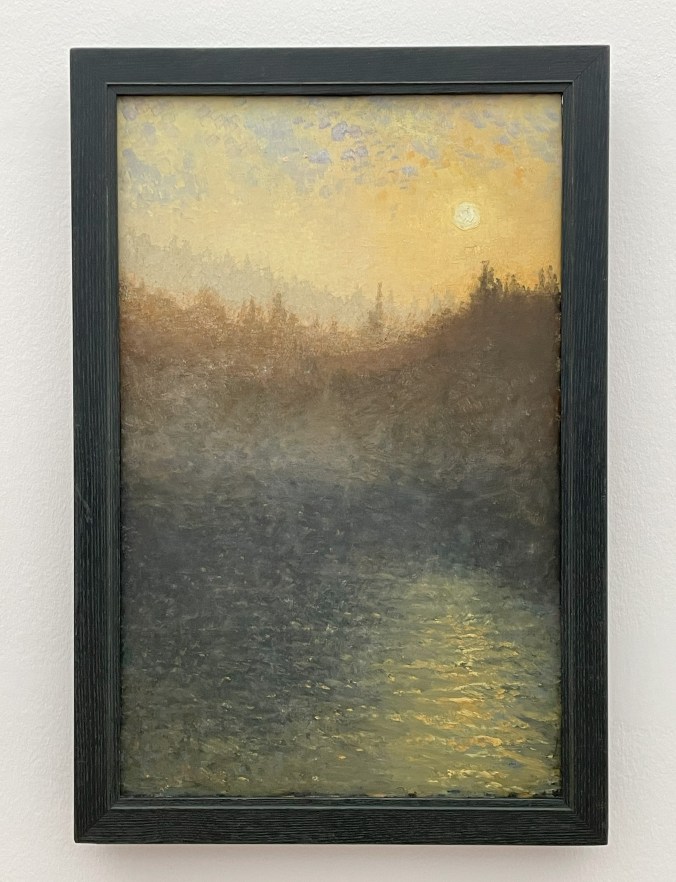
I was particularly keen to see works on show by Hilma Af Klint.  I had not heard of this Swedish artist until I heard children at a local school read about her during my volunteering to help ‘unconfident readers’.  Her two works on show here was very different from her later symbolism and portrayed the eeriness of the forest.

'Sunrise' By Hilma Af Klimt
‘Sunrise’ By Hilma Af Klimt

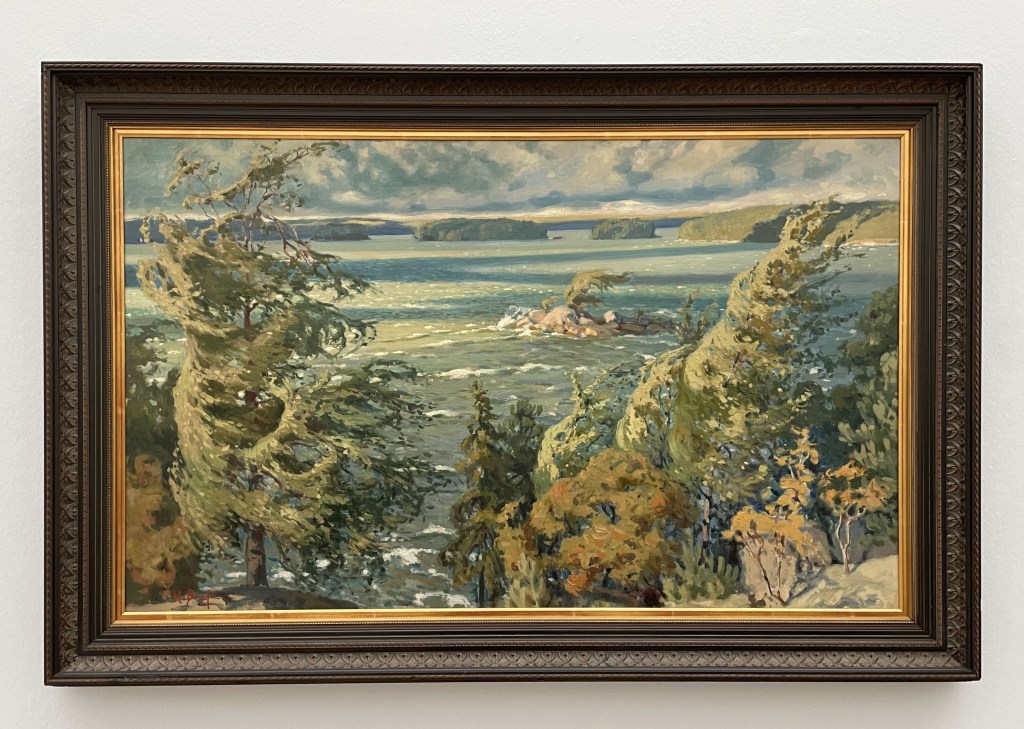
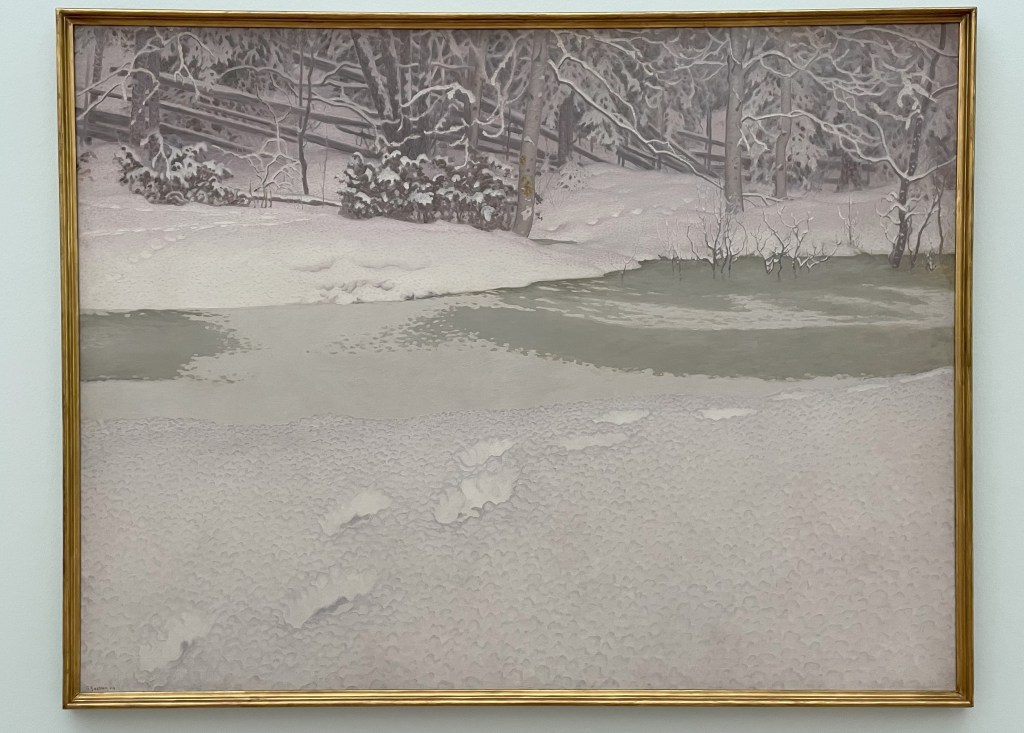
To be honest though, there were paintings in the exhibition that I enjoyed more and all were by artists I had never heard of before.  Both of us really enjoyed a few of the works by another Swede: Akseli Gallen-Kallela.  These were some of my favorites of his:

'Spring Night' By Askeli Gallen-Kallela At The Northern Lights Exhibition, Fondation Beyeler
‘Spring Night’ By Askeli Gallen-Kallela At The Northern Lights Exhibition, Fondation Beyeler
Four More Paintings By Askeli Gallen-Kallela
Four More Paintings By Askeli Gallen-Kallela Including ‘Mantykoski Waterfall’ (Left)

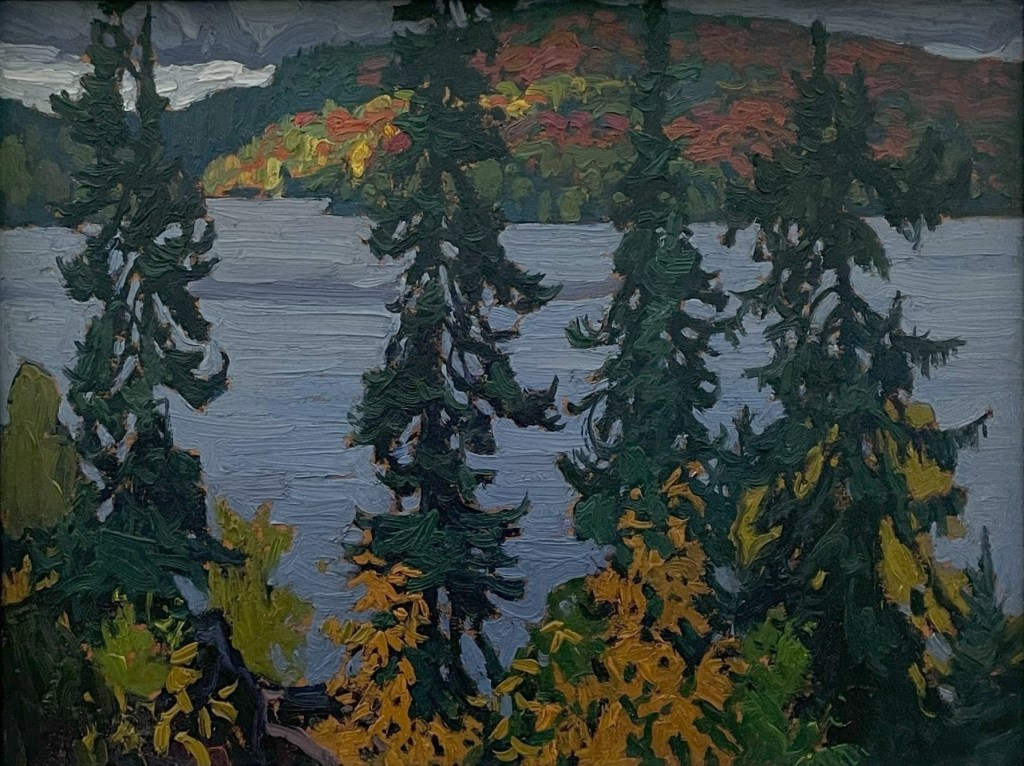
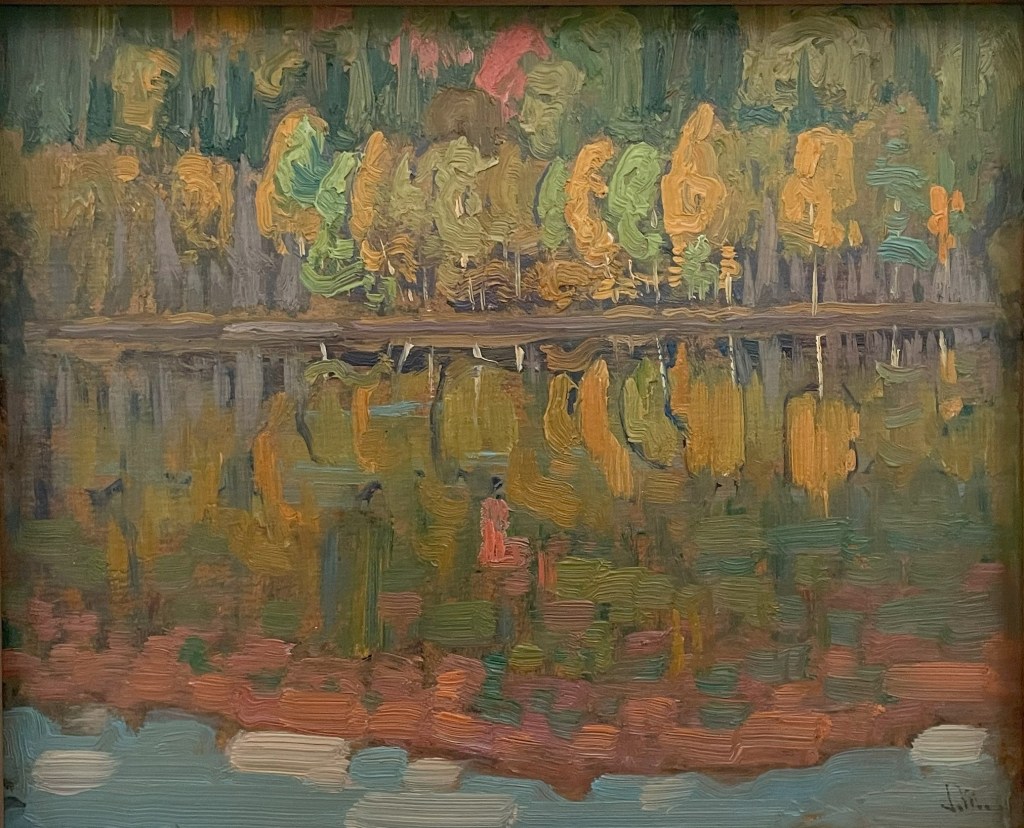
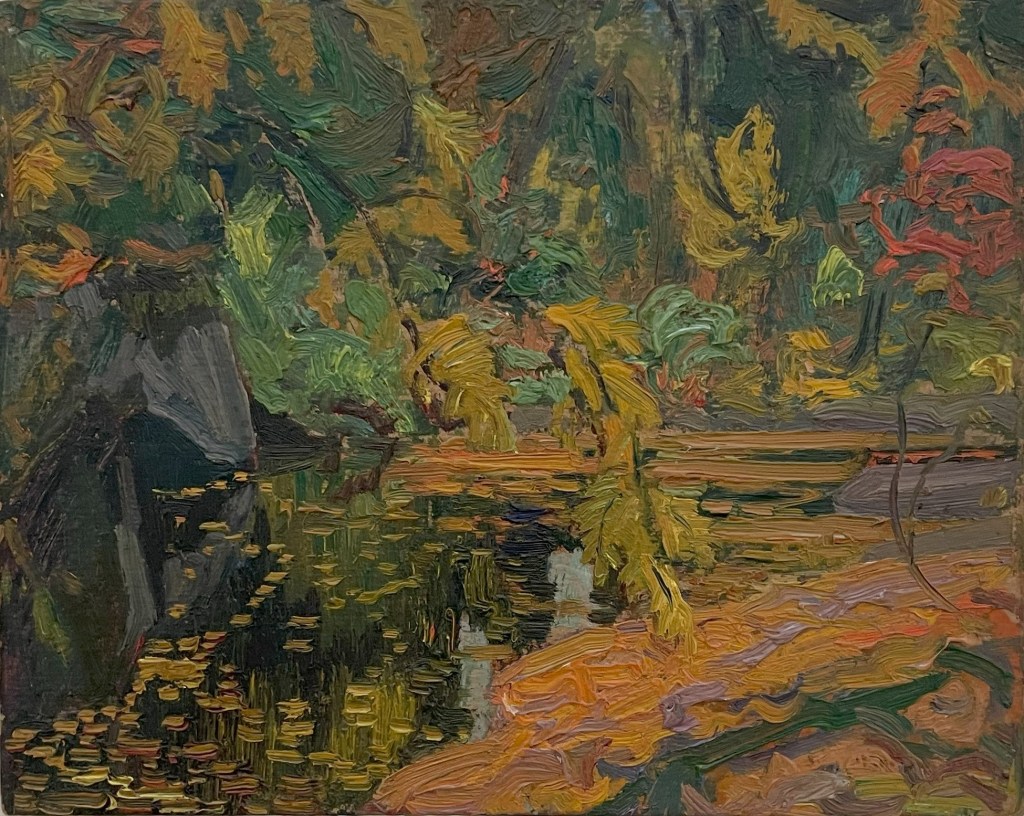
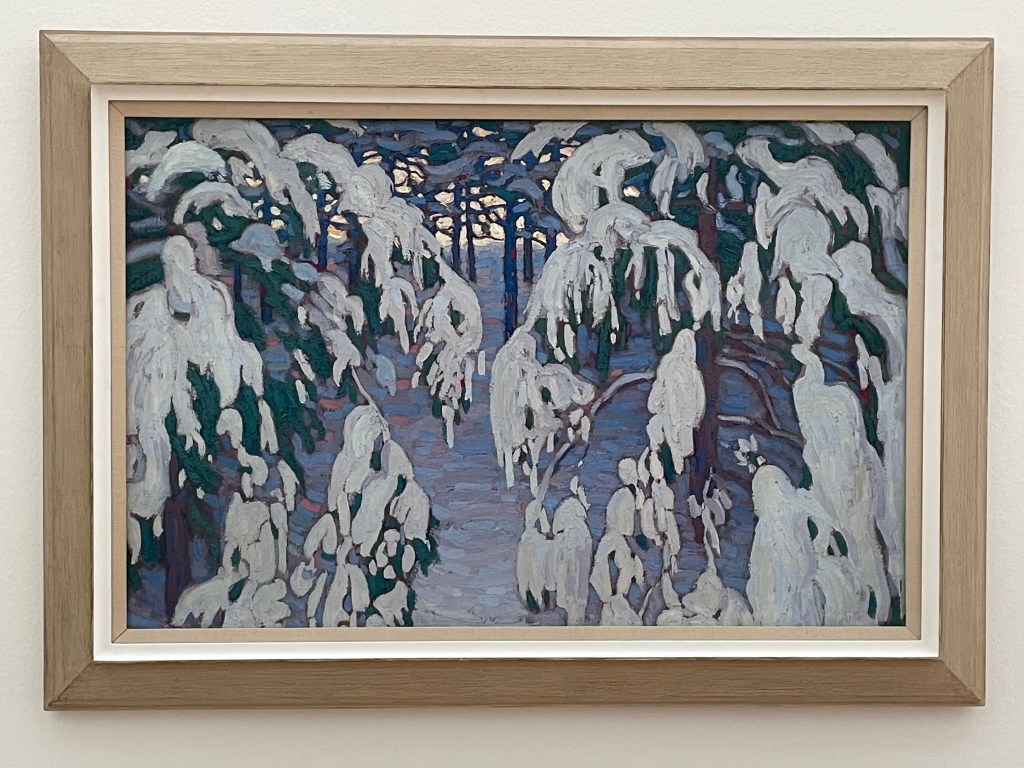
I also really enjoyed the last room of smaller paintings.  Several were by Canadians including Tom Thomson including one of a canoe he used to row out onto lakes and which, sadly, he ultimately disappeared in, and J. E. H. MacDonald who was originally from the UK. 

Paintings By Lawren Harris and J. E. H. MacDonald

Many of the paintings in the exhibition gave a strong impression of the cold of the forest.  Apart from a couple which showed the wind in the trees, they also had a calm, silent, atmospheric quality.   

Throughout the exhibition, the presentation and the information provided was first class.  Both of us liked the fact that the explanatory captions for each art work were on the floor rather than alongside the paintings.  I wonder why this tactic isn’t employed in other galleries.

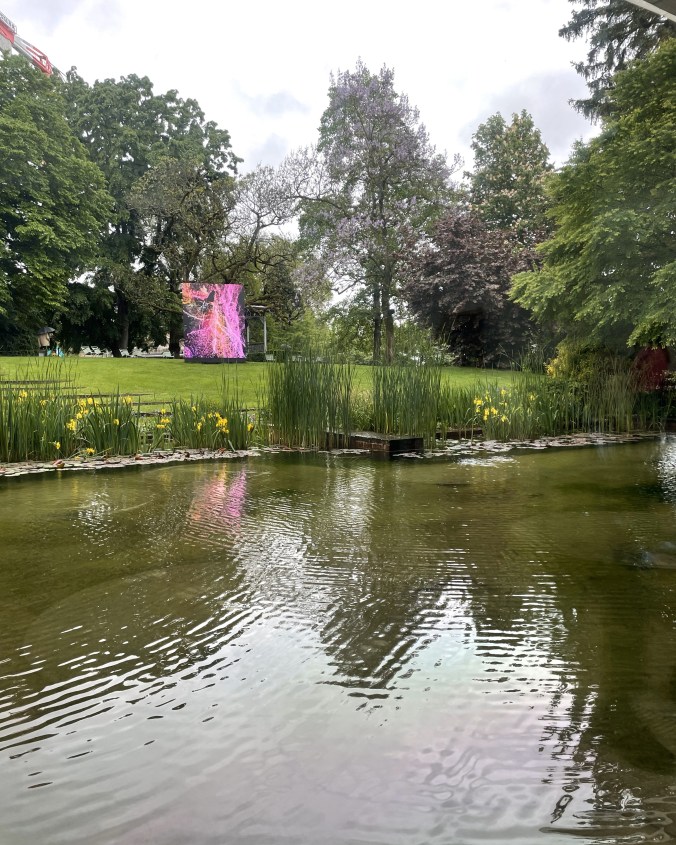
As we left Fondation Beyeler, following very tasty lunch there, we saw some filming going on in the pretty but wet gardens.  Jane overheard that it was related to the Eurovision Song Contest that was gearing up for the finals a week or so later.  I’m certainly glad our excellent, uncrowded visit to Basel didn’t happen to coincide with that!
The Garden, Fondation Beyeler

Edinburgh: Graveyards and Galleries

I have always been interested in visiting old graveyards.  They are generally quiet places for reflection, a secluded refuge for wildlife, and also a rather oblique representation of history and of lives lived.  For me, those characteristics more than offset any feeling of sadness or mournfulness derived from their function. 

Edinburgh has a number of graveyards in or near its centre.  While Jane was resting her broken arm, I took the opportunity to visit a few. 

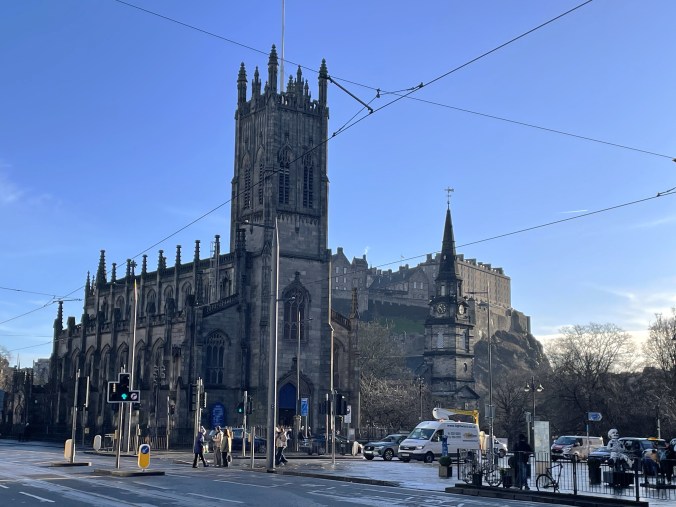
St John’s and St Cuthbert’s Churches At The End Of Princes Street

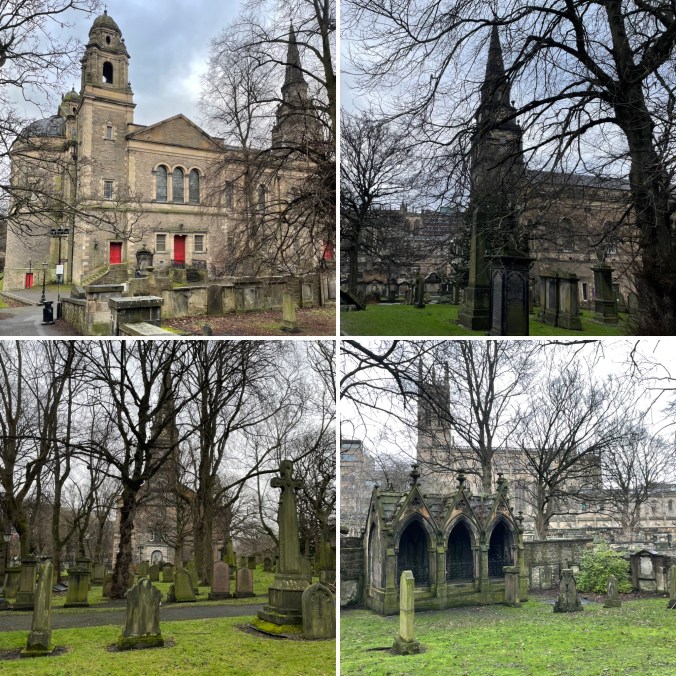
At the west end of Princes Street is Saint Cuthbert’s Churchyard. It seemed to be the nearest cemetery to our holiday flat.  This is a very old graveyard with burials believed to have dated from the 14th century and probably much earlier.  It is one of a few graveyards in Edinburgh that has a watchtower, built in the 19th century, for guards aiming to prevent bodysnatching for the purposes of medical science.

St Cuthbert’s Churchyard Between St Cuthbert’s And St John’s Churches

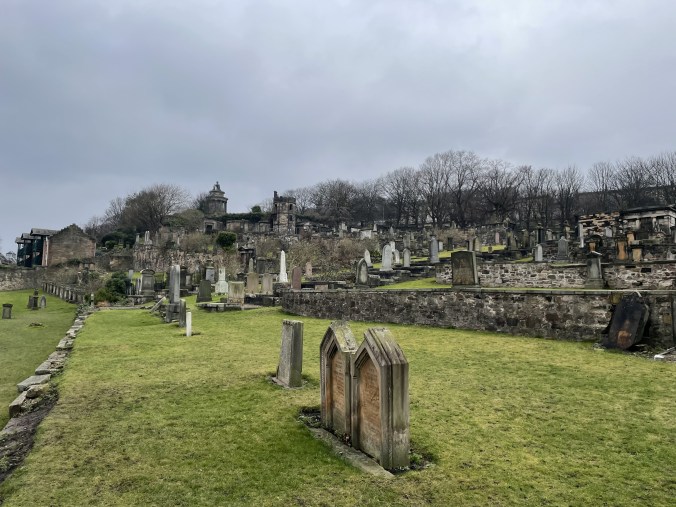
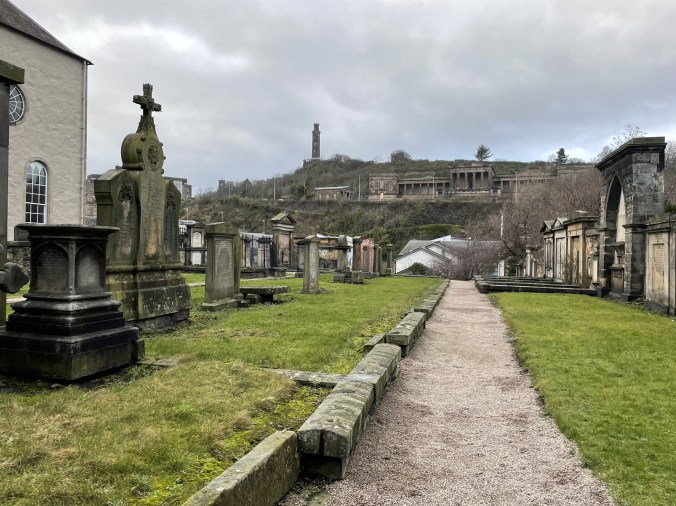
Another such watch tower is in New Calton Burial Ground.  This has great views over Holyrood, Arthurs Seat and the government buildings and alleys off Canongate.  Like many of the graveyards I visited, it has a map to show the location of graves of the Edinburgh ‘great and good’.  On the day of my visit, the northern end was full of birdsong.

New Carlton Burial Ground Including Its Watchtower
View From Near The New Carlton Burial Ground – Canongate Kirk, Salisbury Crags and Arthurs Seat

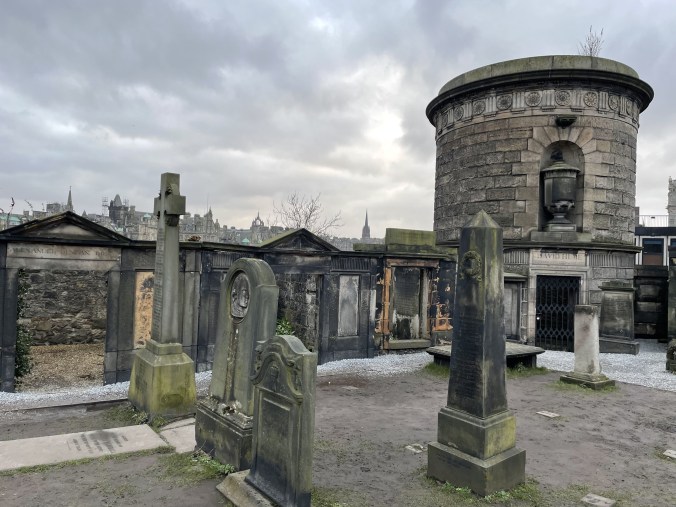
New Carlton Burial Ground was overspill from the nearby Old Calton Burial Ground which I have visited before and which has memorials to a number of notable Scots, including famous radicals of whom some were deported to Australia for their troubles. 

Old Carlton Cemetery

In Canongate is Canongate Kirkyard.  The Kirk and its Cemetery which was created when decreed that the inhabitants of the Canongate would no longer be allowed to worship at Holyrood Abbey in 1687.  It is the resting place of Adam Smith, the famous Scottish philosopher and economist. 

View From Canongate Kirkyard – Carlton Hill In The Background

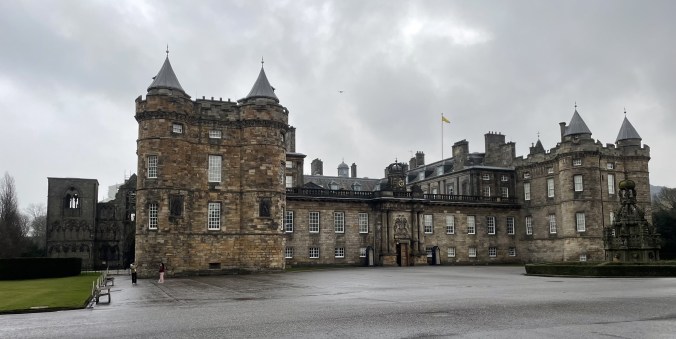
This cemetery has views back to Carlton Hill and is a peaceful haven just yards away from the many tourists – even at this time of year – strolling between Holyrood and The Royal Mile.  I too, wandered down to Holyrood Palace but, impressive as it looks from outside, I demurred from paying £25 to enter the grounds and house; maybe I will on a future rainy, rather than just grey, day in the City.

Holyrood Palace On A Grey Edinburgh Day

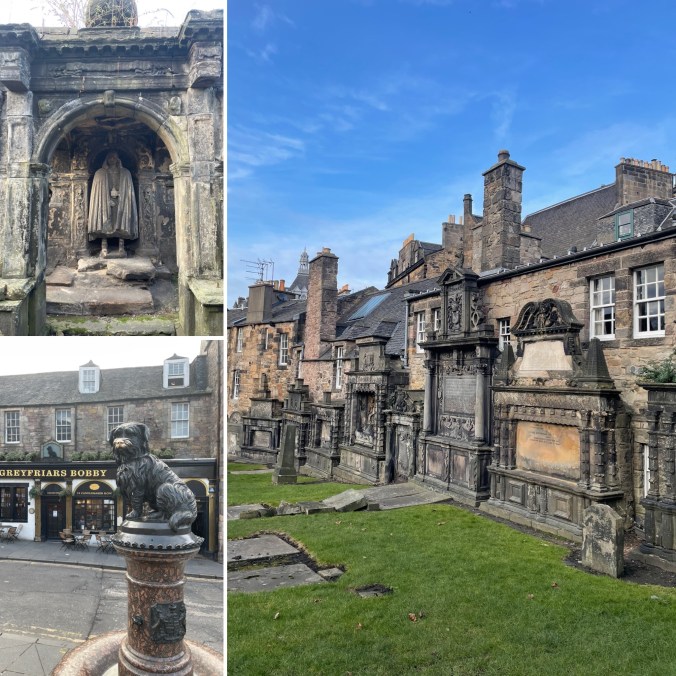
Unlike the other graveyards I visited, Greyfriars Kirkyard was crowded with tourists eager to follow up on apparent connections to Harry Potter characters and the famous story of Greyfriars Bobby, a terrier who sat by and guarded the grave of his owner (a nightwatchmen at the cemetery) for 14 years, without a break, until he too died.  

The more interesting aspects for me were the scale and disposition of the mausoleums in Greyfriars Kirk.  These proliferated from the 1660s when burial in Greyfriars Church was prohibited.  Families of the dead apparently compensated for not being allowed inside by erecting very large monuments outside.  Some of these directly attach to the houses around the graveyard (see below).

Greyfriars Kirkyard and The Greyfriars Bobby Monument

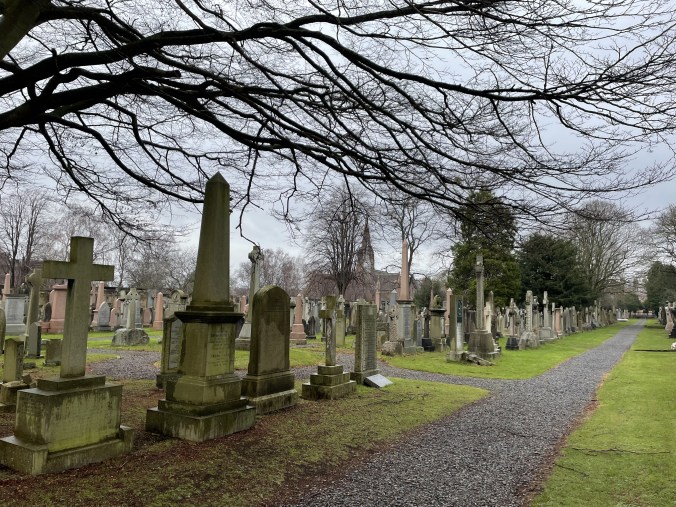
Further afield, I stumbled across two other cemeteries.  Dean Cemetery, behind high walls and full of mature trees, was very quiet except for the birds.  The cemetery is attractive – if you like this sort of thing – but the grey skies gave the cemetery a rather melancholy air and I plan to return when the trees are in leaf and the atmosphere is brighter.

Dean Cemetery

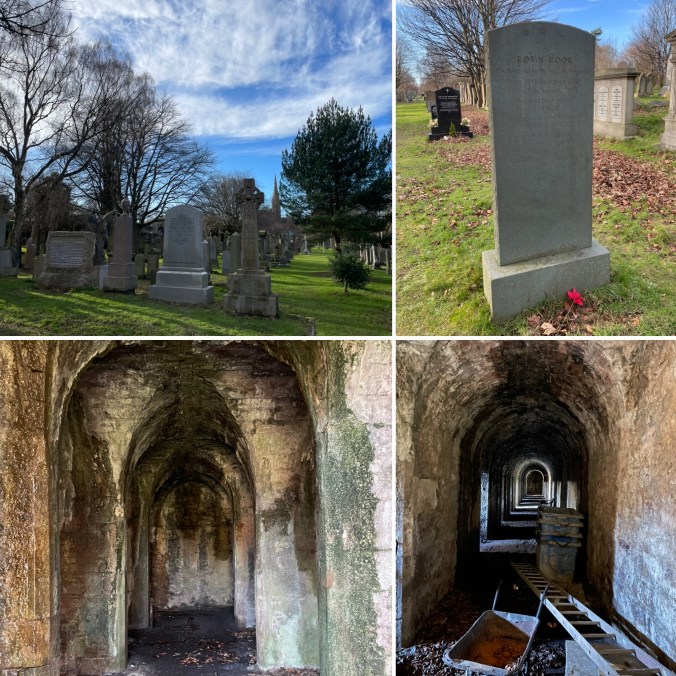
Even prettier – perhaps helped by the blue skies overhead when I visited – was Grange Cemetery.  I found this during a rather random walk south of the centre of Edinburgh.  I noticed the imposing surrounding walls and found a way in.  Like Dean Cemetery it is in two halves.  Here however, the divide here is not a wall but a long array of catacombs that are halfway underground; an interesting dimension to the site.

The Grange Association do a great job of maintaining the cemetery and of documenting its history and its ‘residents’.  Thanks to that, I found the grave of Robin Cook who was one of my political heroes 20-25 years ago.  His gravestone has a nice epitaph referring to the Iraq war: ‘I may not have succeeded in halting the war but I did secure the right of Parliament to decide on war’.

Grange Cemetery And Catacombs (With Robin Cook’s Gravestone Top Right)

In the last week of our Edinburgh stay, I returned to the National Gallery of Scotland to see the permanent collection and we also returned together to Dovecote Studios to see an really excellent exhibition presenting the Scottish Colourists.

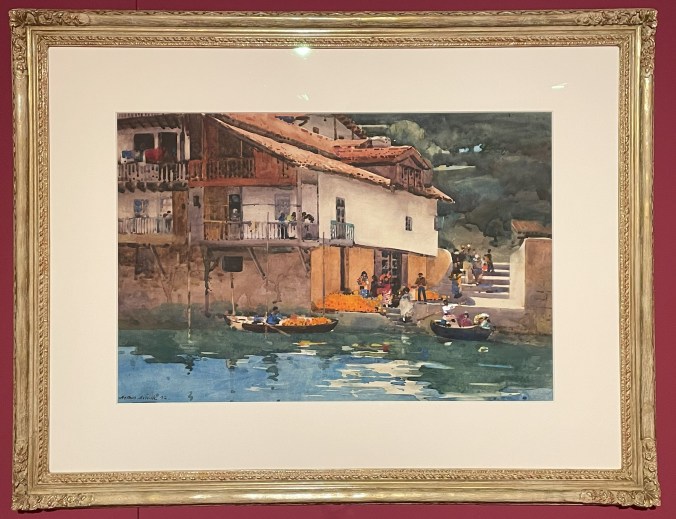
My Favourite Picture In The Scottish Colourists Exhibition At Dovecote Studios Exhibition – By Arthur Melville, A Forerunner and Mentor to the Colourists

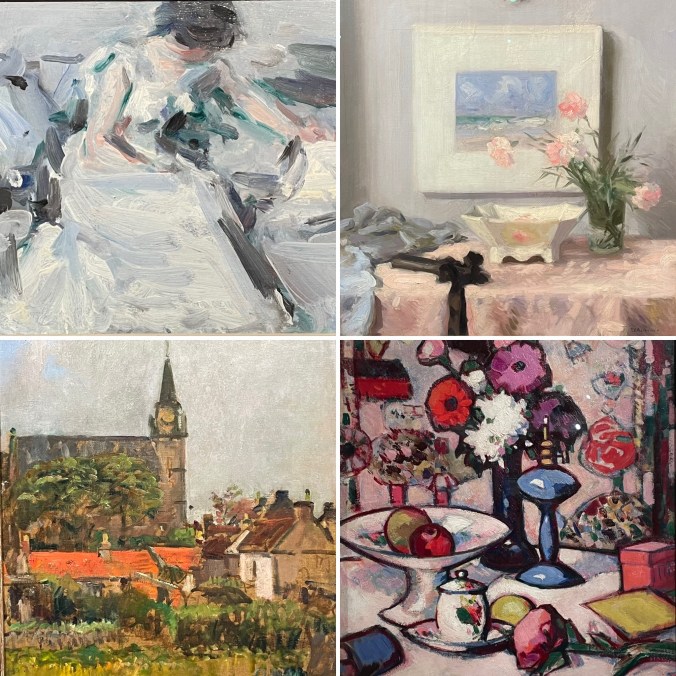
The Scottish Colourists were a group of just four artists who were at their peak in terms of quality and influence in the art world in the first half of the 20th century.  Unlike Jane, I hadn’t heard of any of them as I entered the exhibition.  But interesting information about them was carefully presented and their influencers, and those they influenced, were summarised and then underlined with examples.  I loved the exhibition and felt I learnt a lot.

The Scottish Colourists: Works By (clockwise from top left) SJ Peploe, FCB Cadell, JD Fergusson And Leslie Hunter

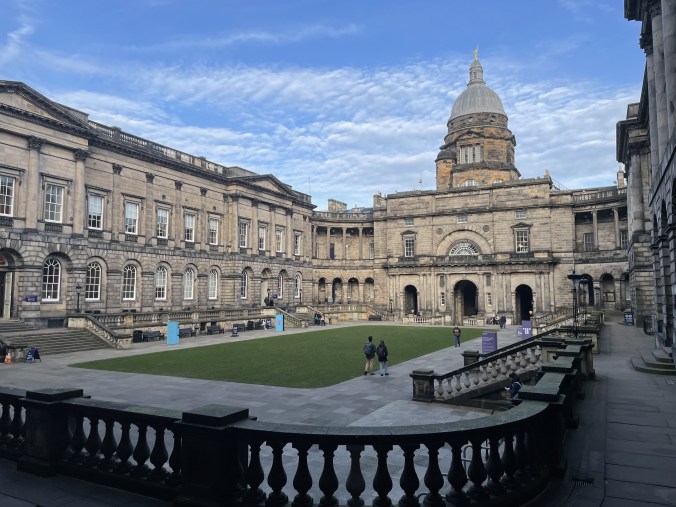
Another interesting exhibition I saw was at the Talbot Rice Gallery.  The gallery is part of Edinburgh University and is within the wonderful buildings of Old College.  The art on show was at another end of the spectrum from that of the Scottish Colourists.  Let’s just say that the anti-woke brigade would not have approved.

Old College, Edinburgh University

The first part was an exhibition of videos by Gabrielle Goliath relating to violence against women.  The videos were images of women describing their experiences but the words were truncated so that only the gaps between their words remained.  It was strangely powerful albeit with really just the one idea and the explanations of the videos were too high-falutin for me to absorb properly.

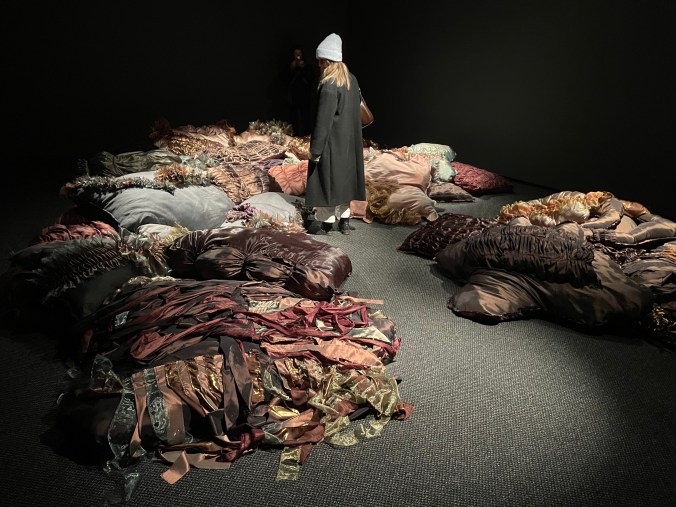
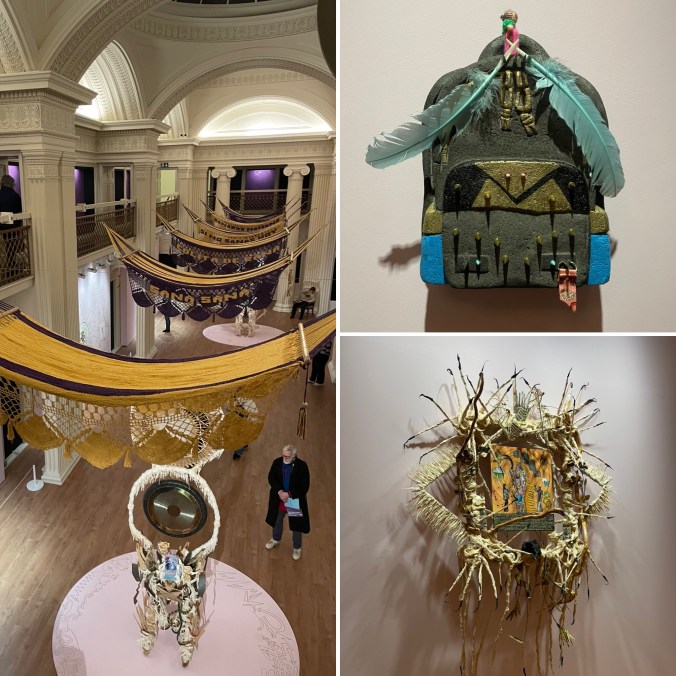
Much more aesthetically pleasing but equally, weirdly impactful was an exhibition of work by Guadalupe Maravilla, an child refugee and cancer survivor from El Salvador.  It’s hard to describe the work (see below) but the allusions to healing, trauma and displacement were fascinating.  All this was in a single, splendid room bedecked with hammocks for the ‘healing gods’; it was all very dramatic.

The Work Of Guadalupe Maravilla At The Talbot Rice Gallery, Edinburgh

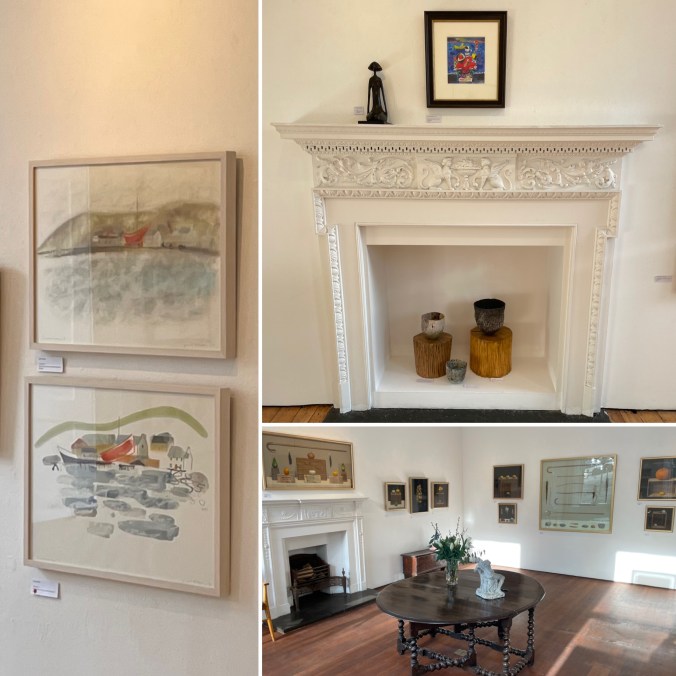
Jane and I also visited a couple of the multitude of private galleries in Edinburgh.  One, the Open Eye Gallery, had some work by a friend of hers, Gail Turpin, who’s exhibition we visited last summer when we were in the city.  I liked her watercolours but was even more taken by a room showing paintings by James Fairgrieve and by a few ceramics by Rachel Wood.

Inside The Open Eye Gallery, Edinburgh

The other was the oft-visited The Scottish Gallery just up from where Eldest Son lives.  As soon as I walked in my eyes fell on a couple of Joan Eardley paintings.  I’d never heard of her until we started to visit Edinburgh a few years ago, but love all her paintings of sea and fields that I have seen since. 

One Of Joan Eardley’s Paintings At The Scottish Gallery

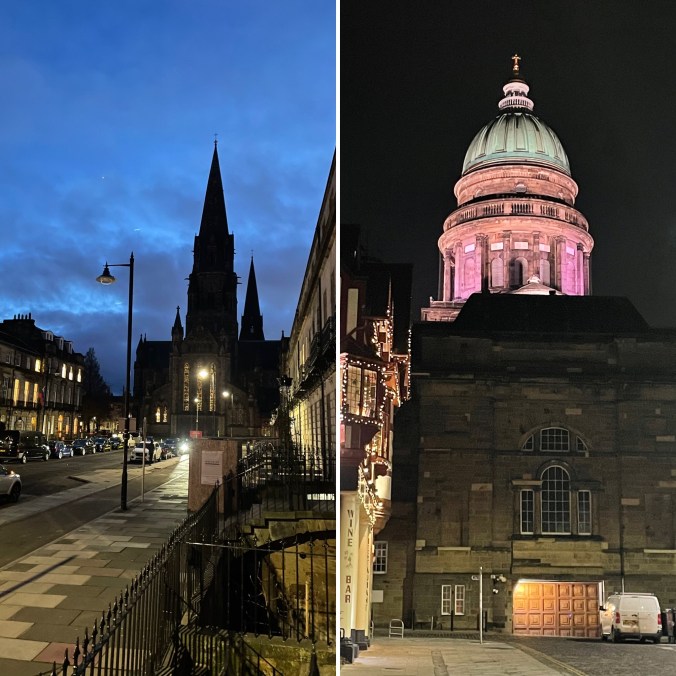
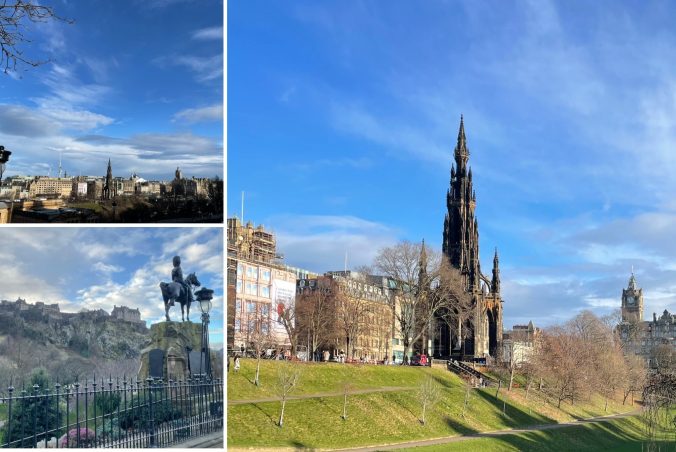
We originally planned day trips to Glasgow and Fife whilst in Edinburgh.  In the absence of those, I was very happy visiting Edinburgh’s graveyards and galleries, and wandering through the wonderful Georgian architecture of central Edinburgh, where most streets seem to have a monument or imposing building at their end.  It’s a great city to visit, and, I think, to live in.

Buildings At Night At The End Of The Street Of Our Holiday Home, Edinburgh

A Different Way In Edinburgh

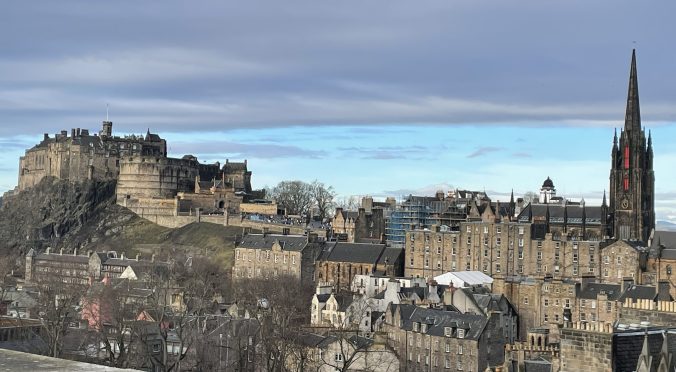
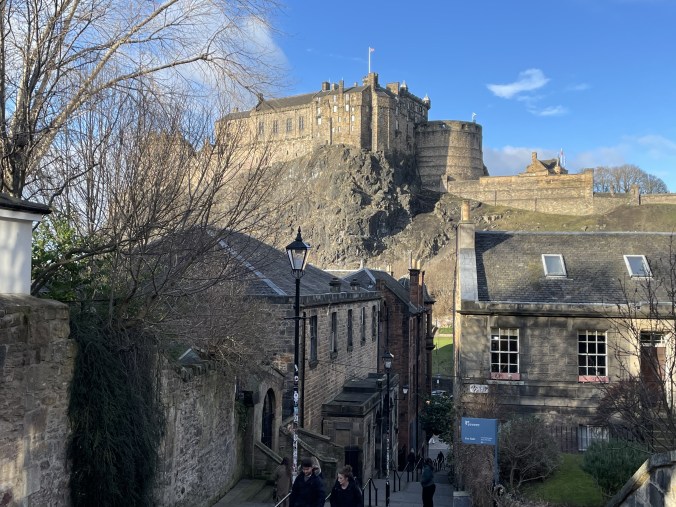
We are booked for a month into a very comfortable, nicely warm and well-furnished Airbnb in central Edinburgh that has a view of the Castle.  Our idea has been to try a model for visiting Edinburgh that is different from our usual 3-4 night stays with Eldest Son, wife and First Grandchild.  In part it is just an extended holiday, but in part a test as to how we might find living more permanently in this wonderful city.

Sunrise Over Edinburgh Castle From Our Airbnb

The first two weeks have been extremely successful – until a bit of a disaster yesterday; more on that later. 

We have already visited lots of Edinburgh sights – the museums, cathedrals, galleries and exhibitions – got into the hinterlands of Edinburgh and, of course, done a bit of grandchild entertainment.  Were lucky enough to have a double dose of grandchildren when Middle Son, his fiancée and Second Grandchild visited us on our second weekend.  That visit, plus the nature of the intermittent contact with First Grandchild over a longer period than usual, has created a bit of a feel of living here rather than just holidaying here. 

Edinburgh From The Top Of The National Museum of Scotland

No doubt that feeling would have been further enhanced by Youngest Son and his wife being able to join us as planned on our first weekend in Edinburgh.  Unfortunately, Storm Eowyn put paid to that.  Their flight was cancelled and Edinburgh was all but shut down during the worst if the storm.  Even at the end of the storm, the gusts of wind were strong enough to knock me off my feet!
Because of, first, Storm Eowyn, and then a visit from Middle Son and family, we have tended to eat in rather than out.  However, we have sampled a couple of our favourite bars and a few cafés, and we love the local pub (Teuchters).  Anyway, there are two more weeks for trying some more recommended restaurants. 

Another View of Edinburgh Castle From Flodden Wall

Cooking in a holiday home is not new to us but doing so most evenings over a few weeks is another way of generating a feeling of being ‘home from home’ rather than just being on holiday.  Next week, we are even entertaining Eldest Son’s parents in law.  That will be a further novelty but a nice reflection of how things might be if we moved to Edinburgh more permanently.

Edinburgh Views (Great Weather!)

During our days here, we have been very active.  We have, of course, sampled the normal delights of the Royal Botanic Garden the Scottish National Portrait Gallery, the Modern Art Gallery of Scotland the Scottish National Gallery and the National Museum of Scotland.  Edinburgh is a capital and has public buildings, exhibitions and collections to match that status.  There were new exhibitions in all of the galleries and all were a pleasure to visit – although it was sad to see the Storm Eowyn damage in the Botanic Gardens.

Storm Damage – One Of The Largest Cedars In The Royal Botanic Gardens Has Gone

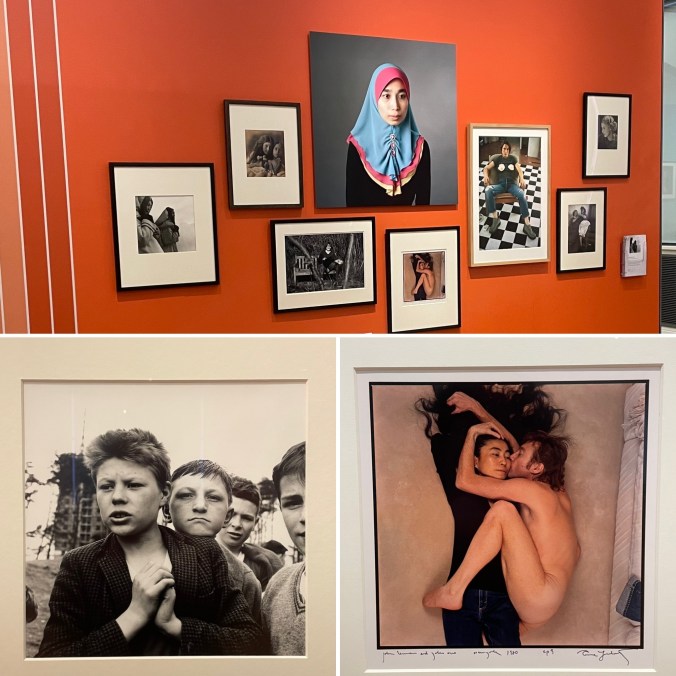
The Scottish National Gallery is celebrating 40 years of its photography collection and curation.  Photography is not my favourite art form but it was good to see some pictures by some famous photographers (such as Robert Mapplethorpe, Annie Liebovitz, and Lee Miller) among the often gritty, local Scottish fare.

40 Year Celebration Of Scottish Photography Collection – Including The Iconic Lennon/Ono Photo

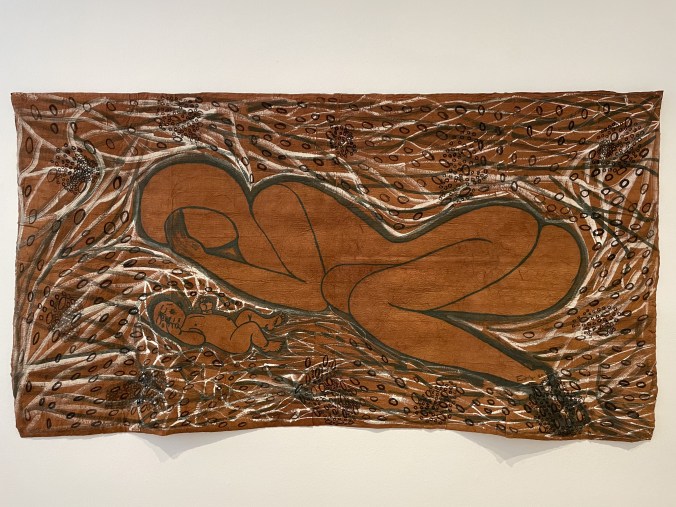
The Modern Art Gallery continues to show the substantial Everlyn Nicodemus exhibition which I saw on our last Edinburgh visit.  I sped through that but perhaps somehow enjoyed it a little more on a second viewing; plus, there are several other works in the gallery’s permanent collection I had not focused on before.

‘After the Birth’ By Everlyn Nicodemus

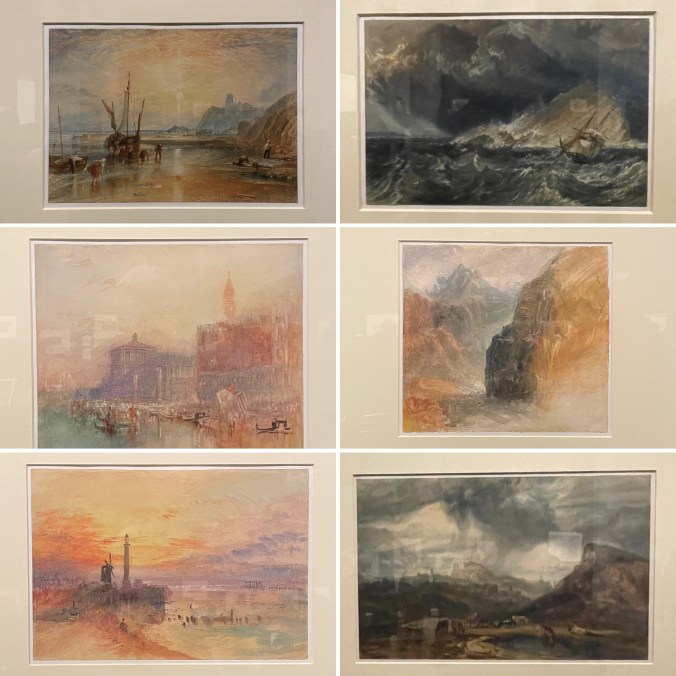
The Scottish National Gallery had a sequel to an exhibition of JMW Turner watercolours that I had seen in the gallery two years previously.  That had shown the section of the Henry Vaughan collection of Turner watercolours that had been bequeathed to Scotland.  This new exhibition was of the selection of watercolours bequeathed to Northern Ireland that again, as part of conditions of the donation, can only be shown to the public in January. 

Turner Watercolours at the National Gallery of Scotland

There were no surprises in the collection of blurry seascapes, sunrises, sunsets and mountain valleys shrouded in mist.  But I like Turner’s style and enjoyed the viewing despite the long queues to get in.

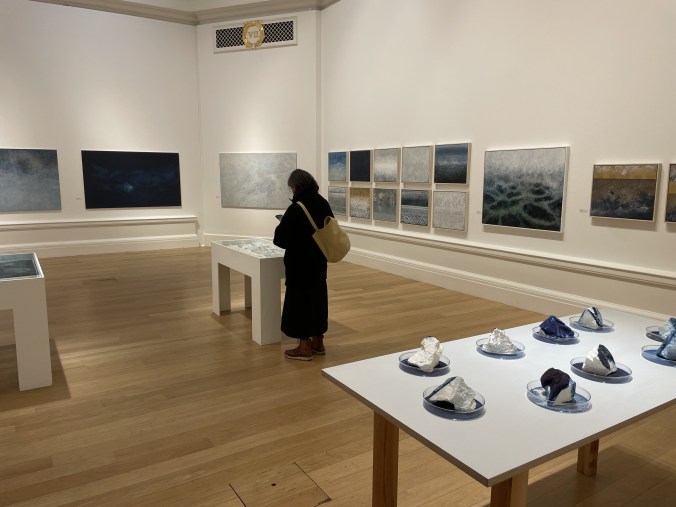
Also at the National Gallery was a small exhibition of art inspired by the landscape of the Orkneys, called ‘In Orcadia’ and including large, interestingly constructed paintings by Samantha Clark

The ‘In Orcadia’ Exhibition

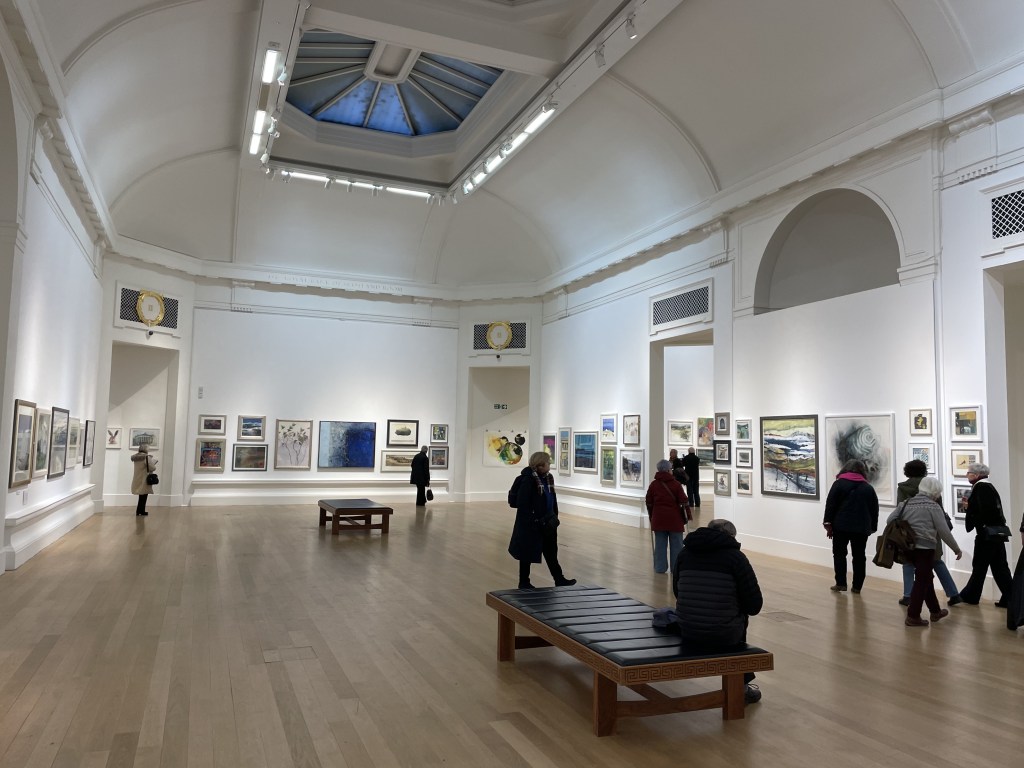
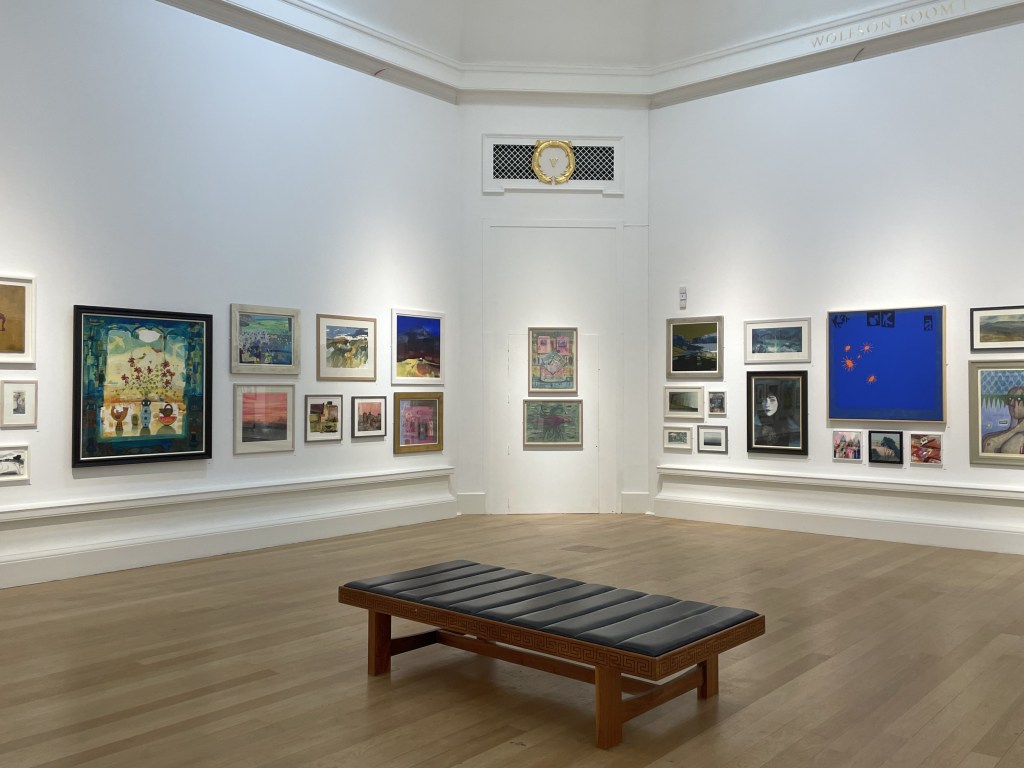
That was good but even better, I thought, was the large exhibition of paintings by the Royal Scottish Society of Painters in Watercolour.  There were hundreds of paintings on show and of course, not all hit the spot for me.  But overall, I thought the quality was very high and I could imagine several on my living room wall.

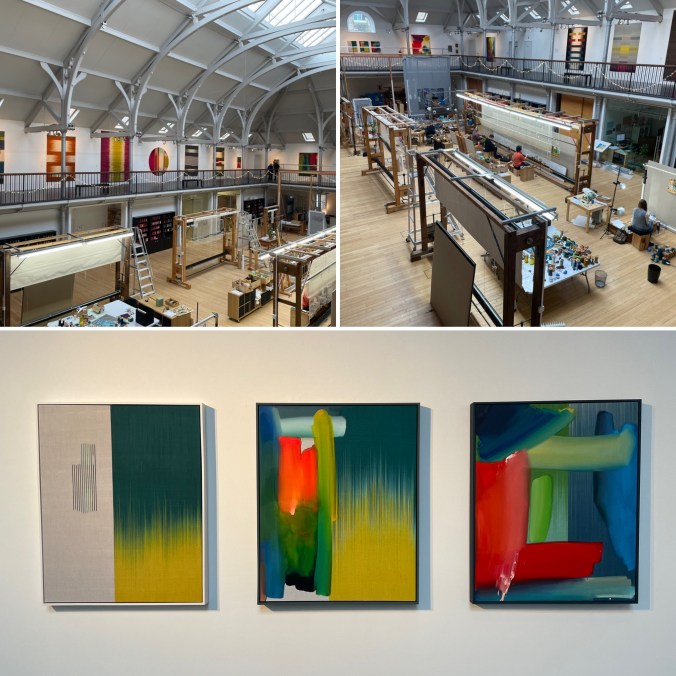
We also went to diverse art exhibitions at Dovecote Studios and the City Art Centre.  At Dovecote we saw textiles and paintings by Ptolemy Mann.  The designs were colourful and bold but Jane was a little disappointed that the majority of the textiles were manufactured in India not Scotland. 

Dovecote Studios And Ptolemy Mann Artwork

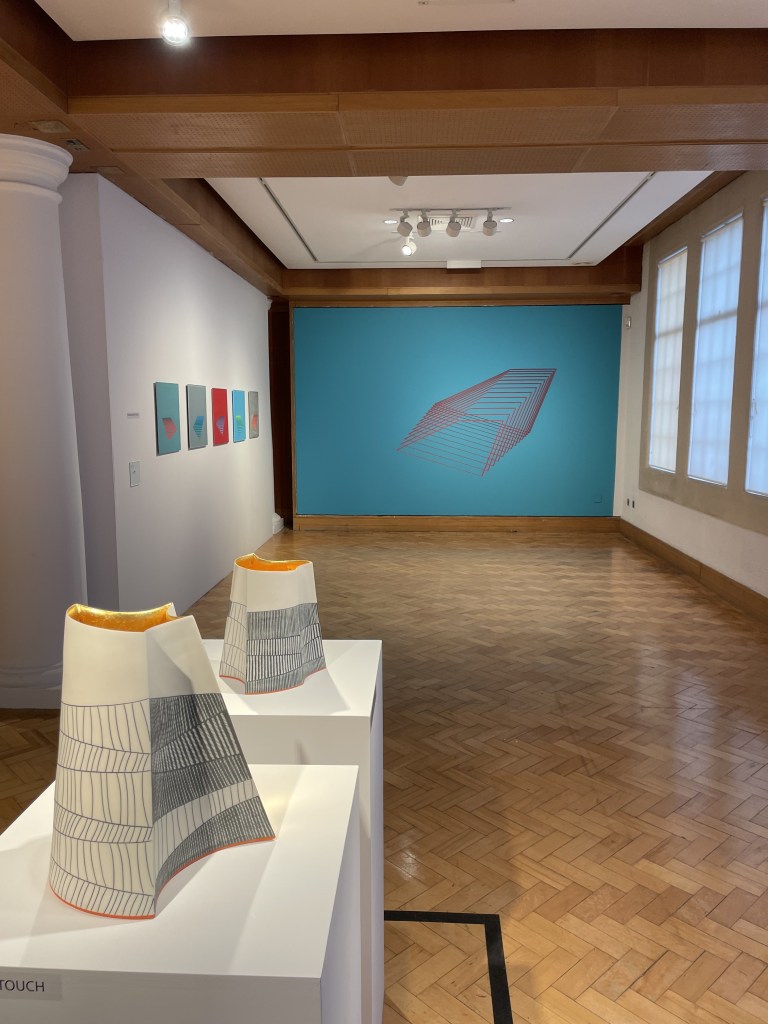
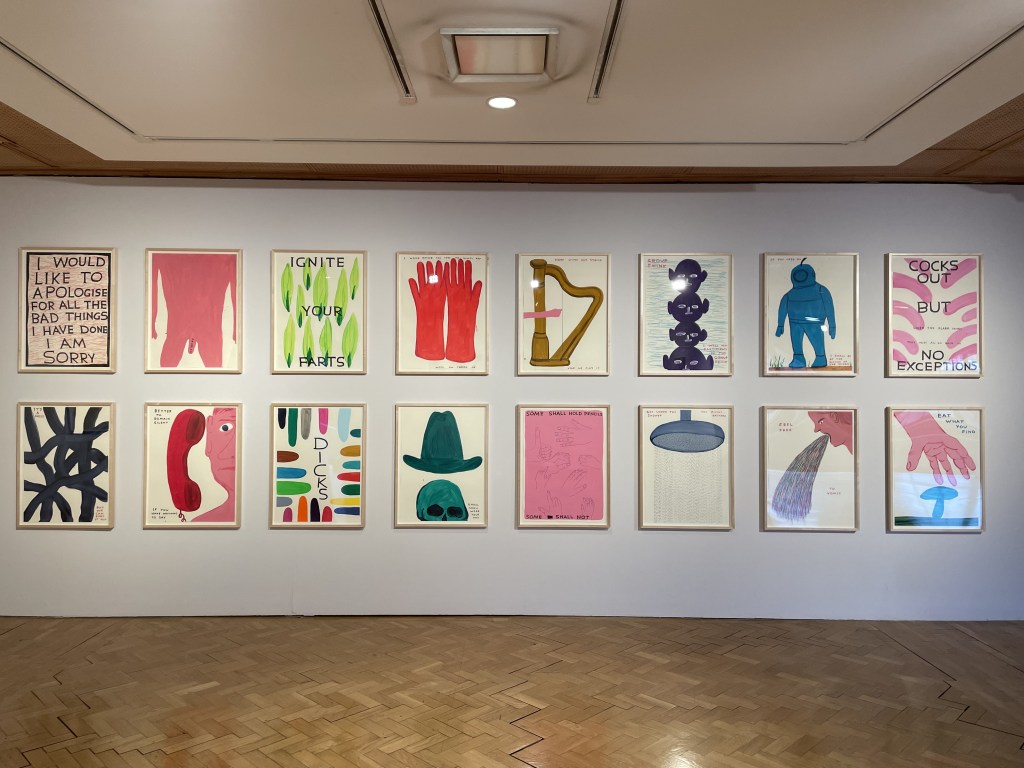
At the City Art Centre were two exhibitions of modern Scottish art and of pop art; I liked the pots by Lara Scobie at the former and the typically irreverent set of cartoonish watercolours by the seemingly slightly unhinged, David Shrigley.

Works By Lara Scobie and David Shrigley At The City Art Centre, Edinburgh

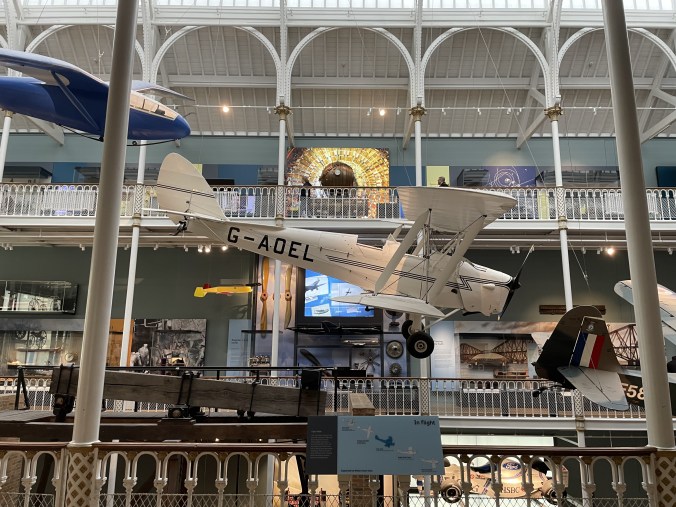
We made a couple of trips to the National Museum of Scotland.  The first to see some of the displays that we don’t get much of a chance to see when accompanied by First Grandchild.  The second was with him; his increasingly calm inquisitiveness was a joy to participate in.

One concept we discussed, as we passed some of the dinosaur and wild animal exhibits, was that of skeletons.  Subsequent conversations indicate that he understood how creatures often have skeletons and that you can’t see until after they are dead.  It’s fascinating to watch children learn.

Everything From Dinosaurs To Hi-Tech On Show At The National Museum of Scotland

And now we come to the misfortune of yesterday….. Apart from Storm Eowyn, the weather during our stay has been largely dry and sunny.  However, it has also been cold and yesterday morning my wife, Jane, slipped on some ice and, it turned out, broke her shoulder.  The pictures of x-rays that we came away from the hospital with have helped First Grandchild understand the importance of bones but there is no other upside to the accident. 

We’ll cope and enjoy the rest of our stay in Edinburgh but plans regarding how are changing……

A Stag In Active August

Retirement in August has felt busy so far.  There have been several separate events to enjoy.  In between these, I have been walking while listening to political podcasts, tidying our field and garden, visiting the local recycling tip with multiple dumpy bags of green (mainly thistle, bramble and bindweed) waste, and enjoying our local community hub: the village pub. 

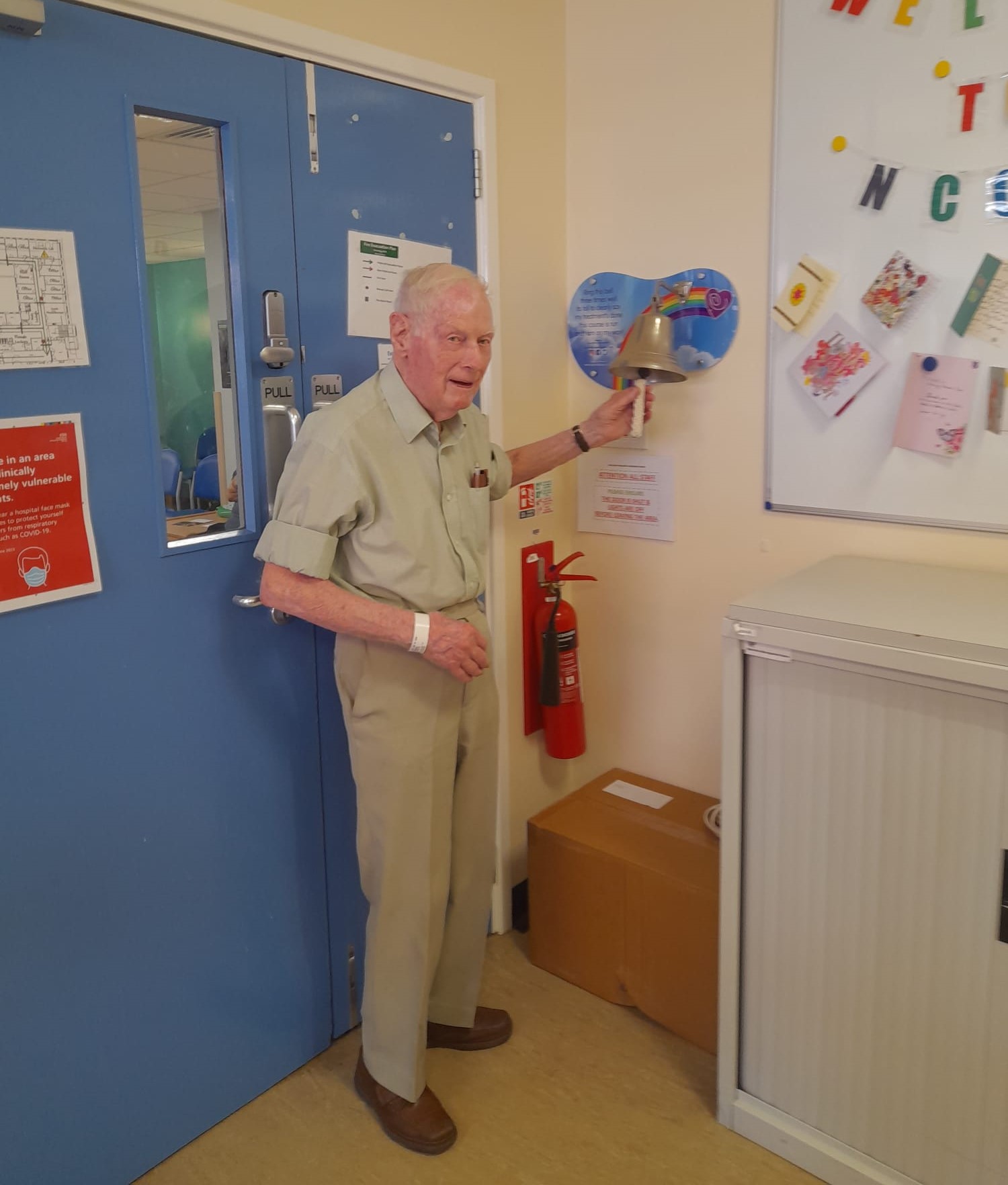
I visited my Dad and sister in Nottingham for the first time since the end of his innovative and apparently very successful cancer treatment.  I’m really proud of him; he has stuck with all the hospital visits, the injections and the infusions and they have not only benefitted him, but furthered cancer research.  It was great to catch up with them and, for a change, win at our games of Mahjong. 

Dad Ringing The Hospital ‘Ward Bell’ To Celebrate His End Of Treatment

The football season has restarted and, during my brief stay in Nottingham, I managed to get to Boston in Lincolnshire to see my dear Forest Green Rovers treat me to a rare, stonking win.  After two successive, distressing relegations, we seem to have found our natural level again.

Boston Football Club: Nickname The Pilgrims Because So Many Original Pilgrim Fathers Migrated To The Americas From Boston

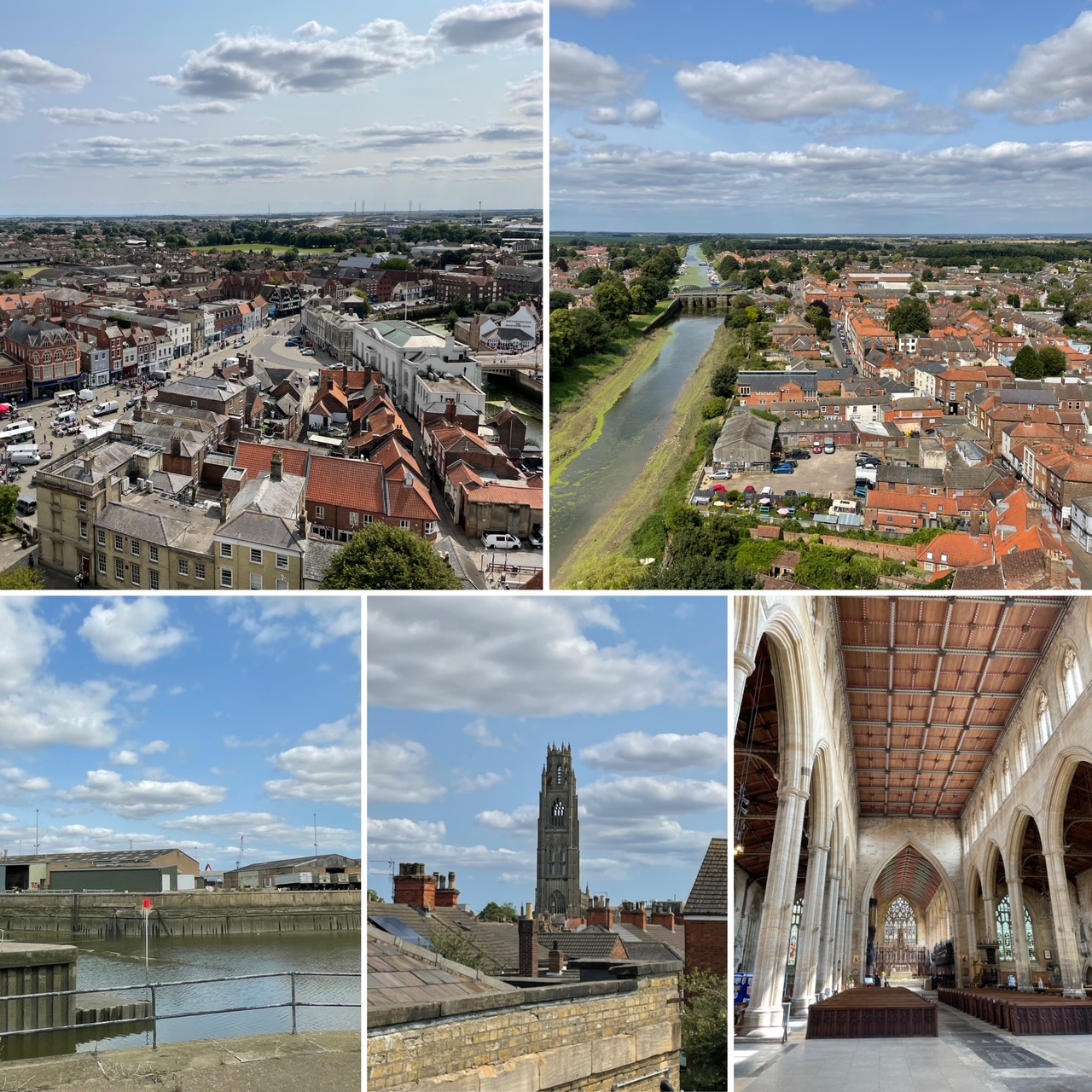
Whilst in Boston I had time to climb the church tower and take in some aerial views of Boston and the very flat surrounding landscape.  The church is large and the tower is impressive.  The port and its surrounding sluice gate system was also substantial but is now looking run down.  Indeed, much of the town looked as though it needs a face lift.

Views Across Boston, The Port And The Church
An Attractive Part Of Boston Next to The River Witham With The Tide In

Also in August, Jane and I have visited Bath, dropped in on Second Grandchild in Bristol, hosted Youngest Son (YS) as he has worked his way through his busy month of multiple stag dos, weddings and video shoots, and attended a talk on artistic gardening in Stroud. 

Amid all this activity the most unusual event for me was the opportunity to attend part of YS’s own Stag Weekend.  That was a lot of fun – even though I opted out of the most boisterous activities and those requiring the heaviest drinking penalties.  It was lovely to be invited and great to catch up with old friends and meet a few of YS’s best mates who I didn’t already know. 

Sunset Over Stag Weekend Tents

Middle Son kindly gave up his bed to allow me a relatively comfortable, though rather hungover, sleep in a large tent also shared by Oldest Son; it was my first experience of something resembling camping since YS was at Primary School and a lot more restful than then!

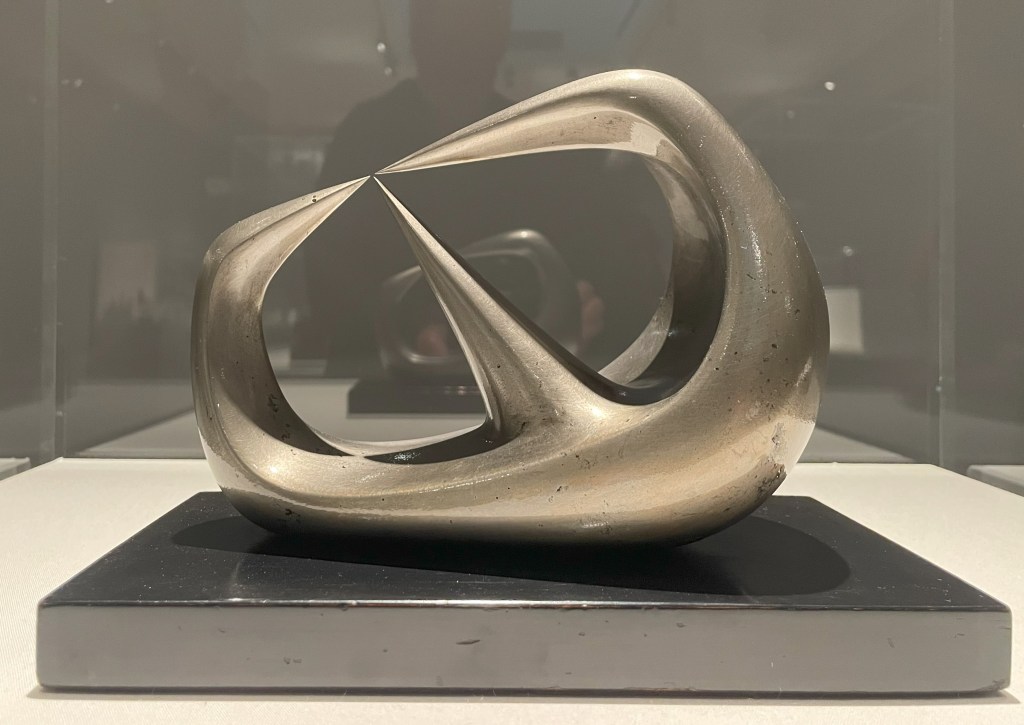
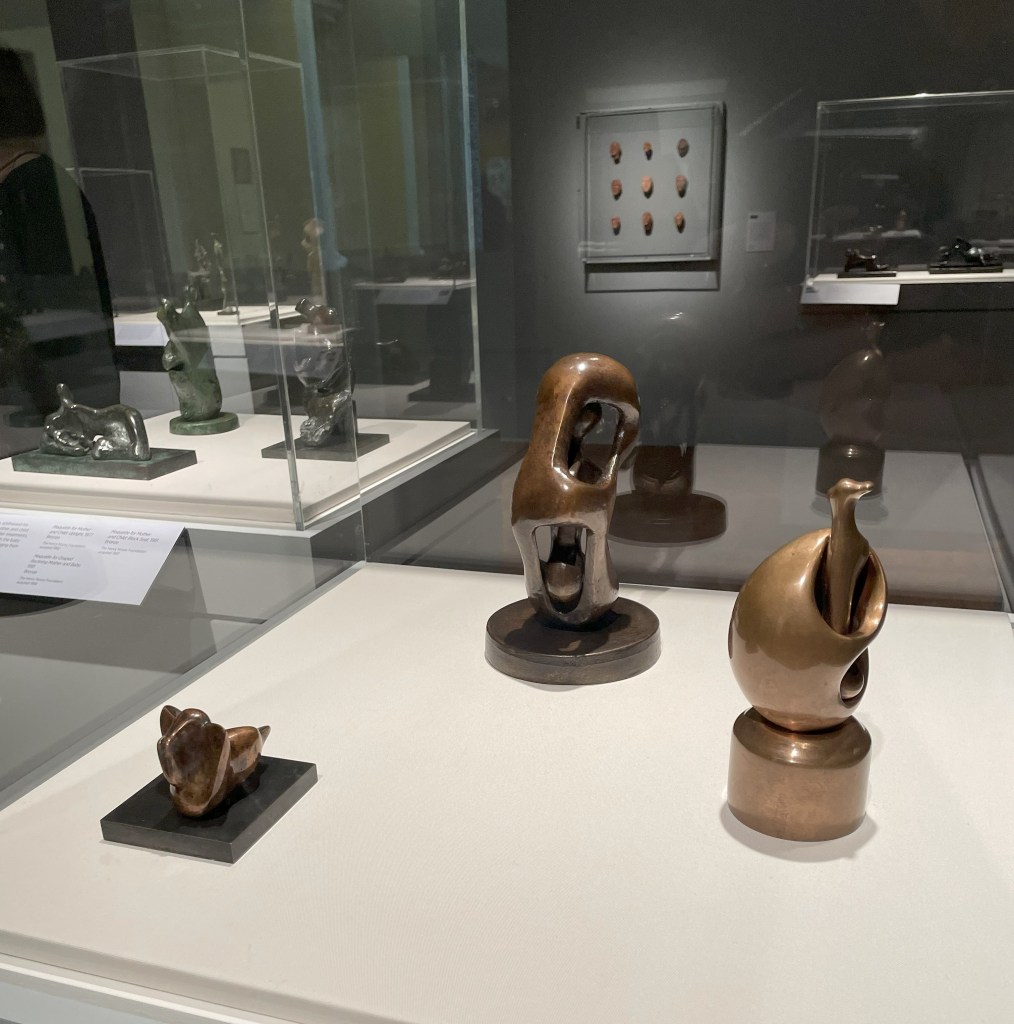
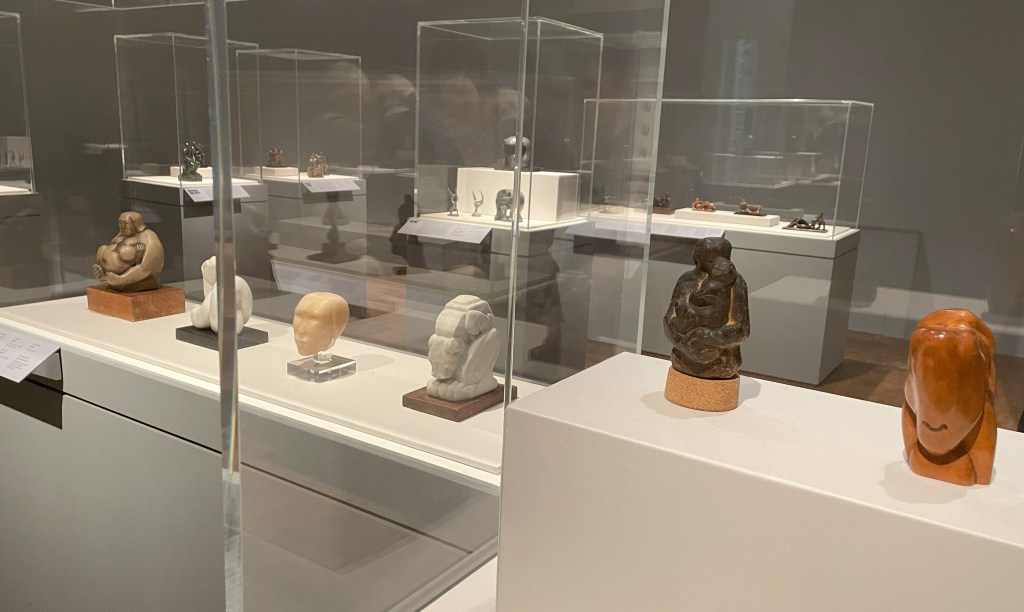
The main purpose of a visit to Bath was to equip YS and myself with light suits for YS’s wedding and for the wedding of one of Jane’s nieces in Italy next month.  With that aspect of the trip satisfactorily achieved, I visited The Holburne Museum to see a Henry Moore exhibition. 

This was a small exhibition of Henry Moore’s small works.  Many of his familiar themes such as mother and child, helmets, family groups, reclining figures in stone, wood and metal were covered in a single room.  The breadth was admirable but it took a while to get used to the delicacy of the work having been used to the more massive Henry Moore sculptures I have seen in the past.  In truth, only a few of the displays in this exhibition really stood out for me but a couple were lovely and it was worth the visit.

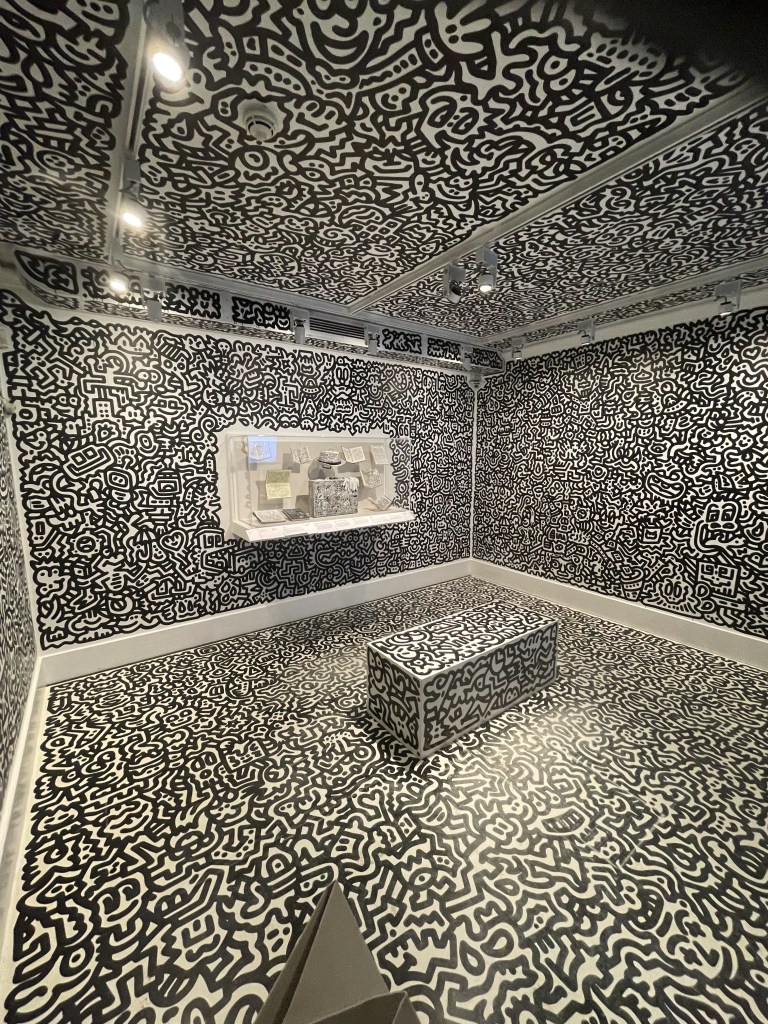
On the way out I popped into a separate exhibition in the Museum by Mr Doodle (aka Sam Cox).  He is clearly into fun art and the room completely covered in his ‘doodles’ (see below) certainly raised a smile.

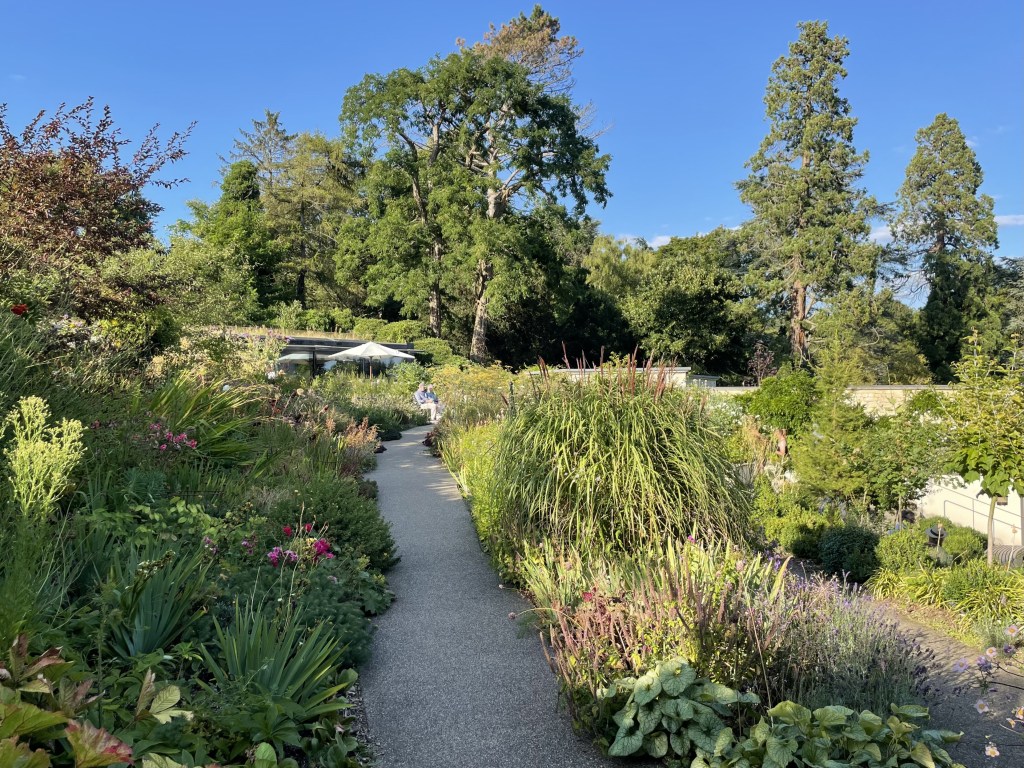
Closer to home we went to a talk on ‘Where Gardening Meets Art’ at the Museum in the Park in Stroud.  The Museum has a lovely terraced and walled garden that I hadn’t visited since shortly after it was built and planted several years ago.  The sun was shining and the garden looked splendid.

The Walled Garden At Museum In The Park, Stroud

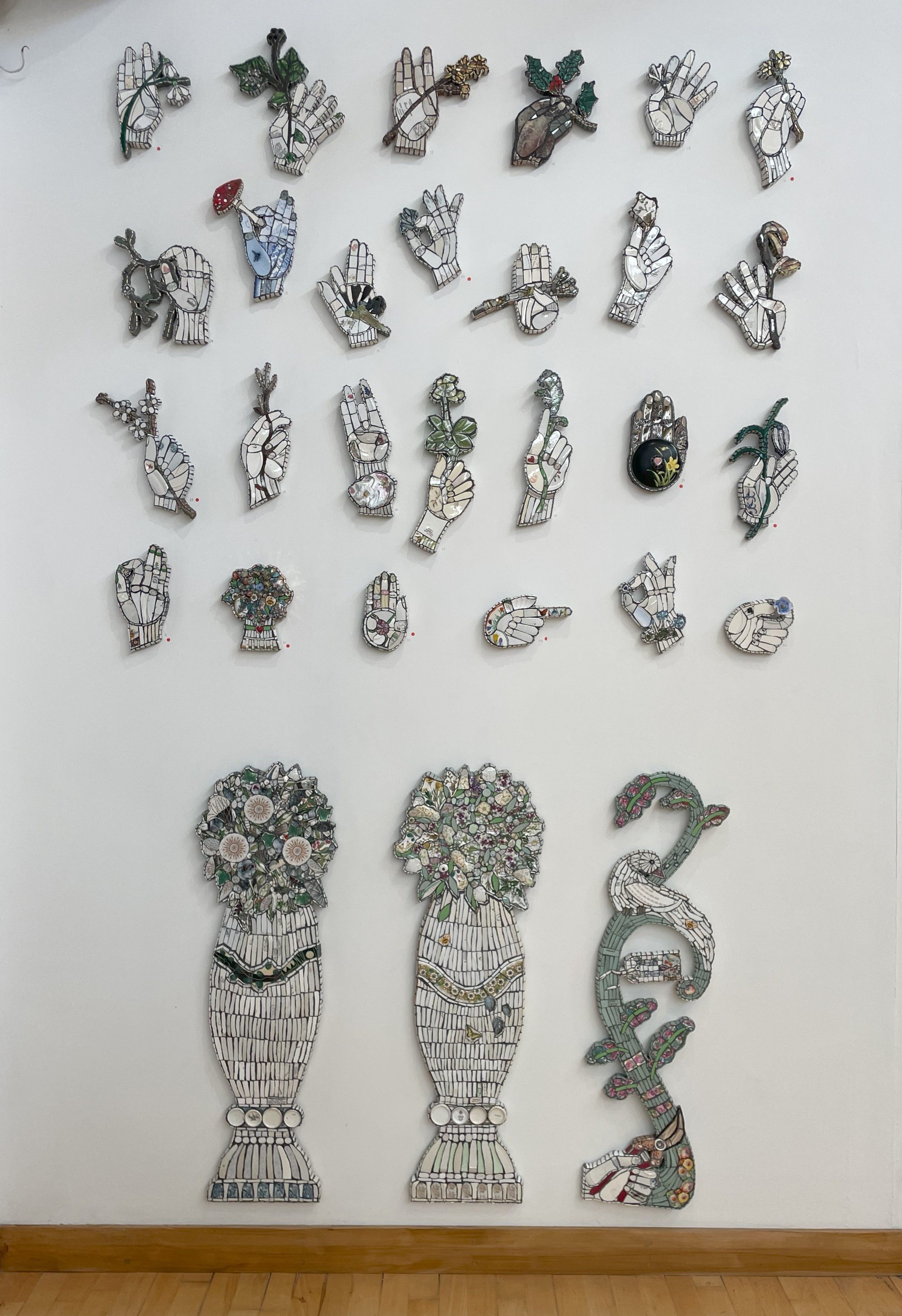
The talk itself was preceded by an exhibition of gardening and plant inspired artworks by Cleo Mussi, who’s work we know well, and Fiona Haser Bizony, founder of Electric Daisy Flower Farm.  I liked several of Cleo’s mosaics, especially the simpler ones, but we quickly moved outside to the garden in evening sun and a small bar offering locally brewed beer.

Cleo Mussi’s Hands Mosaics At Museum In The Park, Stroud

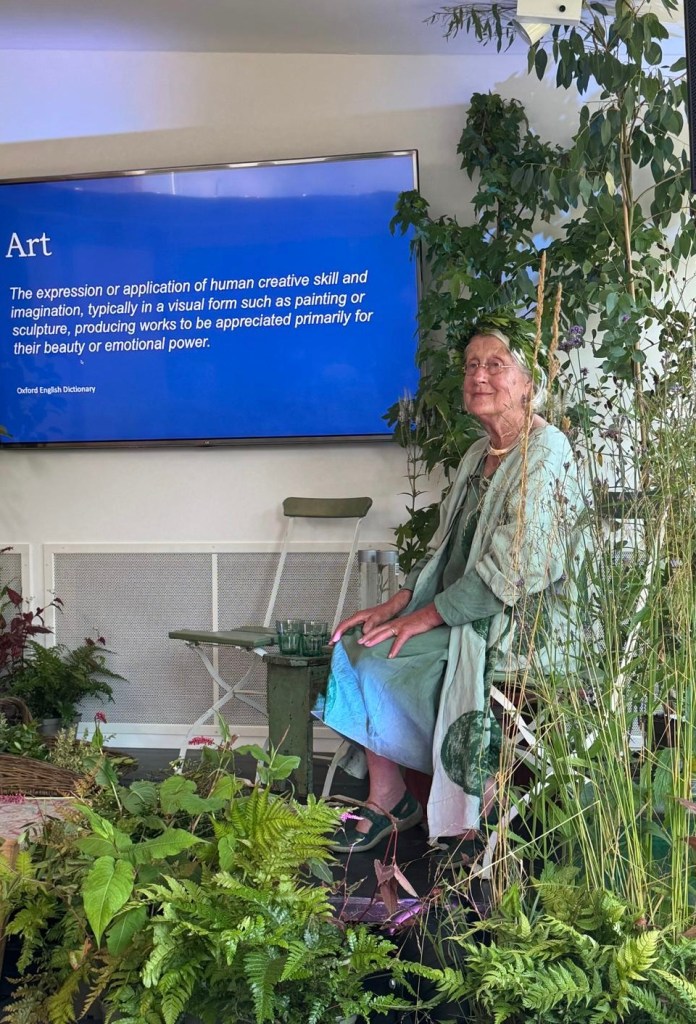
Jane had booked the evening and I didn’t know what to expect from the talk.  In the event, it was efficiently introduced and a thoroughly entertaining.  The main speaker was Charlotte Molesworth who has a renowned garden in Benendon, Kent.  She was terrific.  She had a lot of good sense to share and did it very amusingly.  Her anecdotes were warm and lovely and she had a great answer to every question.  The whole evening exceeded my expectations severalfold.

Charlotte Molesworth Speaking About Where Gardening Meets Art

August – and, unfortunately, summer – is now drawing to a close.  The final week will be punctuated by further visits to The Hog, our local pub, for its Summer Bank Holiday Hogfest (a beer, music and food festival) and then the monthly quiz.  I am also looking forward hugely to Forest Green Rovers’ first home game of the season on the club’s brand-new, hybrid (5% plastic) pitch. 

But then my thoughts will turn to our family holiday in Italy prior to Jane’s niece’s wedding in Rome.  I can’t wait to see the two grandchildren together amongst our sons and their partners.  It is going to be a real treat to have everyone together.

Horsley Unwrapped

The Horsley Festival – subtitled ‘Horsley Community and Culture Unwrapped’ – was substantial triumph.  The events that comprised the festival included concerts, art exhibitions, craft workshops, poetry recitals, storytelling, wildlife walks and dance workshops.  These events were presented very professionally in a brochure and on a dedicated Horsley Unwrapped website.  All of the events were very well attended – indeed, most were fully booked up – and all the events I went to were even better than I expected.  It was an incredible achievement for a village of about 300 households.

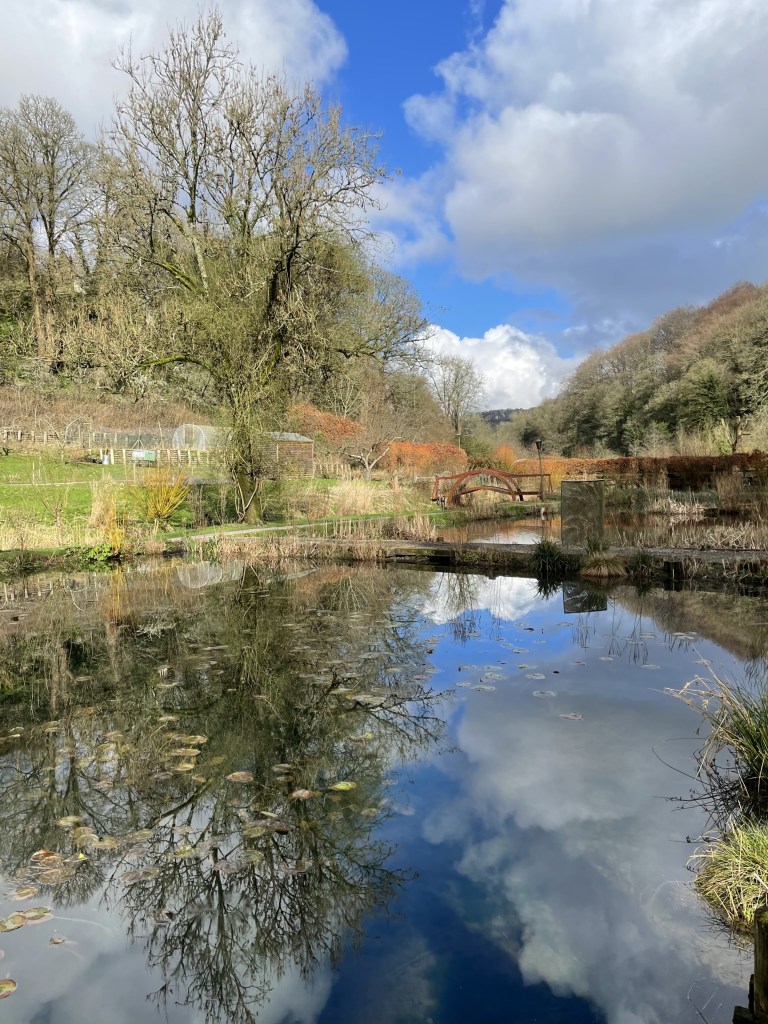
Ruskin Mill Valley Near Horsley, Gloucestershire

My wife, Jane, was on the steering committee.  This was chaired by the brainchild and prime organizer of the event – a friend of ours and a real hero who must have worked almost full time on the festival for weeks and who was incredibly busy during and, especially, between the events! 

The ‘Inspire’ Art Exhibition Organised By Jane Including Works By Children At The Local School (bottom right) and Works By International Artists (bottom left) – A Diverse Mix!

Jane was responsible for the central art exhibition which kicked off the festival.  It was a significant effort to organize about 25 local artists so that information about their work, and the works themselves, were available on time, and that those works taken away promptly at the end.  There were also trials and tribulations associated with ensuring that large display boards and plinths were procured, restored and erected safely and in time.  The result, though, was much-praised and Jane was very happy with its success.

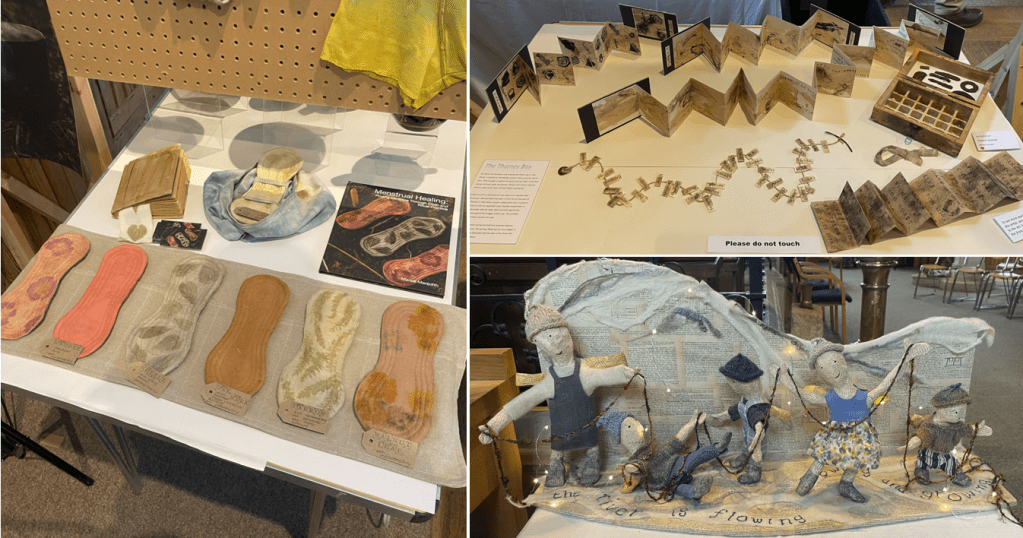
Some Of The Art Works – By Local Artists Maisie Meredith, Jo Hofman And Kim Roberts

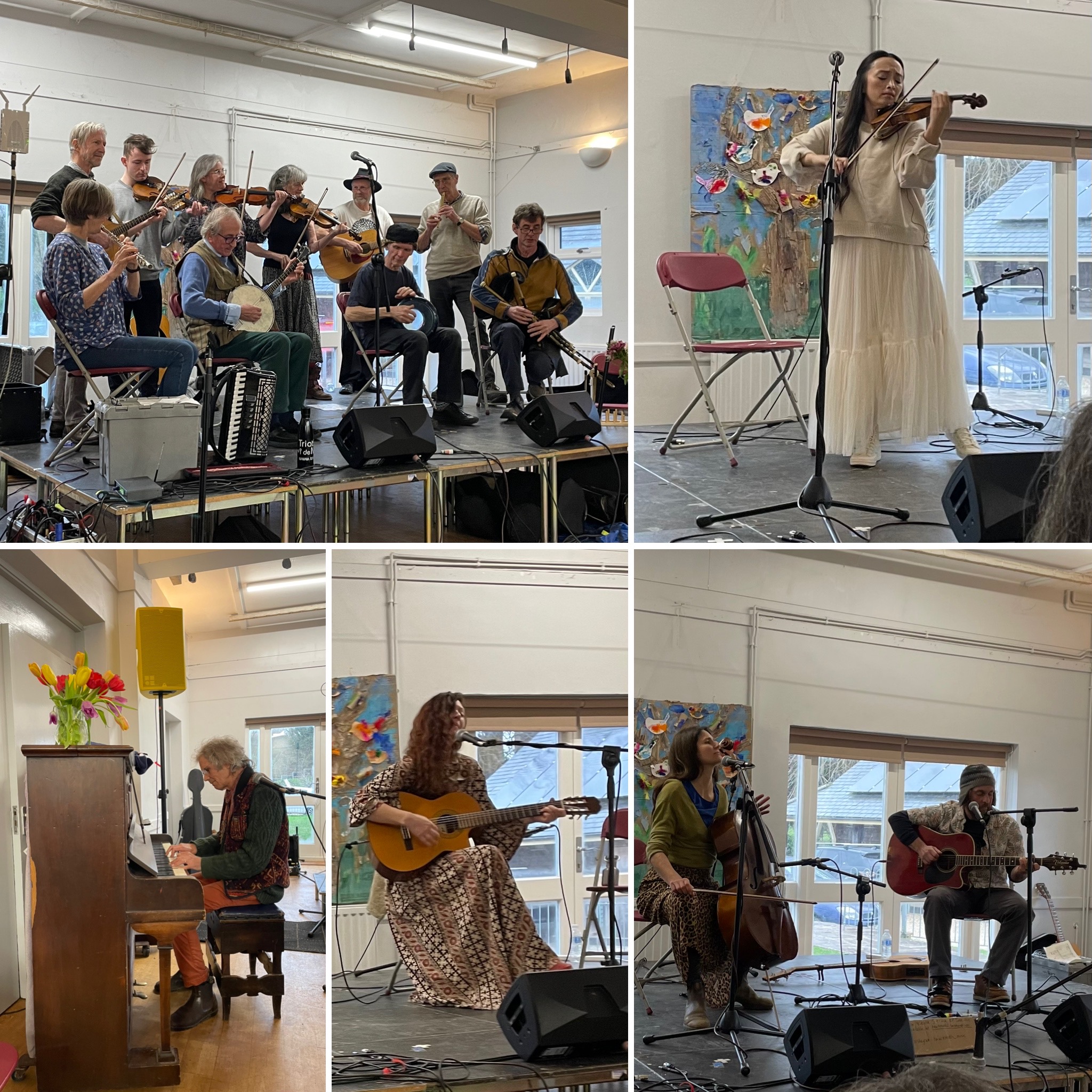
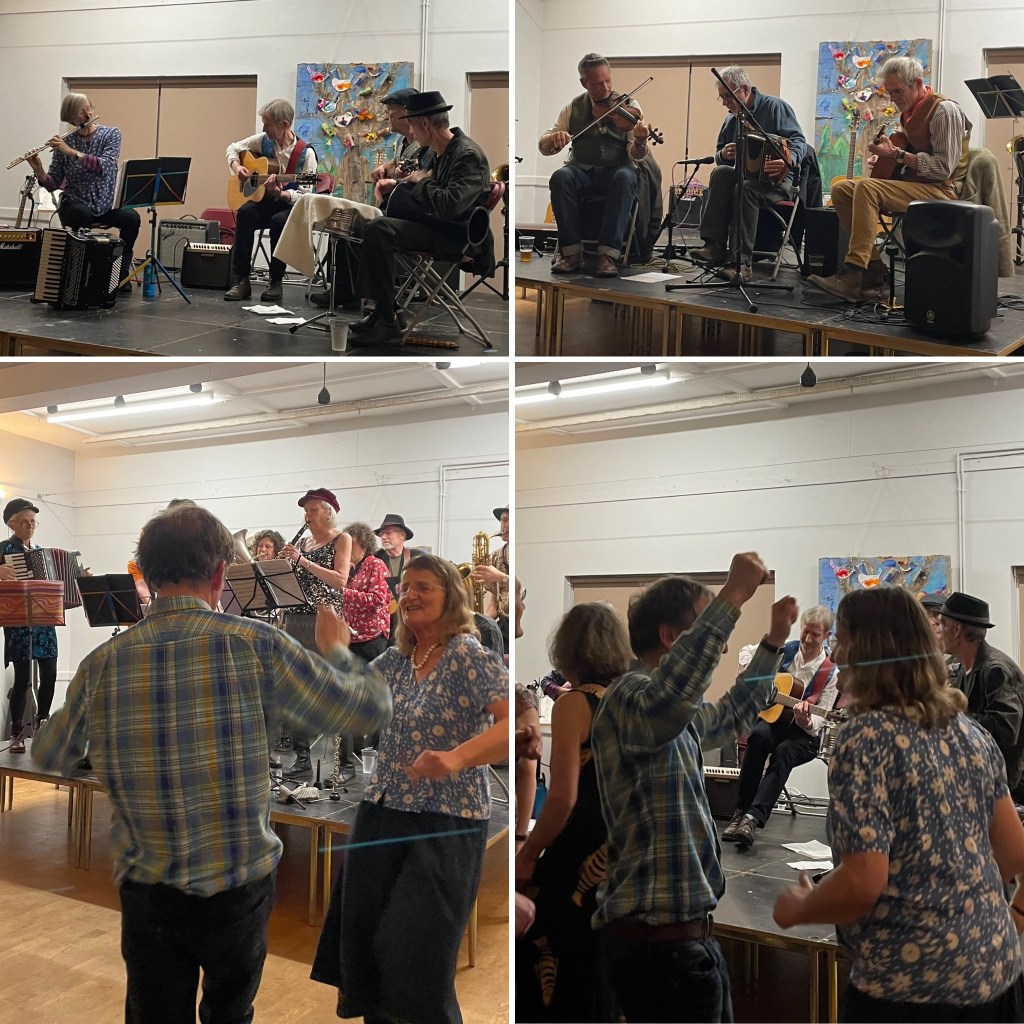
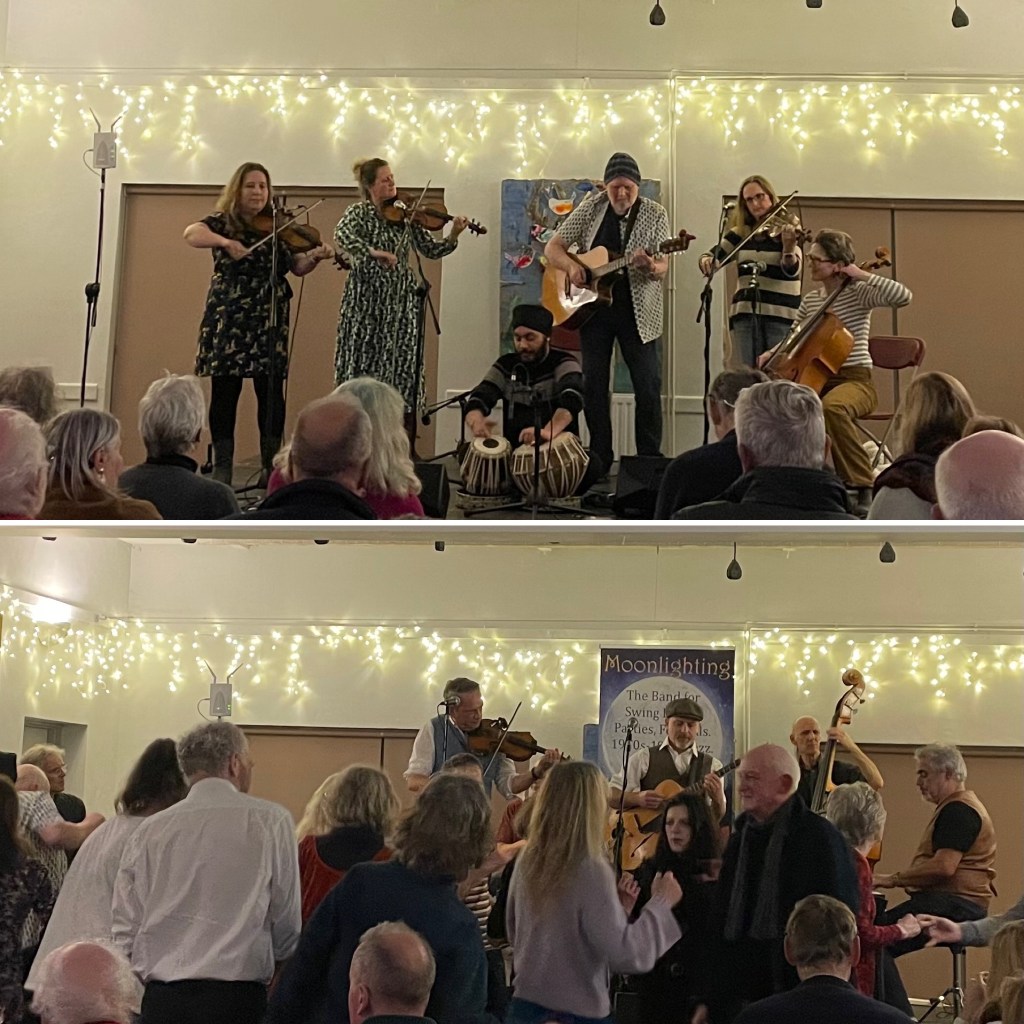
As well as the art exhibition and the associated opening ceremony, I attended a variety of other events.  There were three music concerts during the nine days of the festival which framed the talents of three solo musicians and eight bands from the local area.  Horsley has attracted a large number of artists and musicians over the years and the quality on show was terrific.

Closing The Festival: The Village Concert Starring The Elastic Band, Diana Yukawa, Bill Roberts, Solskin And Hawkmoth

 There was a lot of dancing – including some rather chaotic but very amusing line dancing which Jane enjoyed.  However, the music I liked best was a set of haunting violin-based music by Diana Yukawa.  We have listened to and enjoyed music by this international performer at home before.  Even in a rather ordinary village hall, and in front of her very proud looking daughters, her performance was very moving and memorable.

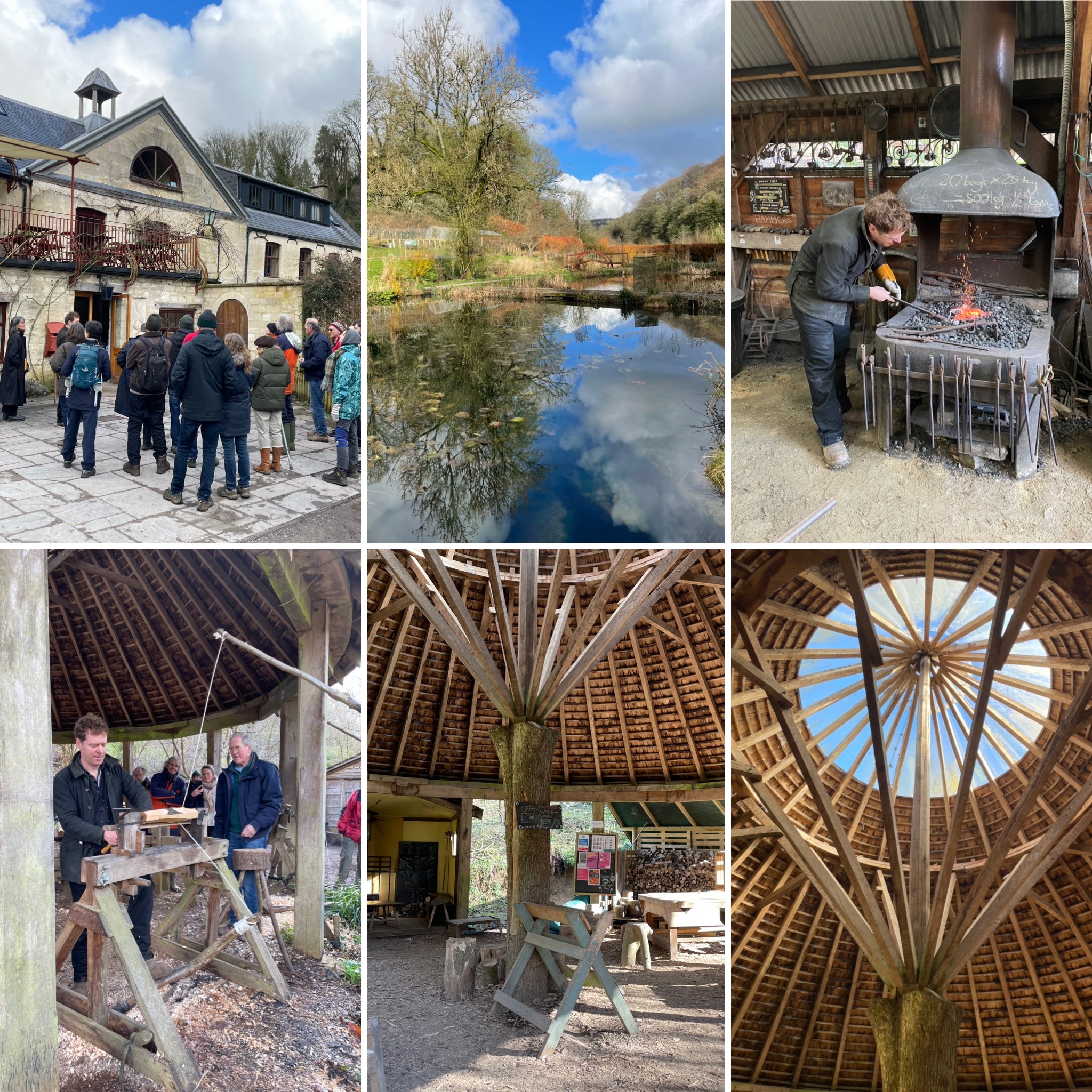
The three wildlife walks with the Chair of the Gloucestershire Wildlife Trust, who lives just down the road from us, were booked up very quickly; too quickly for me to get a place.   However, I did manage to get on a tour of the main Ruskin Mill College buildings and workshops in the valley I walk through frequently on my way into town.

The valley itself is very familiar to me but an introductory presentation on the way the restoration of the old mill and fisheries has taken place over the last 30 years provided fascinating, new information.  We were given a little book describing the history and values of the Ruskin Mill Trust and the way it provides specialist education for teenagers and adults with complex needs. 

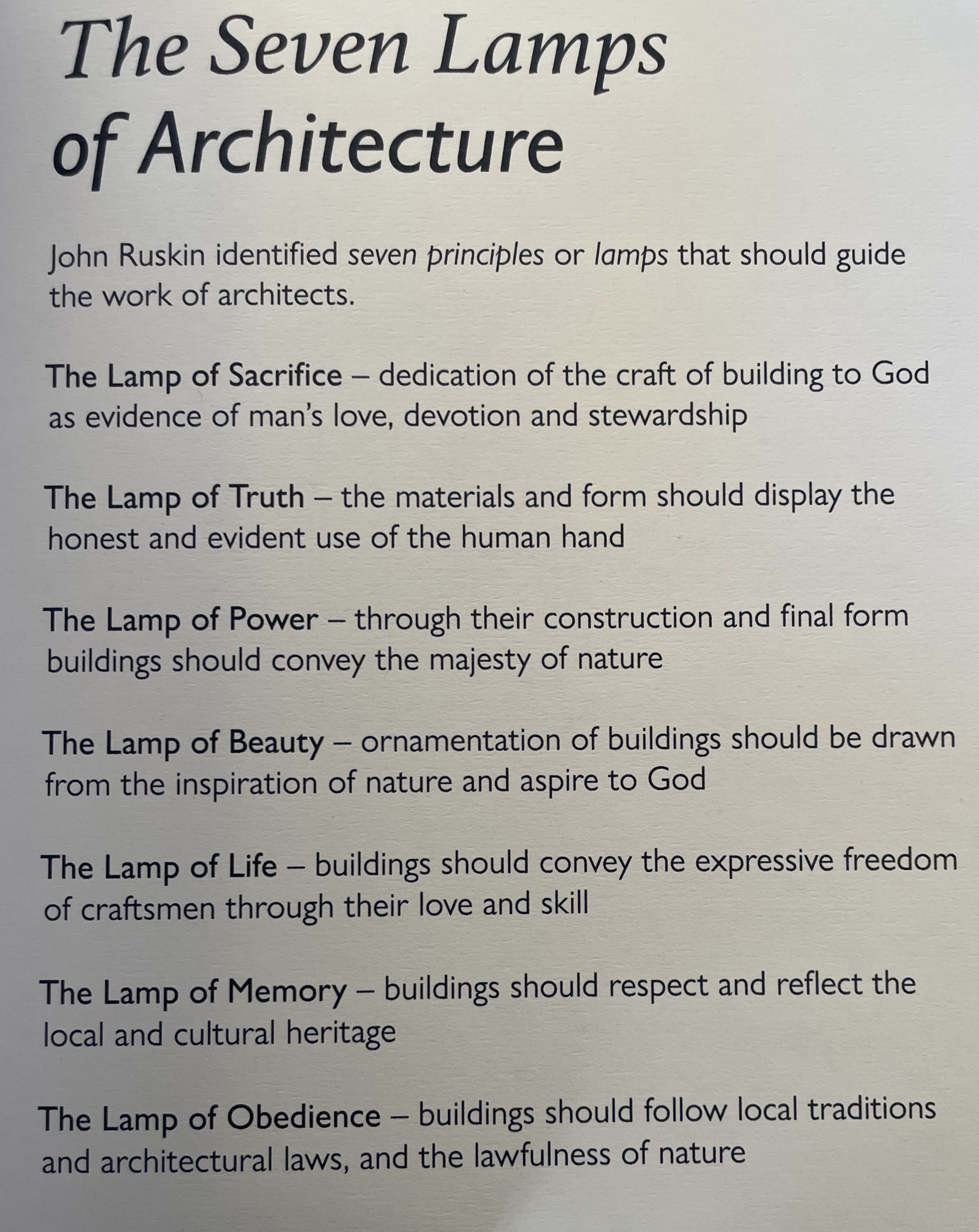
Ruskin’s Guiding Principles

The college values are inspired by those of Victorian architect and artist, John Ruskin.  I have been interested in him, and William Blake who lived a little earlier but shared similar views, for quite a long time.  Both of them were keen to revive traditional craftwork amid the mass production of the Industrial Revolution.  Ruskin’s interest in that is reflected in some of the workshops that now enable students at Ruskin Mill College to learn rural crafts such as pottery, ironworking, trout farming and woodworking. 

Our visits to the fish hatchery, woodworking centre and the forge (with its three forges showing Iron Age, Medieval an Edwardian methods) were enlightening.  The demonstrations of blacksmithery and wood turning were eye-opening. 

Tour Of Ruskin Mill, The College Forge And Greenwood Workshop

The tour was crowned with a visit to the college staff art exhibition and delicious, homemade pizzas made in the college pizza oven; very nice!

Ruskin Mill Staff Exhibition: Some Gorgeous Wooden Spoons By Richard Turley

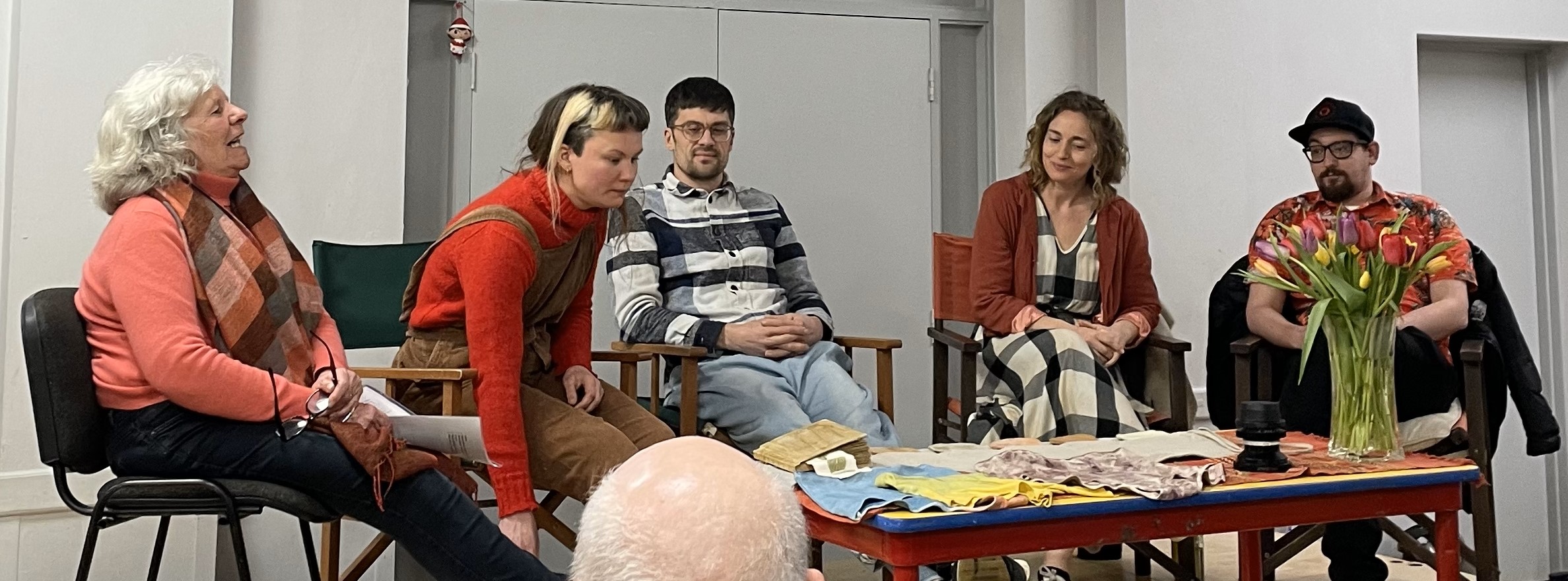
Another highlight for me during the festival was an ‘in conversation’ session with four local, young artists that was facilitated by a good friend of ours.  The artists were a commercial film maker working in the advertising world (in a similar but bigger way to that of our Youngest Son), a photographer, a storyteller and a maker of naturally dyed textiles.  The latter, Maisie Meredith, is someone I know a little and her work, including a beautiful booklet, is a brave, direct response to her personal issues with endometriosis.

The artists described their work, approach and way of working.  That was very interesting and the dynamic as they asked each other questions and reinforced or developed each other’s points was refreshing. 

Local Young Creatives ‘In Conversation’

The point when the storyteller, Hannah Moore, told a brief story to illustrate the way she used stories to facilitate restorative justice – the process of getting criminals to talk with their victims to reach some point of closure following a crime – was my best moment of the festival.  It was matched a few minutes later when she told another story, impromptu but masterfully, in response to a question from the audience about the possibilities of using storytelling to resolve wider conflicts such as wars.

I should mention too that the All-Comers Darts event I organised in a small corner of the less serious end of the festival, went very well.  We had he right number of participants for an event where no-one had much darts skill but where all improved over the course of 90 minutes.  We all had a lot of laughs and fun.  I almost won!  That was a reflection of the low quality of dart throwing on display (the pub darts team was playing away from home that night) but encouragement enough to get me thinking of organising a village darts ladder. 

We will see….. but whether I do or not, the Horsley Festival has left a legacy of fond memories, reminders of past cultural events – some of which were well before our time in the village – and a momentum that may result in future, similar events.  It has also enabled new personal connections between the residents and I, for one, have strengthened or initiated new relationships.  I know Jane has strengthened and made many more. 

Jane Walking Through Mist And Sun In Horsley

Since retirement I have embedded myself into this little Gloucestershire village and, over the last couple of years, for the first time, have felt as though I am a proper, full part of a local community.  When we ‘downsize’ again and move out (timescales yet to be agreed), we will miss Horsley hugely.

Anniversary and Birthday in Edinburgh

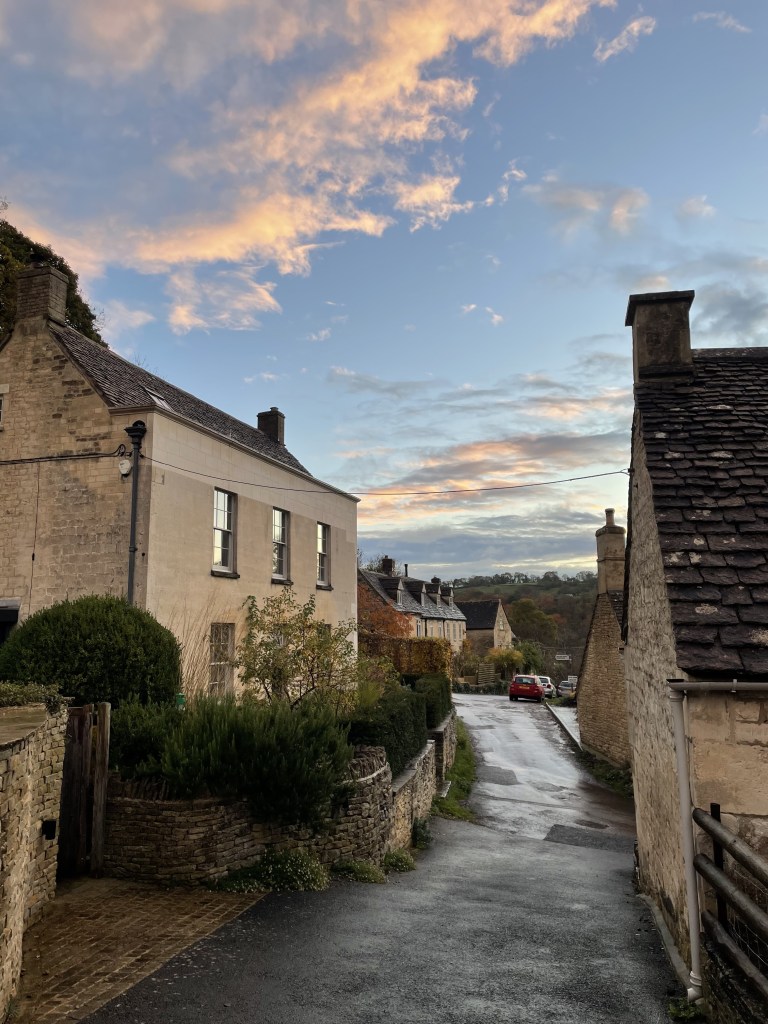
Autumn is turning to winter but there is still some colour in the trees and the occasional sunny day provides a bit of autumnal sparkle.  I continue to feel fortunate to live in a pretty (but not prettified) part of Gloucestershire and we enjoyed showing it off a bit while some friends stayed with us at the end of October.  When the sun is low as it is now, the Cotswold stone of the houses glows beautifully and the crispening leaves on the trees glimmer in the breeze.

Local Autumn Colour

I am well behind on the bedding down of the garden and allotment for winter.  I have made some progress but, when the weather has been nice, I’ve tended to take the opportunity to go for local walks.  When the weather has been cold and wet, I’ve stayed close to the heating in our kitchen.  I feel that, as I get older, I feel the cold more than I did.

Chilly Early Starts

Our First Grandchild (FG) doesn’t seem to feel the cold anywhere near so much!  He is thriving up in Edinburgh.  We visited Edinburgh recently to celebrate his second birthday and his parents’ first wedding anniversary.  They have a lovely flat and, now there is a wood-burner in the lounge, a very cosy spot for the evenings.  FG can now lark about before bedtime in his nightwear – or just his nappy – without me feeling chilly by proxy. 

We stayed in Edinburgh for longer than usual but hopefully avoided overburdening the working parents by staying a couple of nights in a hotel rather than with them.  FG seemed to enjoy having two more people to order about especially once his birthday brought more toys for us all to play with. 

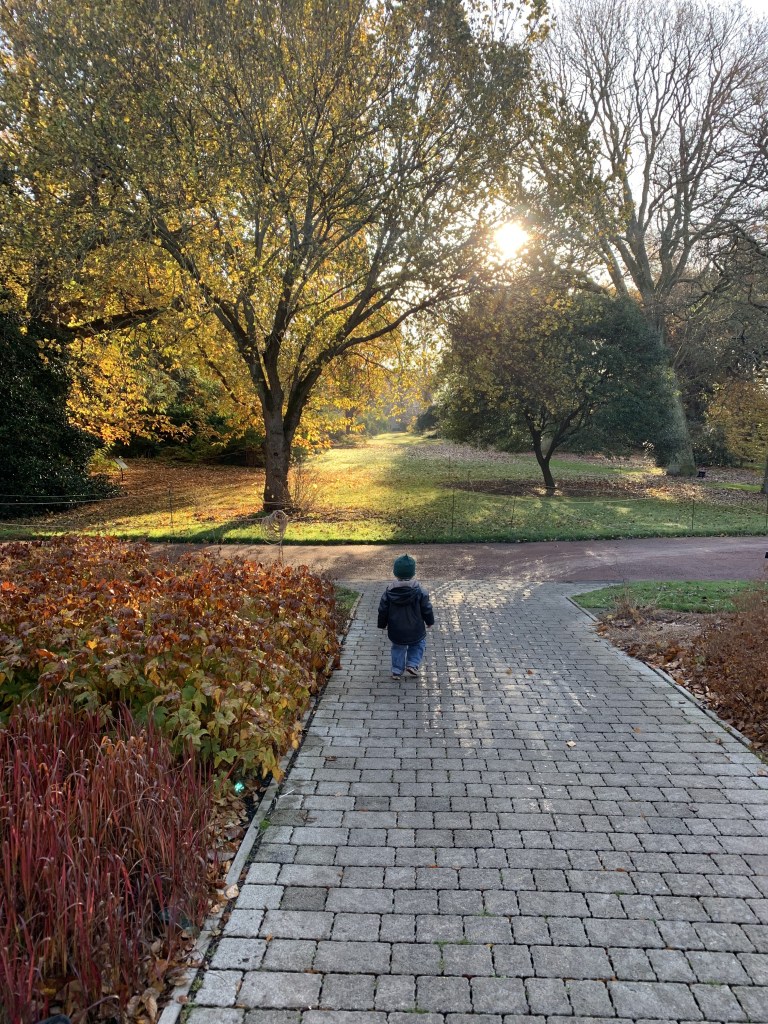
He also liked his usual trip with us to the Royal Botanic Garden, where we collected different colours and sizes of leaf.  It’s a wonderful, free resource regardless of the time of year.

Edinburgh’s Royal Botanic Gardens

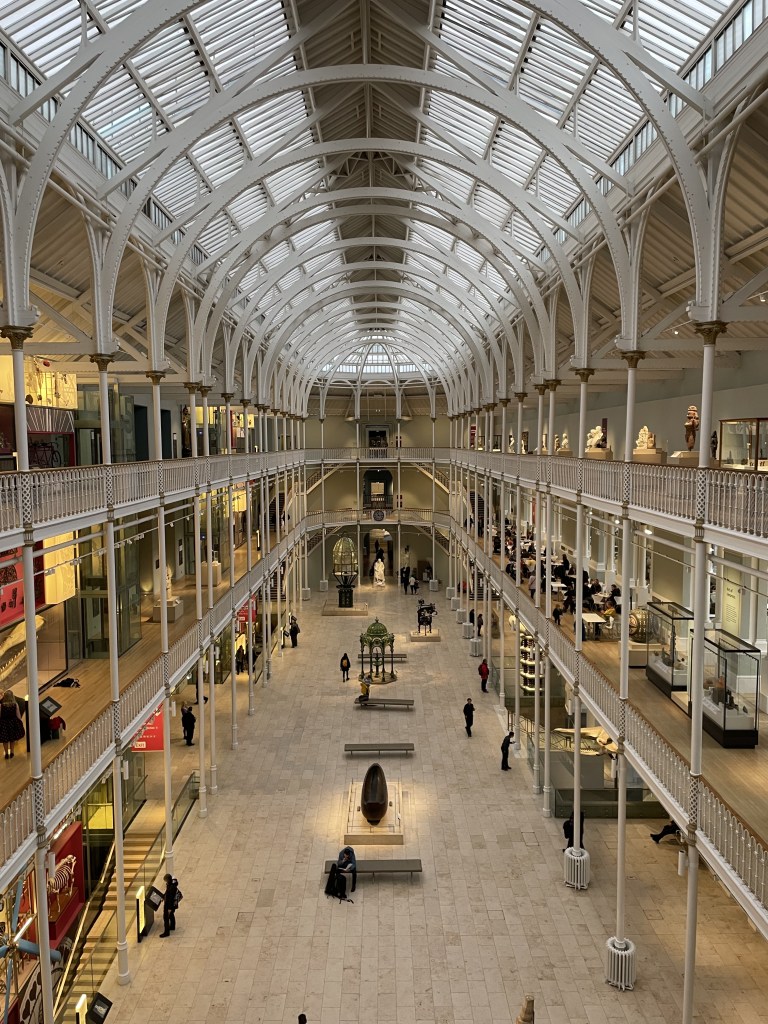
On the actual day of his birthday, we all joined him on an extended visit to the National Museum of Scotland where he joyfully rushed from exhibit to exhibit.  It’s a great place for kids.

The National Museum Of Scotland

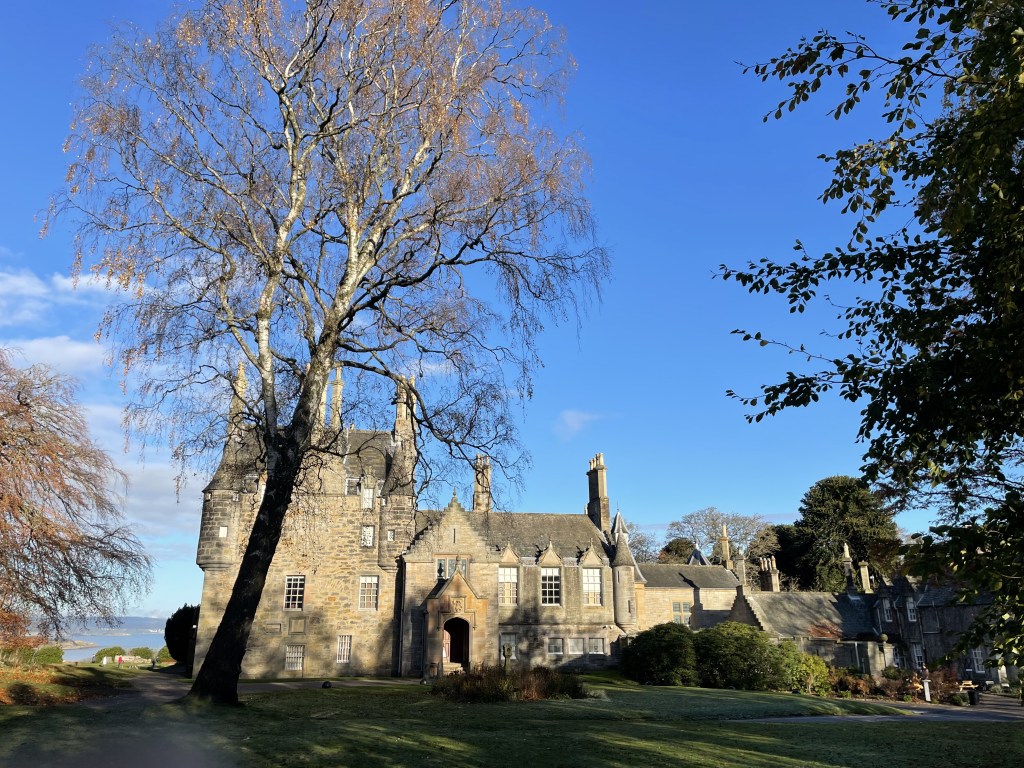
We had other lovely family outings in brilliant sunshine to Saughton Park, which had an interesting history and a goldfish pond which fascinated FG, and to Lauriston Castle gardens with its great views across the Firth of Forth.  Much to Jane’s satisfaction, each visit involved a café stop.  This is something that, when we are alone together, she finds hard to persuade me to indulge in.  With FG, it’s another little opportunity to watch him develop.

Lauriston Castle With The Firth Of Forth Beyond

It was convenient that we had our car, could get around easily with everyone, and that ES and his partner had some time off work so they could enjoy their anniversary and birthday fully.

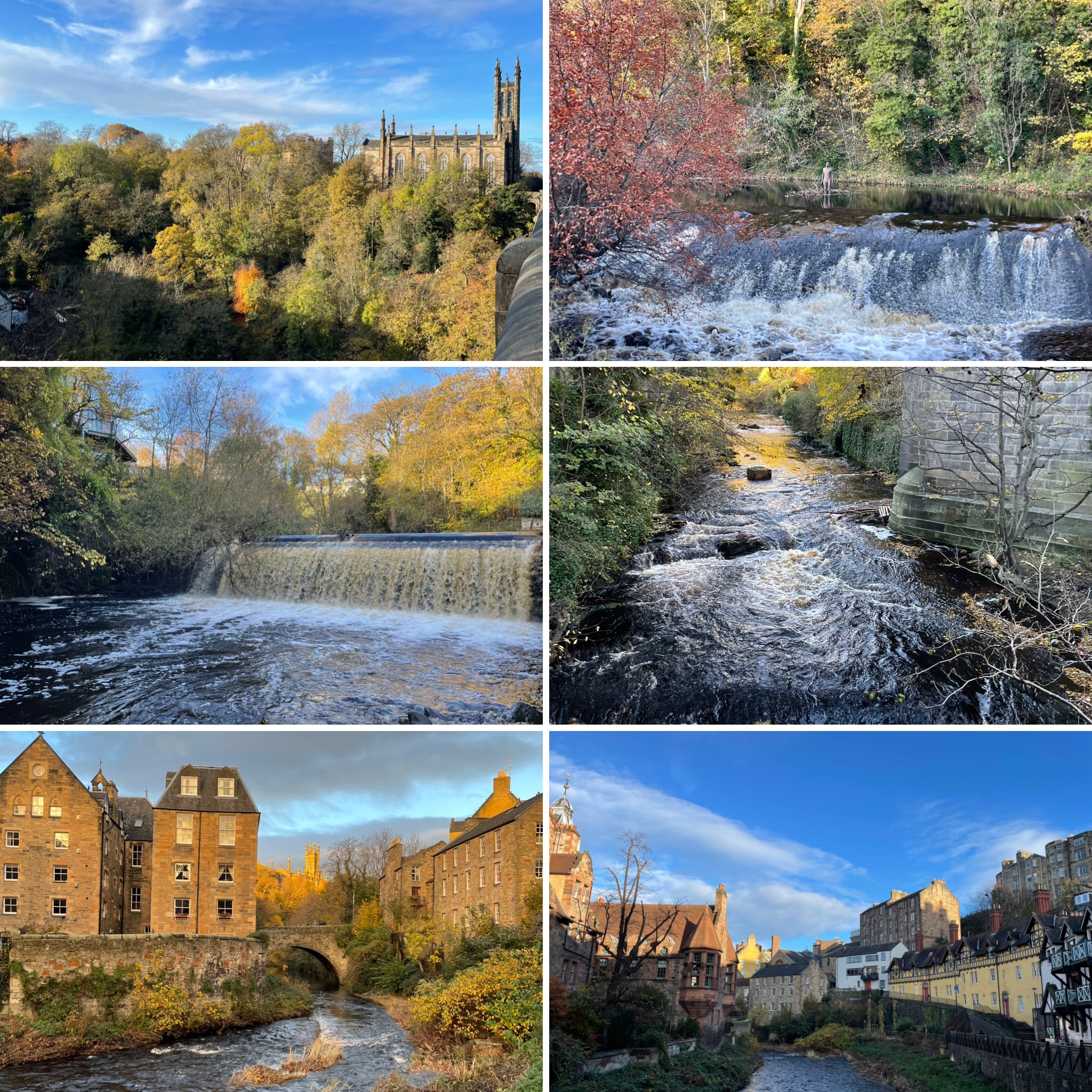
Jane and I also went off on our own for perusal of Stockbridge’s shops (Jane) and walks by the Water of Leith (me).  The Water of Leith was gushing more than usual following the recent storms which made the riverside walk somehow even more pleasurable than usual, especially as the sun was shining.

We also managed to slide off for an hour in Spry, our favourite wine bar, and for a set of very tasty, innovative small lunch plates at Noto where Eldest Son (ES) and his partner had celebrated their anniversary a couple of nights before.

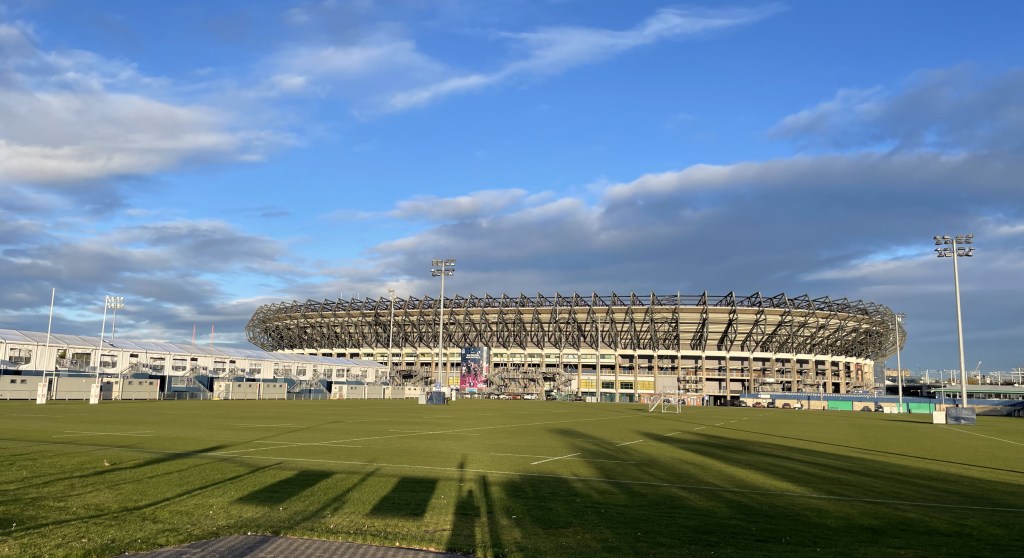
My Walk Along The Water Of Leith Led Me To Murrayfield

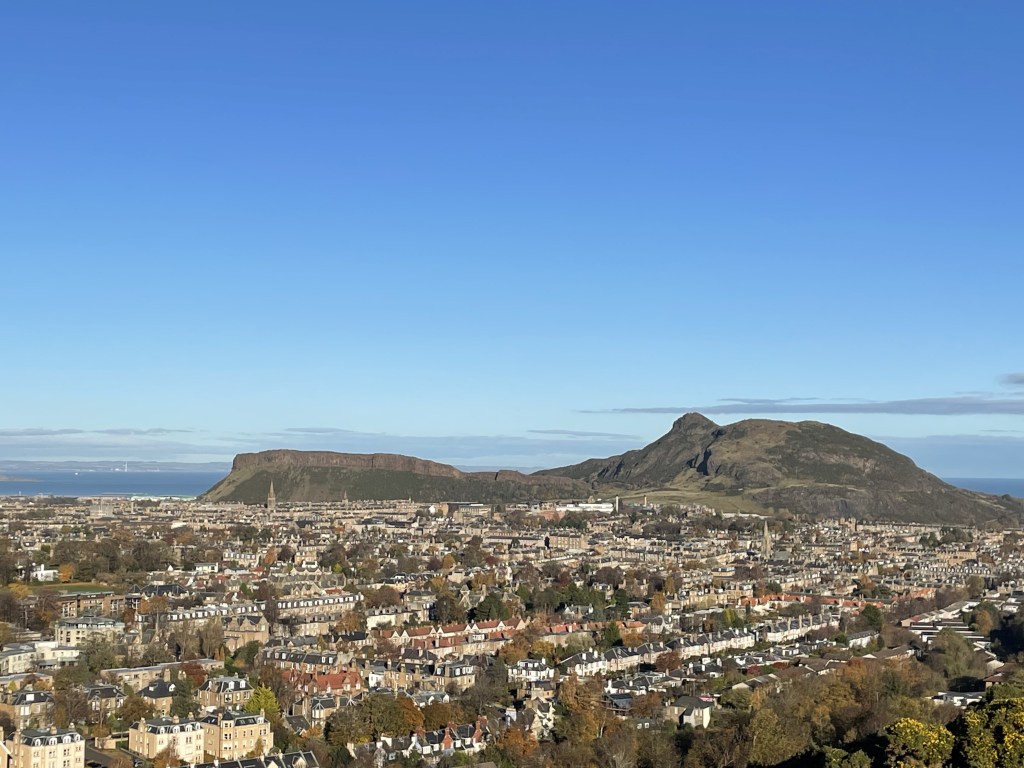
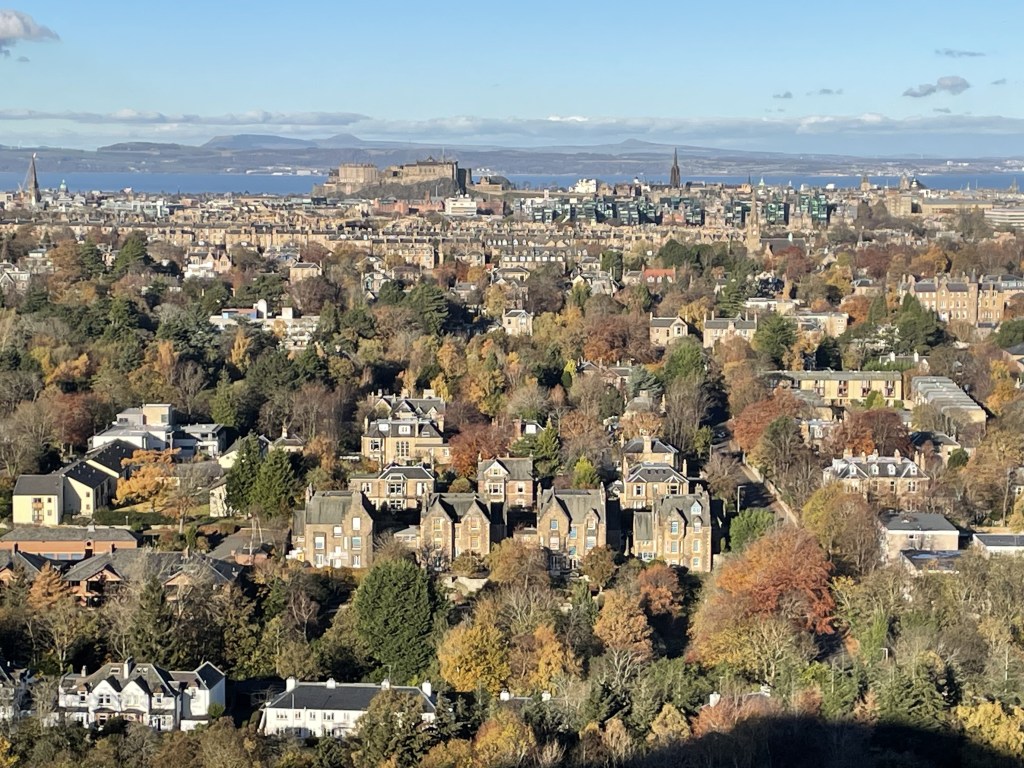
While FG and his parents went off to a birthday party of one of FG’s contemporaries in south Edinburgh, Jane and I took advantage of more sunny weather to climb Blackford Hill.  This afforded great views north of Arthur’s Seat and the city and I had a bit of an internal psychic glow knowing that this was where ES had proposed marriage.  

Views North From Blackford Hill

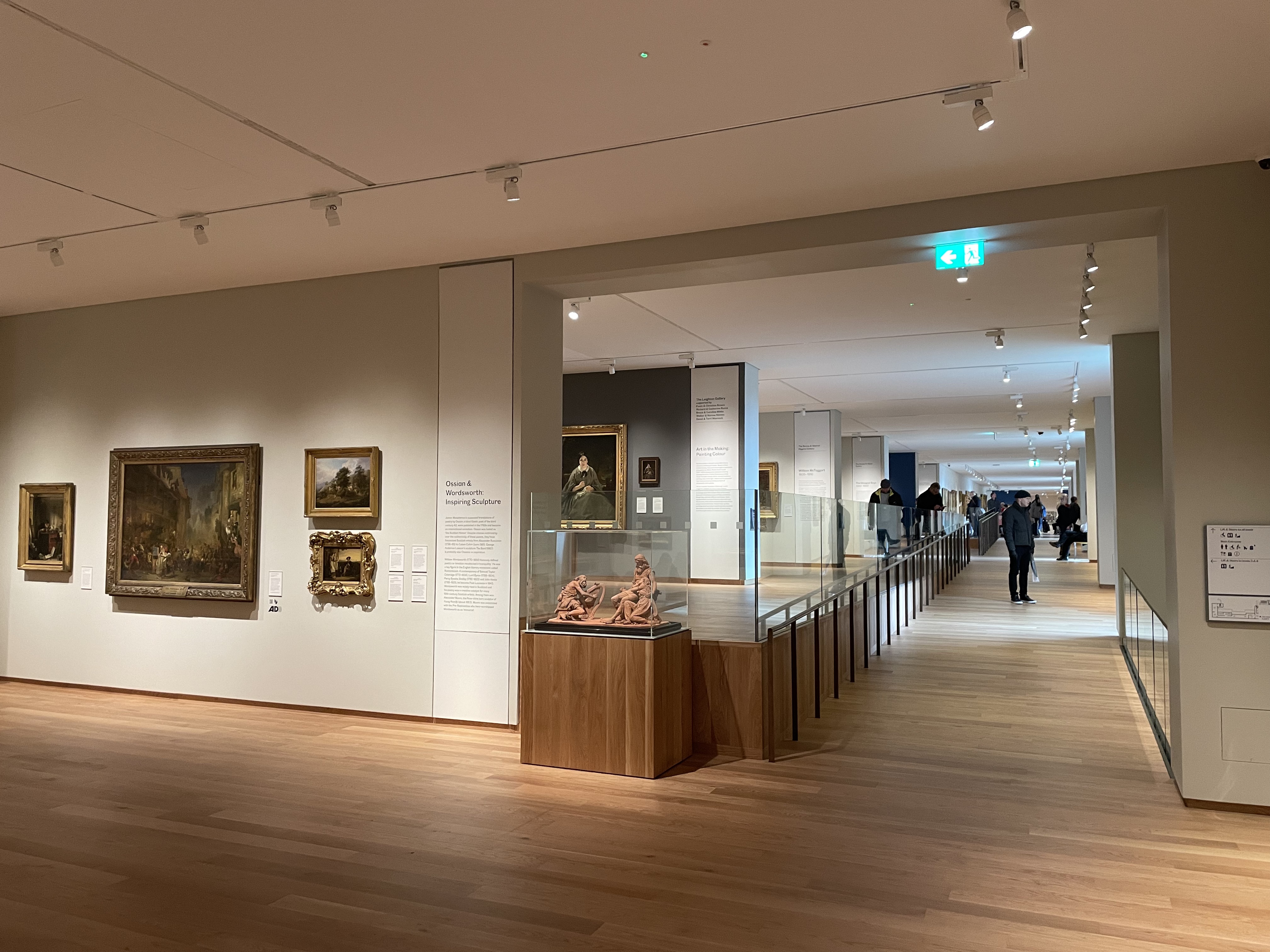
In between the anniversary and birthday festivities, and as the weather deteriorated, Jane and I visited the newly opened half of the National Gallery of Scotland.  This great new space doubles the size of the gallery and has some excellent works including many by the Glasgow Boys and the less renowned Glasgow Girls.

The New Galleries At The Scottish National Gallery

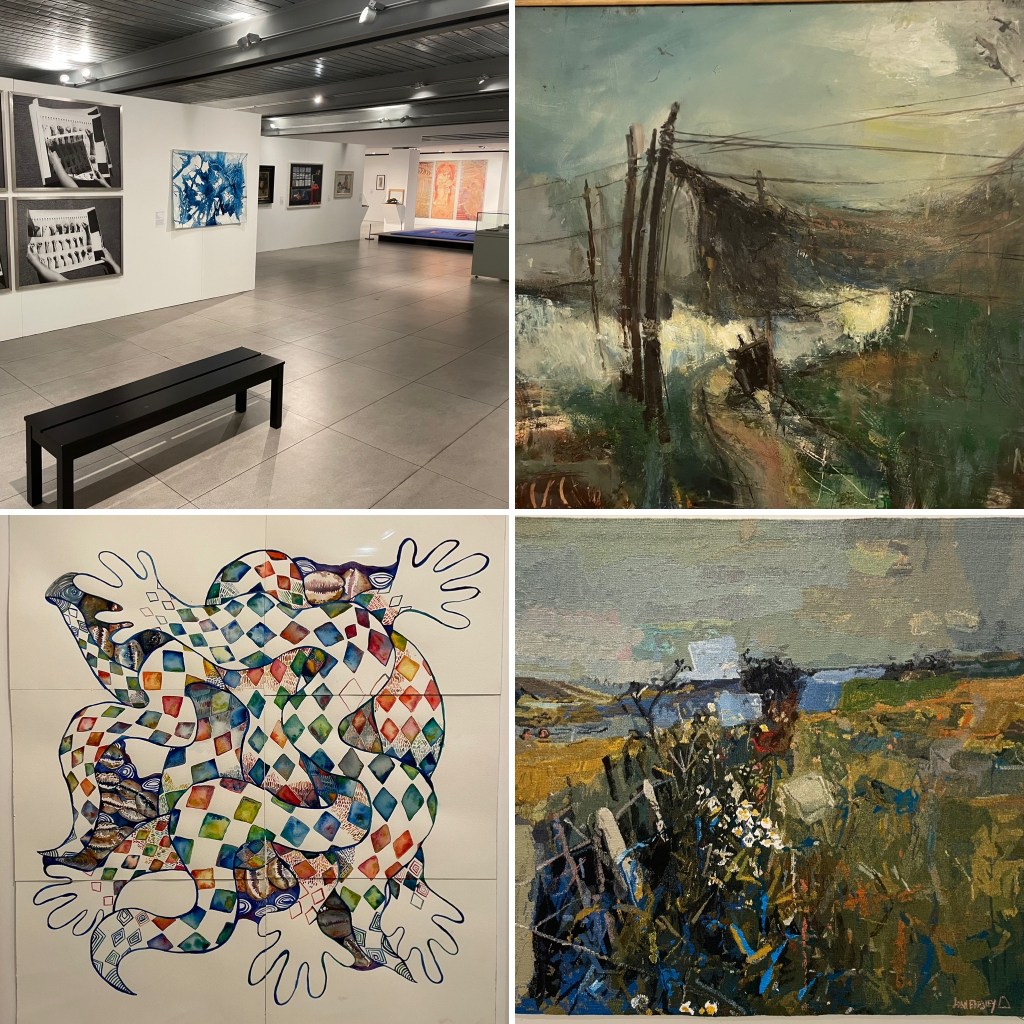
In a slight overdoing of cultural experience for one day, we also visited Dovecot Studios to see an exhibition called ‘Scottish Women Artists: Challenging 250 Years of Perception’.  This too had art by the Glasgow Girls.  I thought the exhibition was a bit uneven but particularly liked the works by Joan Eardley and a few others. 

Dovecote Studios: Scottish Women Artists (Including Joan Eardley And Alberta Whittle – bottom right and left respectively)

While we were in Edinburgh, ES’s partner cooked us lovely meals and we had great toast-laden breakfasts (Archipelago Bakery sells outstanding bread) plus a couple of substantial delivery meals from local food outlets.  Fortunately, this visit, we met ES’s partner’s parents again and we all tucked into an Indian spread while sharing FG-stories.  

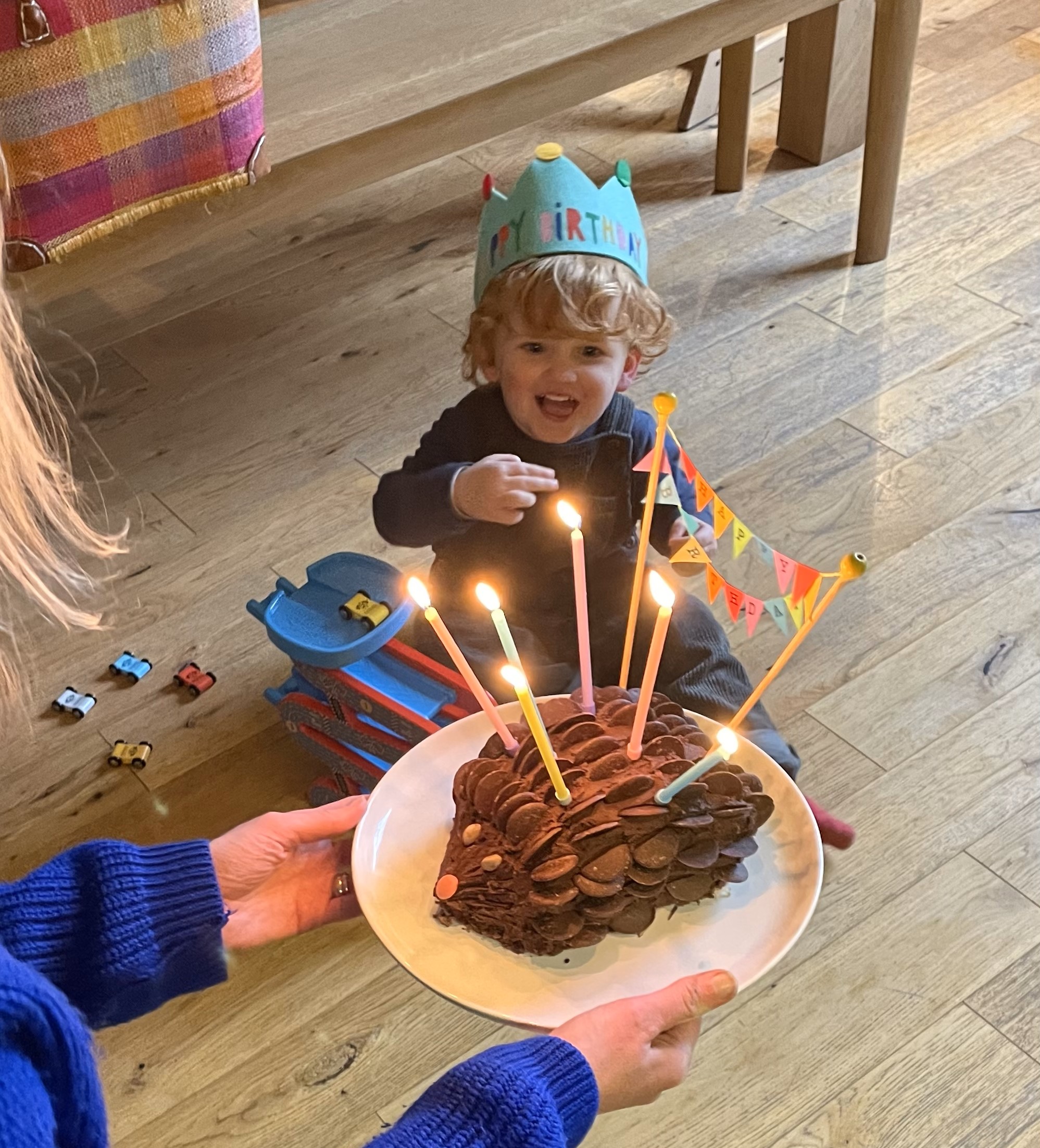
FG’s birthday cake was a delightful mum-made ‘hedgehog cake’ with chocolate buttons for spines (he loved the candle blowing out process and the chocolate).  Later, his birthday dinner was a shared set of delivered pizzas.  Meals delivered to the door are rare treats for me; we don’t have them at home since the choice is limited and the distances feel too great.  I put on weight in Edinburgh but it was well worth it.

Birthday Joy

It’s a long way to Edinburgh and back in our car (though we again had no real problems with charging it up as we travelled).  But we love Edinburgh.  Jane and I know that had ES not met someone from there who wanted to settle in the city, we would not have had such an opportunity to get to know Edinburgh so well.  There is so much more to see there and we look forward to another trip for ES and his partners’ birthdays early next year.

More Sun in Ghent

Following our day in Bruges, we had two full days in Ghent.  As in Bruges, we spent quite a bit of time just walking the streets.  However, there were churches, museums and galleries we wanted to see and, to facilitate that, we bought a pair of Ghent ‘CityCards’.  Despite the significant up-front cost, these proved good value and reduced the hassle around ticket buying and queuing.  Also, they encouraged us to venture into a couple of places that we might not have bothered with if an entrance fee had been required.

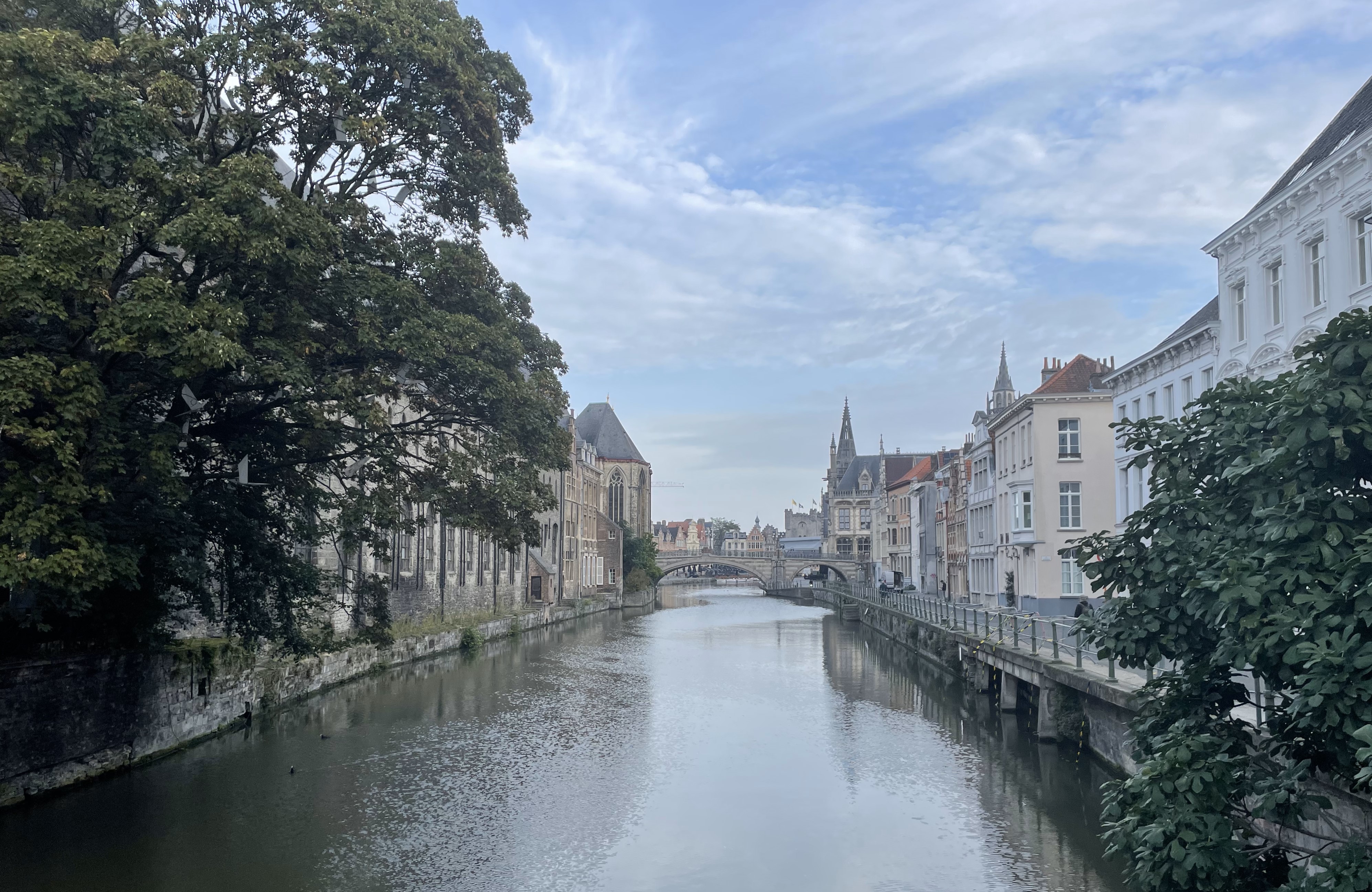
Ghent Waterways: (Quite) Early Morning

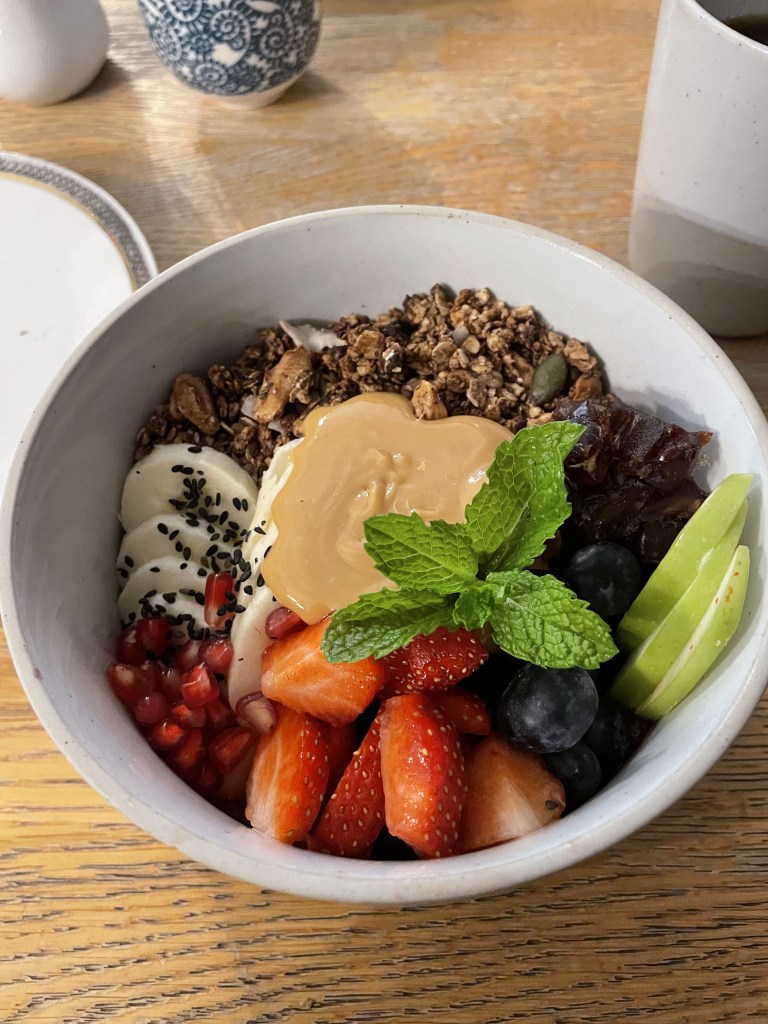
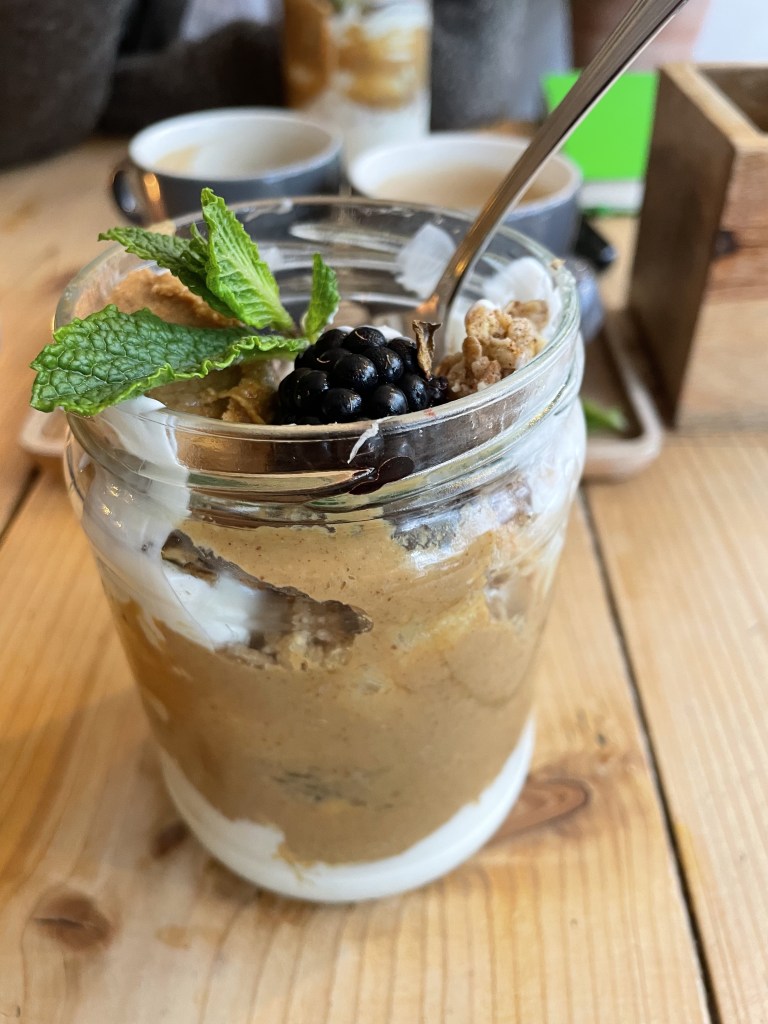
First though, we had to fortify ourselves with breakfast.  On our way to Bruges the previous day we had passed a café, STEK, that had looked promising and we made the first of what turned out to be two visits there.  The breakfast was excellent – rivalling the brunch we had had the previous day in Bruges – and again I was sold on the inclusion of peanut butter in my banana crumble.  I have been adding nut butter to my breakfasts at home ever since.

Lovely Belgian Breakfasts: Blackbird (Bruges) vs STEK (Ghent)

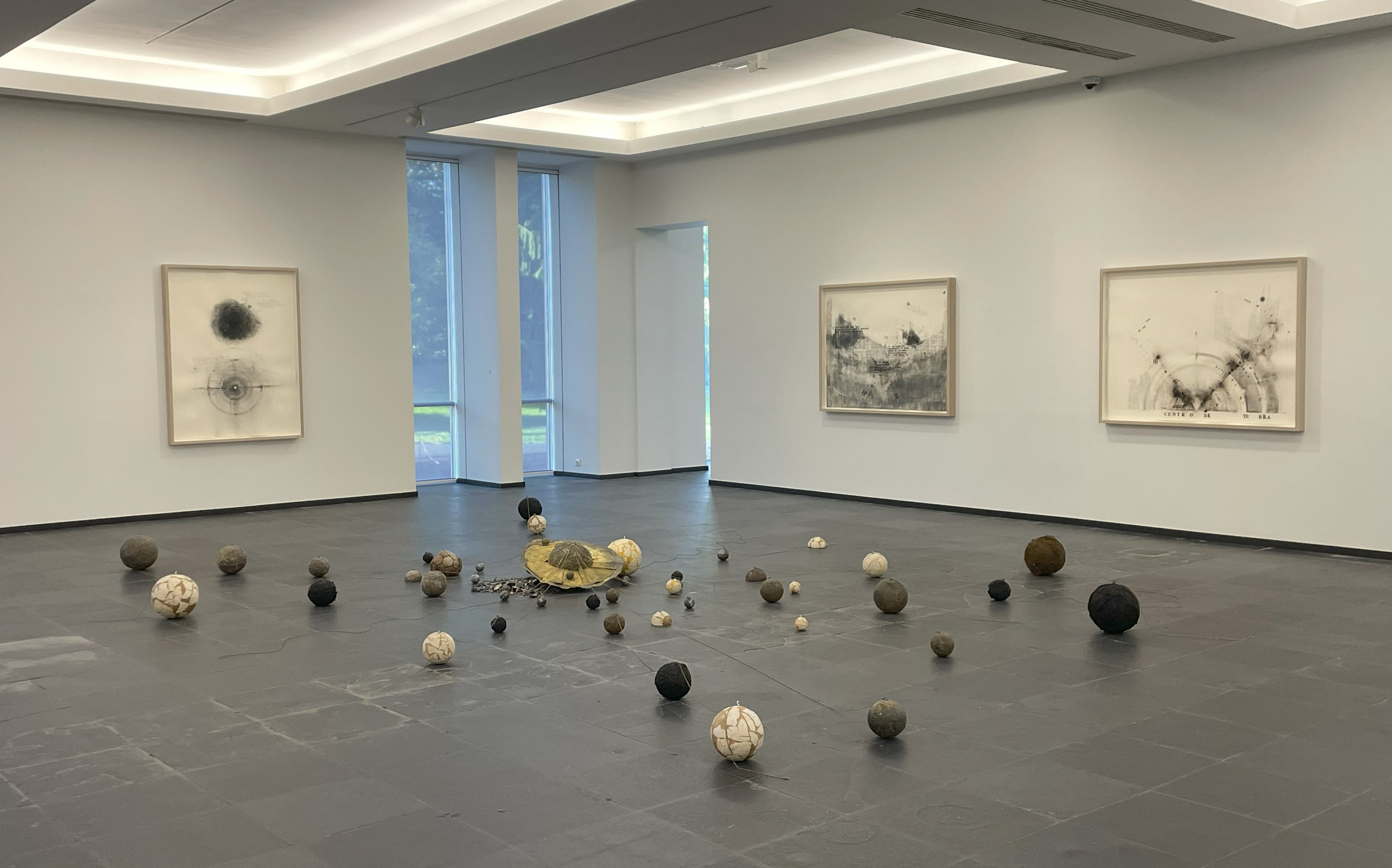
Our first gallery visit in Ghent was to the Municipal Museum of Contemporary Art Ghent (S.M.A.K.) to the south of the city.  This was only established in 1999 and, frankly, the collection betrayed that.  The gallery has some big rooms – all white as is usual for galleries of this type – but there wasn’t a huge amount on show.  I enjoyed the peace and quite of the place but we didn’t stay long.

In S.M.A.K.

We strolled over the road to the Museum of Fine Arts Ghent (MSK).  This holds a vastly more comprehensive collection than S.M.A.K.  It’s collection represented art across several centuries, a solid coverage of Belgian art and a diverse set of artists from Hieronymus Bosch (who I always find interesting) to Rubens, Rodin and Magritte. 

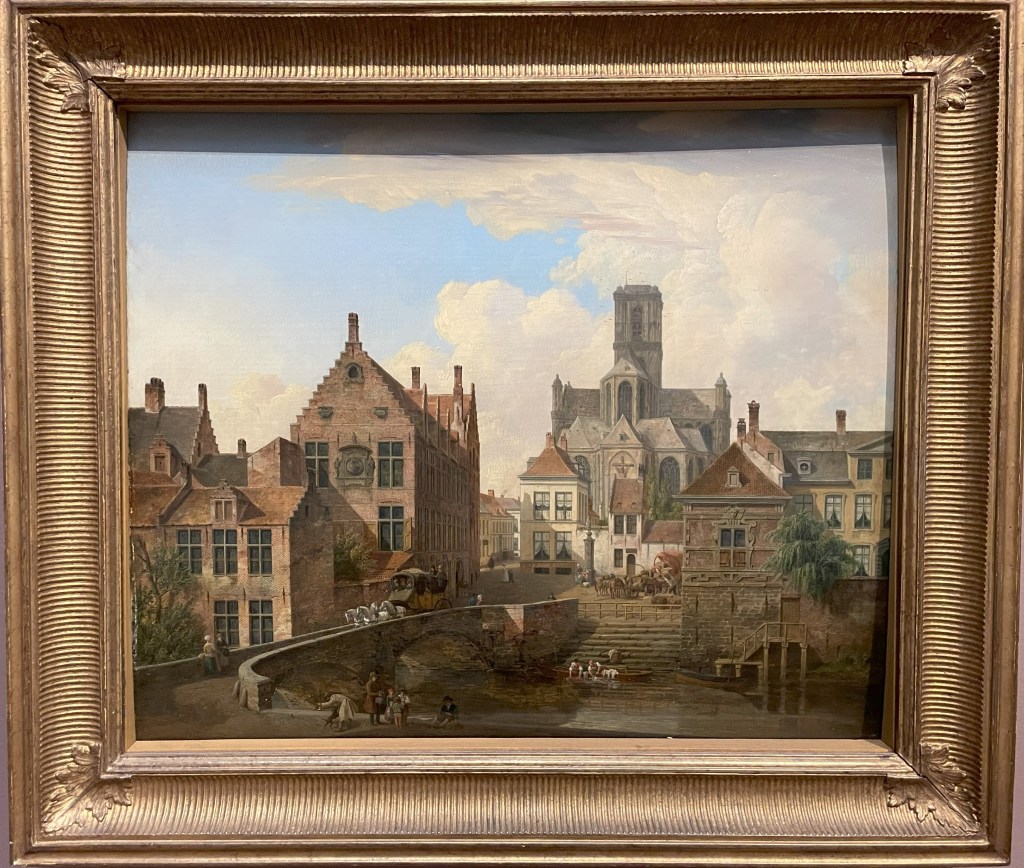
St Bavos Cathedral – A Painting By Belgian, Pierre Francois de Noter at MSK

I was initially impressed by the incredibly well-preserved colours in the medieval religious works, then flagged a bit through the portrait rooms, before reviving as I moved into the galleries of more modern art.  The gallery has been renovated recently and it was very comfortable, quiet and well laid out according to chronology but also thematically.

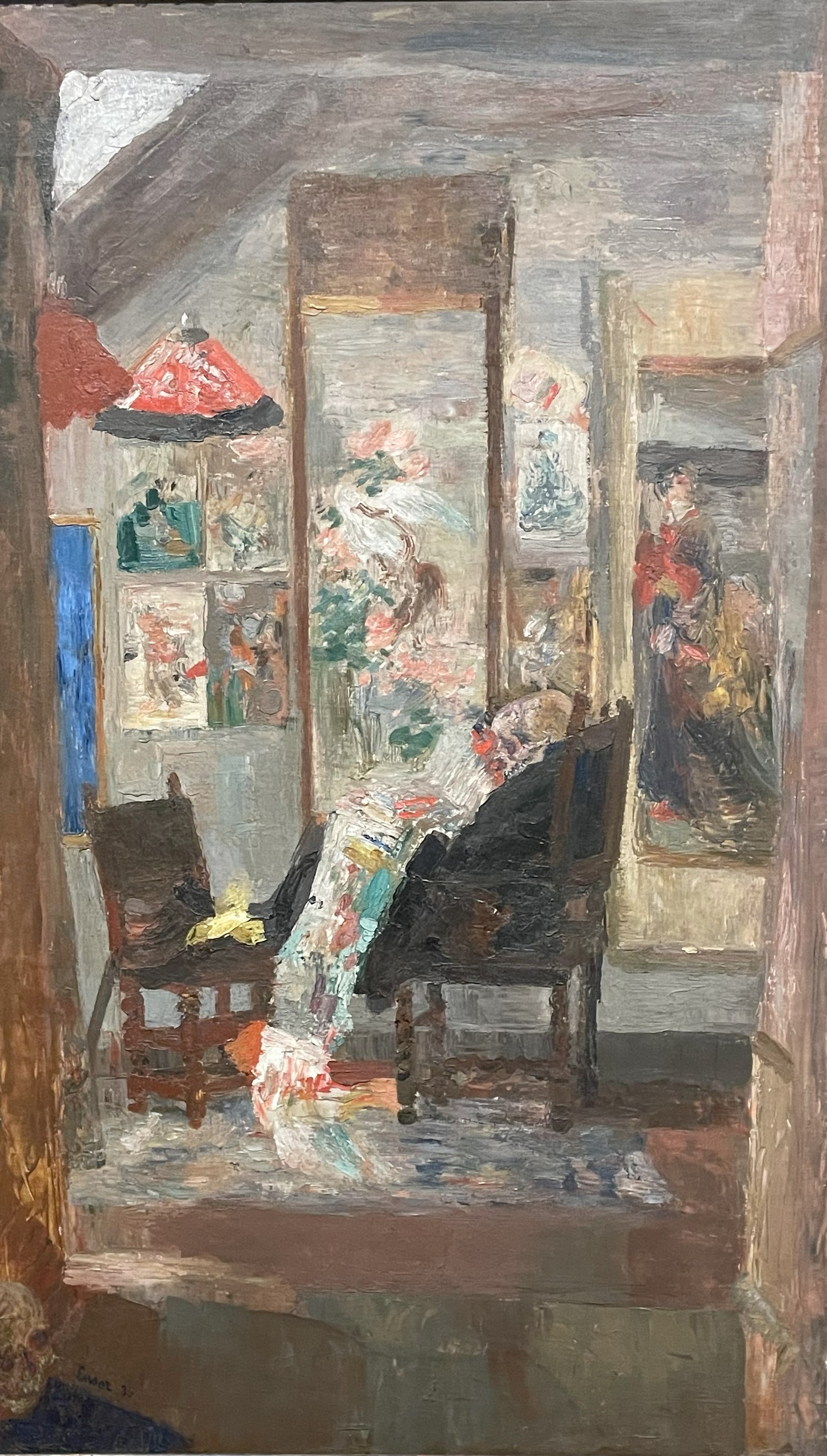
A More Modern Belgian Painting – ‘Skeleton Looking At Chinoiseries’ By James Ensor

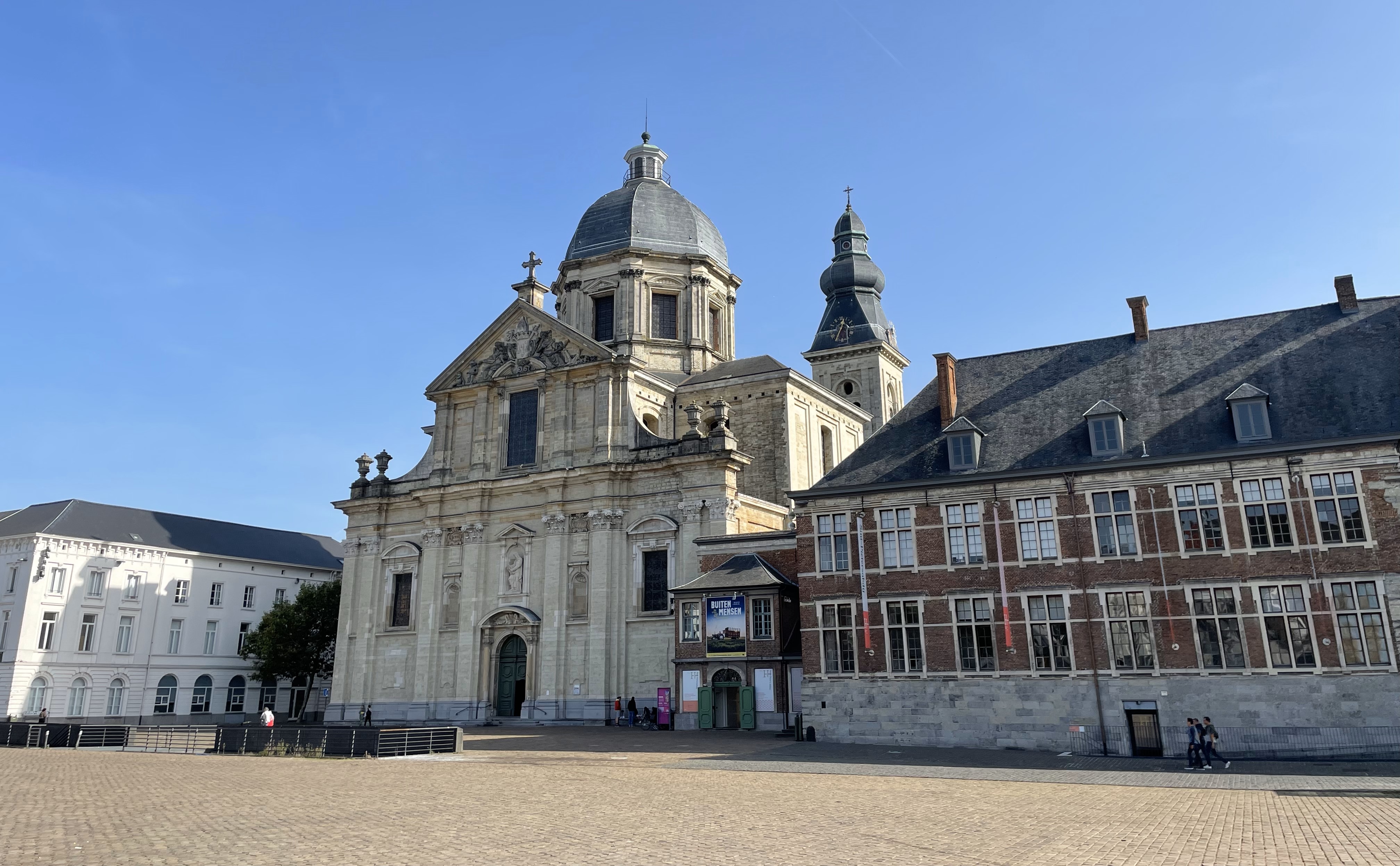
Having had our culture infusion for the day, Jane and I strolled back in increasing sunshine towards the centre.  We popped into Saint Peter’s Abbey but were confused by the lack of things to see and took what turned out to be a wrong turn into the attractive, but unremarkable, adjacent gardens and vineyards.  It turned out that these were open to the general public and we were now locked out of the Abbey.  It was not the only time during our stay in Belgium that a combination of our lack of language skills and dubious signage confused our sight-seeing.

St Peter’s Abbey And Church, Ghent

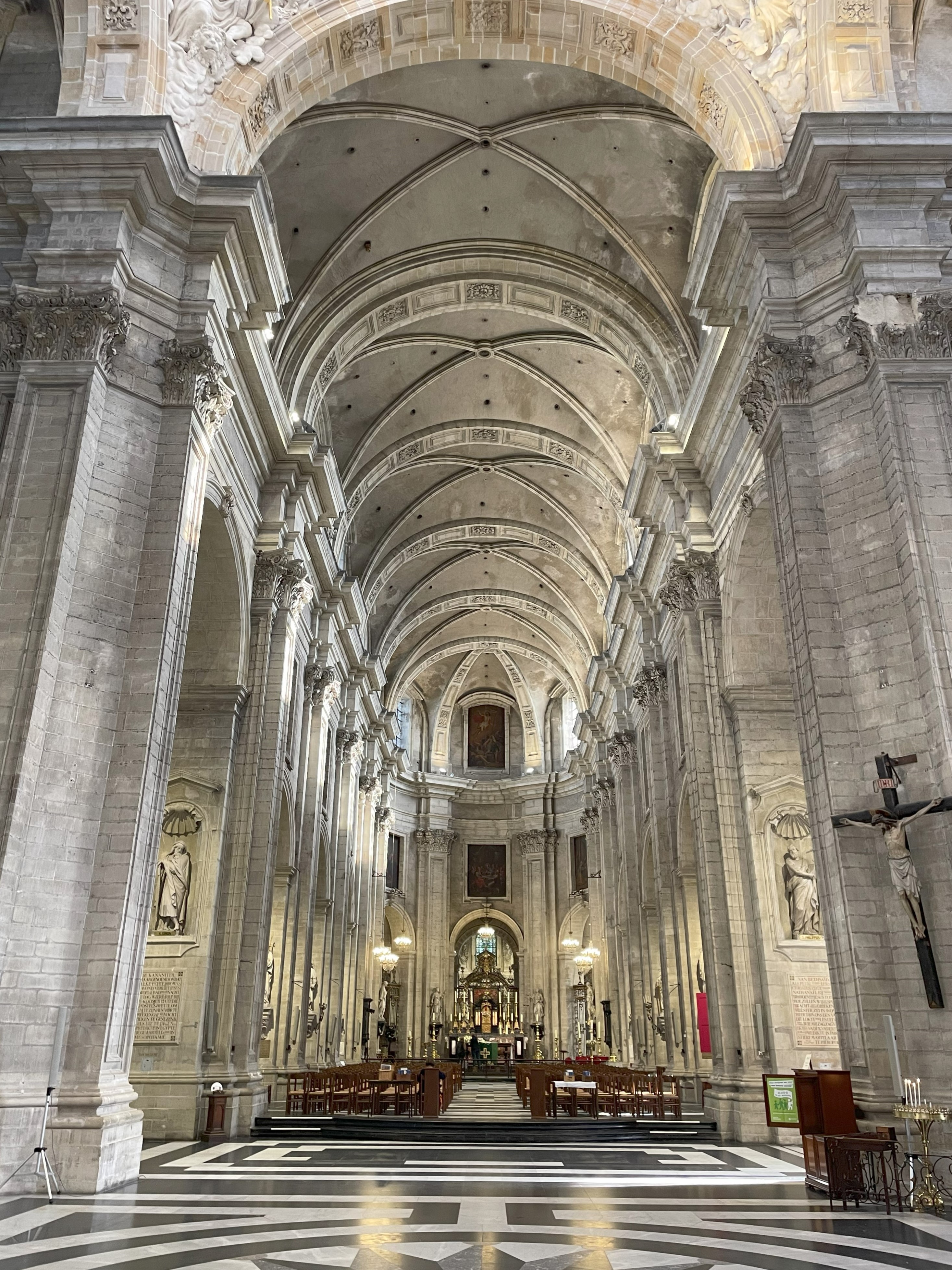
We found our way back to the Abbey entrance but since there was no exhibition on, we moved swiftly next door to Our Lady of St Peter’s Church.  This was part of the original abbey complex which was one of the earliest settlements that ultimately became Ghent.  It dates back to the 12th century and was rebuilt in a Baroque style in the 17th century.  It was impressive inside and out.

Inside Our Lady Of St Peter’s Church

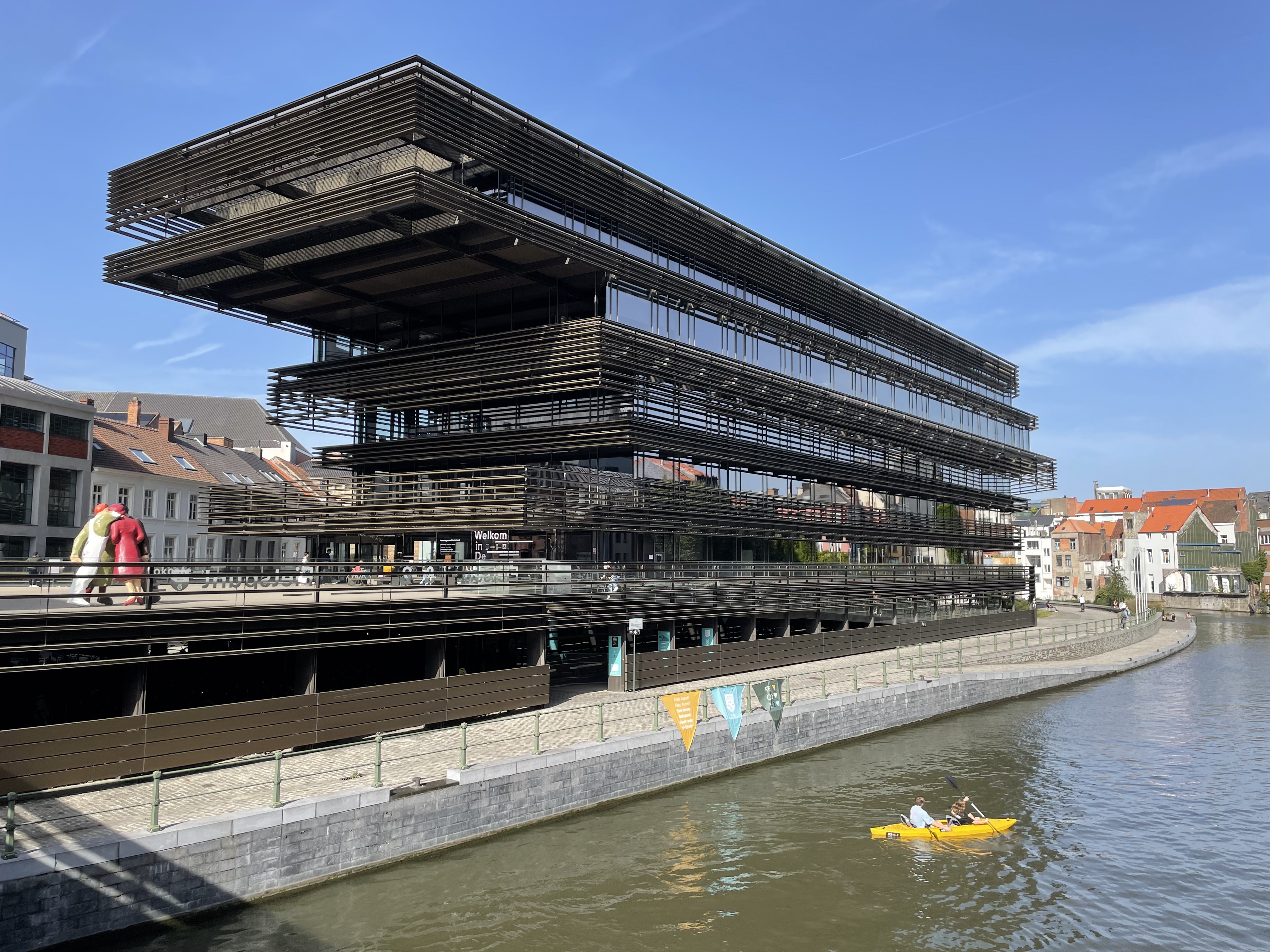
The sun was well out by now and we continued a relaxed walk along the Ghent waterways, past the new and radically modern-looking library to St Bavo’s Cathedral

Ghent City Library

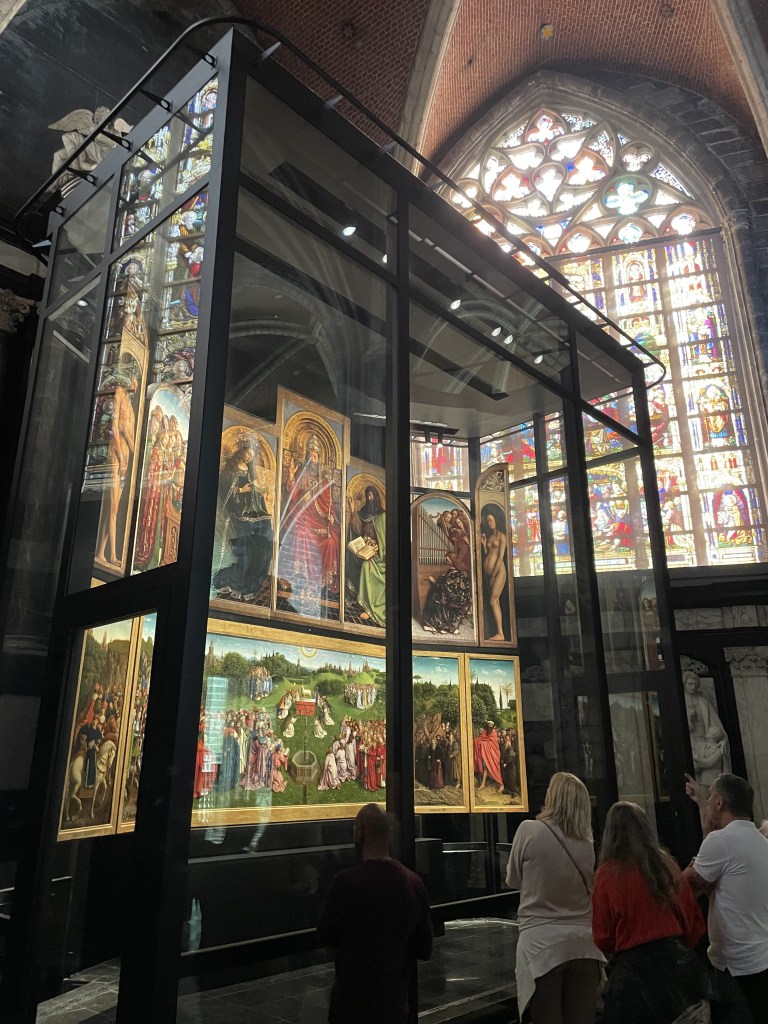
As expected, the Cathedral was crowded with tourists most of whom were seeking a view of the famous Ghent Altarpiece which was completed in 1432 by the Van Eyck brothers. 

The altarpiece has survived clandestine sales of some of its parts, thievery, war and religious uprisings.  It has been restored in recent years – indeed, we saw part of this process during our visit to the Fine Arts Museum.  It is now largely back in St Bavos and is a huge tourist attraction, including a virtual reality tour (which I opted out of).

Inside St Bavos (With The Ghent Altarpiece To The Right)

While Jane sought out places to buy Belgian linen, I visited St Michael’s Church and St Nicholas’ Church.  In the latter, there was an ongoing service so I didn’t loiter. 

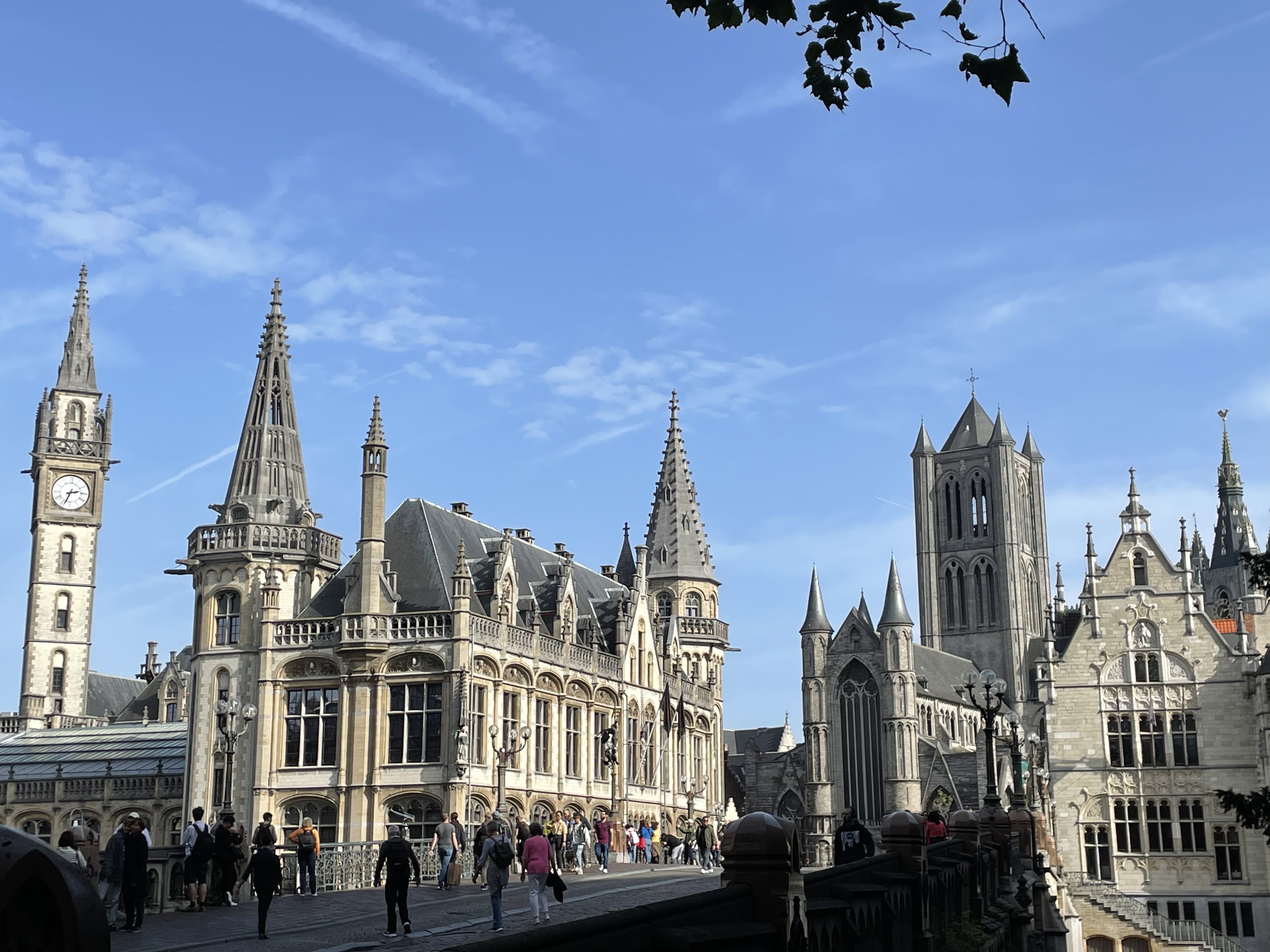
Our Hotel (1898 The Post) And St Nicholas Church From St Michael’s Bridge, Ghent (From a Similar Angle to The Painting By de Noter Above)

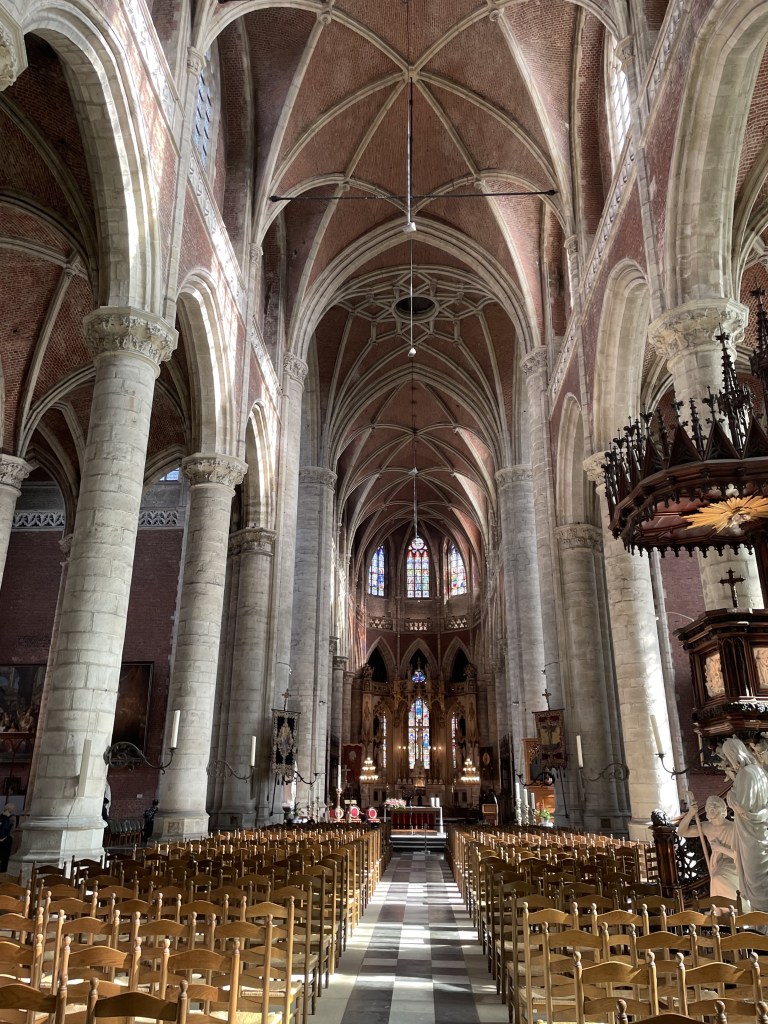
St Michael’s Church was rather lovely – probably my favourite of the churches in Ghent that I saw.  It is another very old church; it was started in 1440 but its tower was only completed in 1825.  Its internal brickwork was beautiful in the dappled sunshine coming into the nave past nearby trees and, although ornate in parts, it felt slightly less polished and more homely than some of the other churches we had seen.

Inside St Michael’s Church; Empty, Airy And Beautifully Sunlit

Whoa!  It had been a very full, long morning.  By now we were ready for something other than churches and galleries.  Food and Belgian beer beckoned.

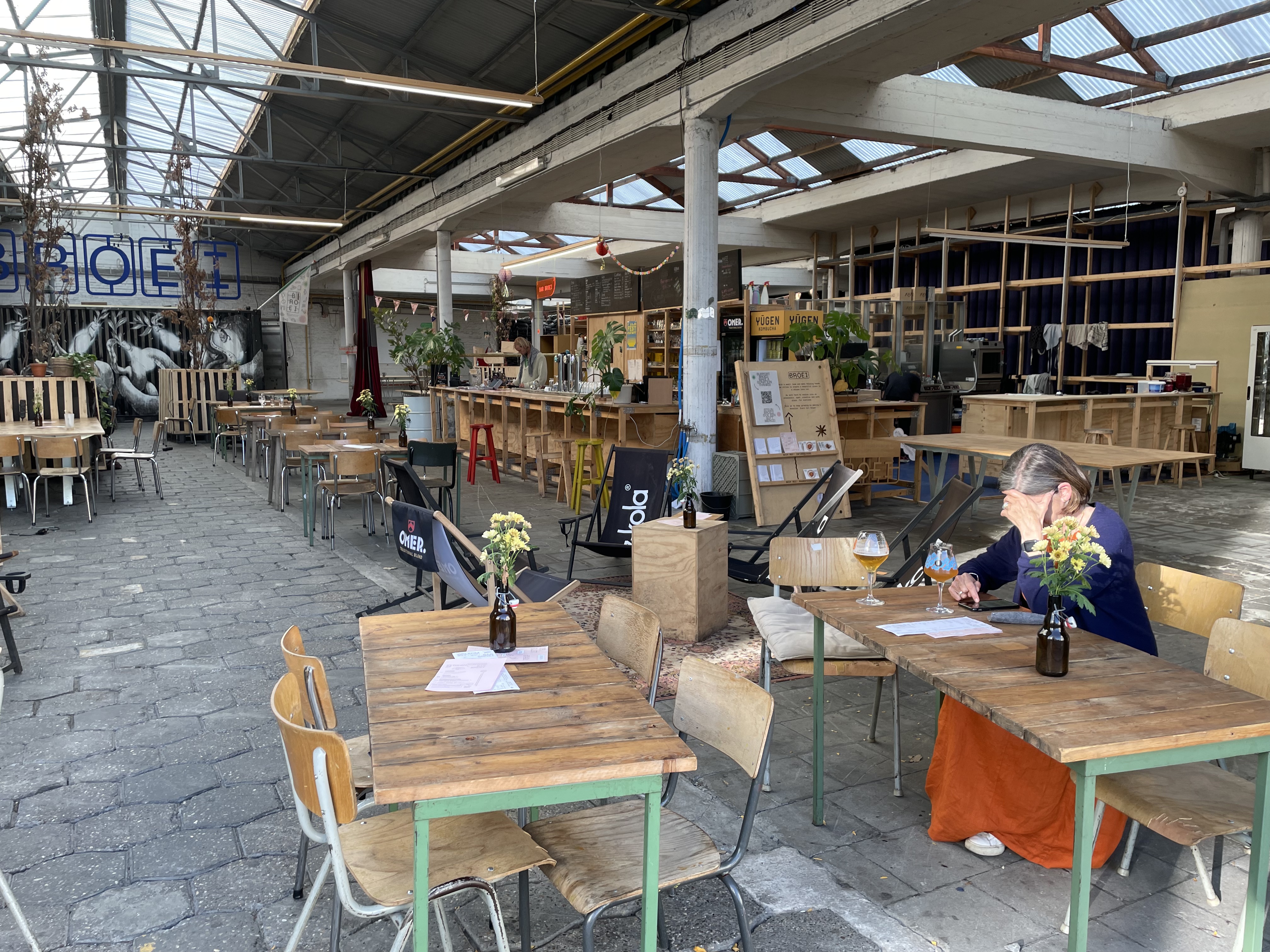
I spotted that the brewery for the beer I had drunk on our first night in Ghent, DOK, was open for food as well as drinks.  It was at the northern end of the waterways surrounding the centre of the city and we set off in what was by now warm, continuous sun.  As we approached the brewery, we passed Bar Broei, a rough and ready looking bar that nonetheless sold good, homemade snacks and excellent beer.  We chilled out there very comfortably and with a very personable barman for a couple of hours.

Bar Broei – Rough And Ready But Just What We Needed After A Long Morning Sight-seeing

We resumed our walk to Dok Brewery and discovered that it was in an industrial area surrounded by a variety of street food outlets busy with, it seemed, mainly local residents.  This was perfect for us and we tucked into more beer and, of course, a beef burger. 

Dok Brewery: Vibrant Eating And Drinking Establishments

Such meat eating was becoming the norm.  So were the early nights back at the hotel, first in the bar and then our room.  We still had another day in Ghent to go.

Our Final Night Scene, Ghent

Proper Baby-Sitting and Grayson Perry

We have babysat First Grandchild (FG) a few times for short periods during visits to Edinburgh during the last year or so.  It’s been a joy and a privilege to be able to do so. Plus we always enjoy visiting his parents and seeing Edinburgh.

The Water of Leith From Dean Bridge – The Steep Gradients So Near To The Centre Of Edinburgh Still Surprise Me

Our baby-sitting responsibilities went up a notch at the beginning of September when First Grandchild’s (FG’s) parents went to a wedding of an old friend in Spain.  Jane and I were thankful to be asked to baby sit for the 36 hours they were away but were unsure how the experience would go for us and for FG. 

His other grandparents do a lot of babysitting and look after him all day on Thursdays.  But it would be the first time that someone other than a parent would get FG up in the morning (twice), manage his afternoon nap (twice), put him to bed (once), plus feed, entertain and keep him safe in between.  It was our first go at proper grandchild babysitting!

Eldest Son and his wife had departed in the small hours of the night.  Apart from 15 minutes of full-on anxiety and yelling after he woke up that morning, and another five minutes of low-grade moaning after his first nap, FG was fine with the whole weekend. 

First Grandchild Exactly Where We Wanted Him – Asleep With His Monkey and Other Soft Toys

FG knows his routine down to the fine details: which soft toy needs to be kissed goodnight in what order, which book is the last book to be read before bedtime, which bedroom light goes on and off when.  As long as we stuck to that routine and provided plenty of book reading, tower and garage building, and other activities at other times, he was very happy.  FG, his parents in Spain and, certainly, the two of us, all had (tiring) fun.

Of course, we visited a few Edinburgh playgrounds and, as usual, the Royal Botanic Garden with FG while we were with him.  The weather was kind to us and we were able to walk, to and from everywhere and around the gardens, at FG’s pace. 

Like most kids his age he loves being able to take mini-decisions about what to do when and, as grandparents, we have the time to allow that.  That Jane has had a motherhood bringing up three boys and then a career in providing parental advice to troubled mums and dads really helps.  I learnt a lot from her about how to give toddlers options so they feel a semblance of decision making while the adults actually remain in control.

A highlight with FG was a trip to Portobello beach.  We got there early so the crowds were yet to gather in large numbers in the sunny and warm weather.  FG loves the outdoors and the novelty of visiting the coast.  He loved wandering along the shoreline and collecting shells and other debris along it (and, in some sort of memory throwback to my own childhood, so did I).  It was a great way to spend a morning.

First Grandchild (FG) And Granny On Portobello Beach

Another morning with FG was consumed with a trip on the new tram service to and from Leith.  FG was more concerned with engaging with fellow passengers willing to smile at him than with looking out of the window.  He enjoyed the journey and a big vegan biscuit at Williams and Johnson Coffee Co.  Leith appears to be an increasingly cool place to live and work and the tram extension is surely a catalyst for that.

Leith

Before FG’s parents shot off for their whirlwind jaunt to the wedding, we managed a good dose of art and culture by visiting The Scottish Gallery, a nearby private gallery we have visited several times before, and the National Gallery of Scotland.

‘Folk At Heart’ At The Scottish Gallery, Edinburgh

The Scottish Gallery was showing a range of artists embracing traditional folk art.  Although the gallery is quite small, there was plenty to admire.  I particularly liked the woven baskets, the muted colours of some of the naïve style paintings and prints and, downstairs, the textiles by Jane Keith which were innovatively displayed given the compact space.

Textiles By Jane Keith At The Scottish Gallery

The headline exhibition at the National Gallery was a substantial retrospective of Grayson Perry’s work.  I’ve enjoyed Grayson Perry exhibitions before – notably the Summer Exhibition at the Royal Academy in 2018 and, more recently, in Bath.  The latter was a small exhibition of his ceramics where Grayson explained the pieces in his own words. 

Grayson provided the captions for each piece at the National Gallery exhibition too and, apart from the art itself, this was one of the most attractive features of the show.  His art is very accessible anyway but his thoughtful captions alongside each piece were unpretentious, clear and highly explanatory of the themes that have dominated his work since he was a very young man and how they have developed in his mind.

Examples Of Grayson Perry’s Ceramics, Iron And Tapestry Works – With Typical Intense Detail

From the first work – a plate he made in 1983 called ‘Kinky Sex’ – the irreverence of his approach and the courage of his anti-establishmentarianism came through.  But rather than be just a series of bold, even brash statements, the exhibition and particularly Grayson’s own words, drew me into what I see the Guardian newspaper calls ‘a thrumming conversation’. 

Grayson’s ‘Tomb Of The Unknown Craftsman’ (2011)

Some of the pieces on show were beautiful to my eyes, some were rather ugly, but every one of them had something to say and was engaging in some way.  Rather than say more here, this is a link to a video hosted by Grayson describing much of the show: Grayson Perry’s Smash Hits.  Watch out for references to ‘Alan Measles’ who is Grayson’s (troubled) childhood teddy bear who, entertainingly, crops up in various guises throughout the exhibition.

‘Kenilworth AM1’ (Including Alan Measles’s ‘Stunt Double’ In The Box On The Back)

The only downside to the exhibition was that, somehow, I missed the last room and exited prematurely.  Nonetheless I thought it was brilliant.

As was the whole weekend!  Proper baby-sitting was a resounding success and we look forward to doing it again (we are scheduled for a longer stint in April next year during another Spanish wedding trip). 

Having said that, it was great to get home, slot into routines less driven by a 21-month-old, and have a bit of a rest in what remained of summer in our home and garden. 

Late Summer In Our Garden