In my last post, I mentioned that, during our latest Edinburgh stay, both Jane and I enjoyed the exhibition of Andy Goldsworthy’s art at the National Gallery of Scotland. This was a celebration of fifty years of his work with natural materials such as clay, reeds and stones and even sheep poo. I thought it was a tremendous display and I’m only sorry I haven’t paid more attention to him before.
The entrance to the gallery immediately thrusts you into Andy Goldsworthy’s world of sustainable, largely transitory art, and his relationship with nature. The entrance stairway is partly covered by discarded and stained sheep wool stitched together into a stair runner. At the top of these stairs was a dramatic piece made of reclaimed barbed wire. Immediately to the left and right were canvases caked in mud and sheep droppings around a blank space where once there was a sheep lick that attracted the unknowing sheep as participants in the work. It was an arresting start to the exhibition.
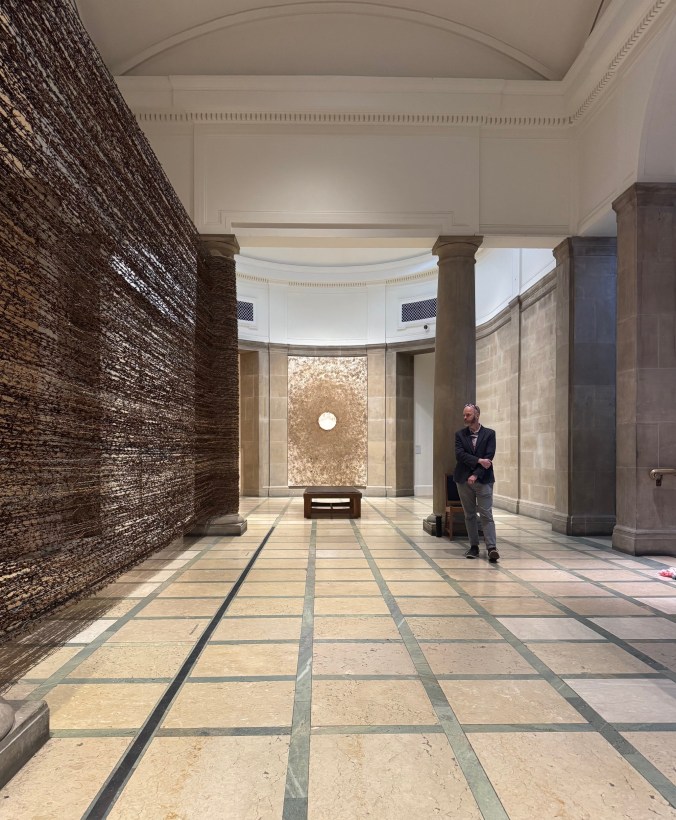
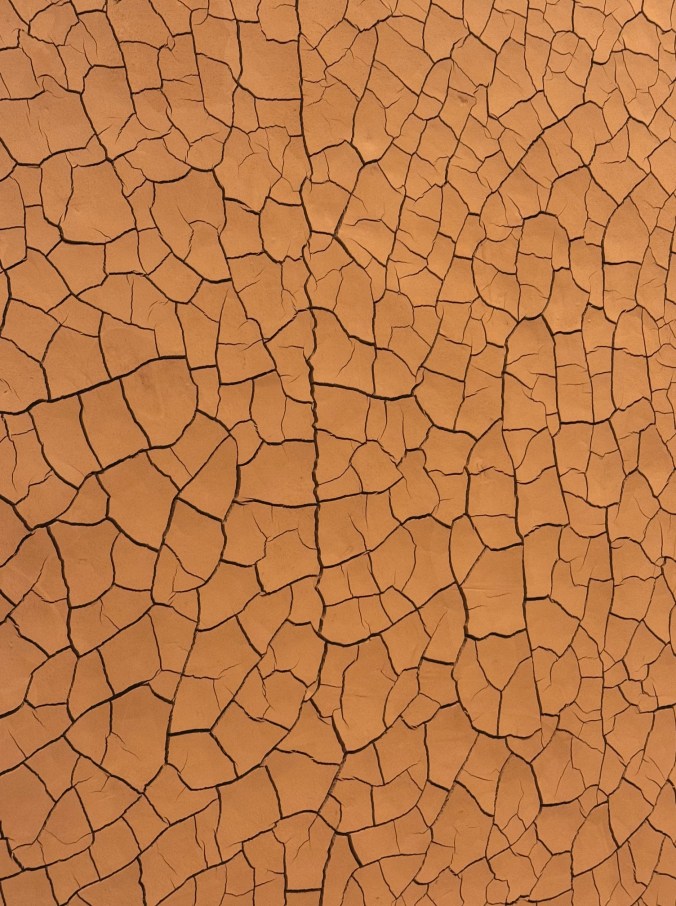
Many of the works were constructed by Goldsworthy specifically for the space afforded by the Gallery. For example, one room was filled with rocks gathered from 108 graveyards in Dumfries and Galloway where piles of surplus stone have built up as graves have been dug. (I confess that this was actually the only work I was not impressed by). Another room, with a lovely skylight, was hung with hundreds of bullrush stalks. Elsewhere, an entire wall was covered with dried and, therefore, cracked mud that is bright red/orange from the iron it naturally contains.
The centrepiece on the first floor of the exhibition was a corridor of oak branches. At one end was a beautiful twisted collage of fern leaves and at the other a circular array of long reeds. The whole room was very memorable.

Indeed, every room was memorable. I particularly liked the room devoted to photographs of Goldsworthy’s manipulations of sheep wool, stones, reeds and leaves to develop images of a fallen, dead elm tree. I presumed that all the photographs here were shot by Goldsworthy himself but there were other videos and photos that involved others; I wondered who they were.
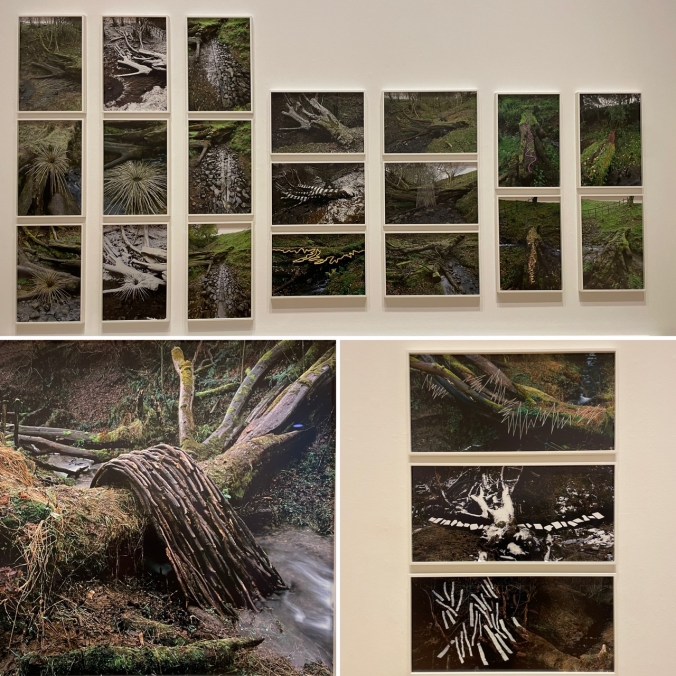
Throughout the exhibition there were unpretentious explanations of what we were seeing and what Goldsworthy was trying to do – even the three works made from dripping hare blood and snow onto paper.
By the time I got to the end of the exhibition where Goldsworthy’s early work was shown, I felt that perhaps these might have been shown at the start to show the chronological development of his ideas. But, as Jane pointed out, that would have made the exhibition entrance less impactful. Fair point; anyway, it was one of the best art exhibitions I have seen and I recommend it to anyone in Edinburgh before very early November 2025.
 My Retirement Journey